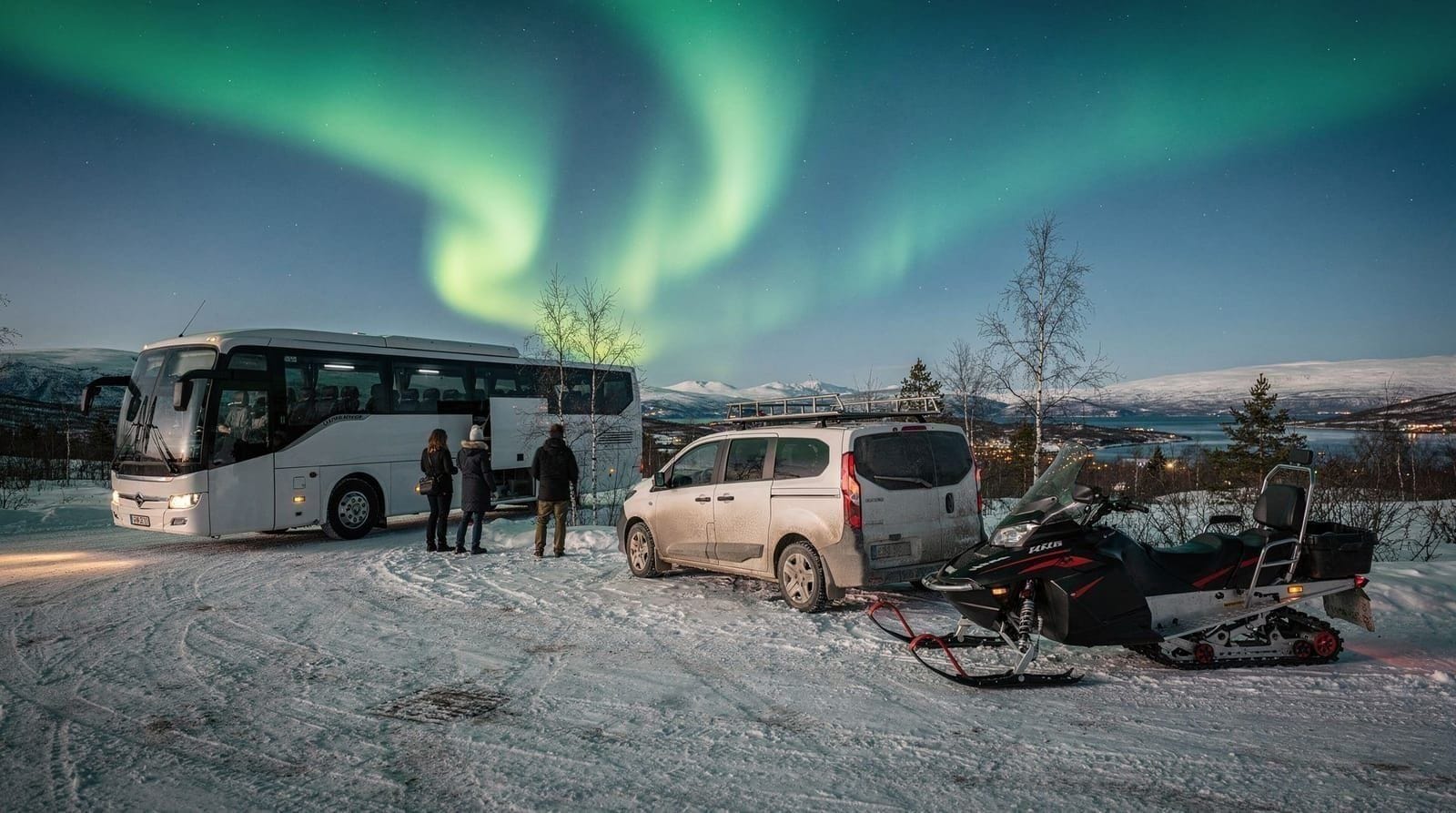
Where to see the northern lights near Tromsø
Tromsø: Unlimited Northern Lights Chase Across Borders
Where is the best place to see the northern lights near Tromsø?
Tamok Valley (~50 km east) and the Lyngen Alps plateau offer the most reliable clear skies because they sit inland and east of the coast. Sommarøy and Ersfjord on Kvaløya are popular, scenic, and close — but suffer from the same maritime cloud patterns as Tromsø itself.
Quick answer: The most reliable aurora-viewing spots near Tromsø are Tamok Valley and the Lyngen plateau — inland locations that escape the coastal cloud that plagues the fjord. Scenic coastal spots like Sommarøy are beautiful but share Tromsø’s weather. Distance from the city (50–150 km) correlates directly with cloud-escape success.
| Location | Distance | Best for |
|---|---|---|
| Tamok Valley | ~50 km SE | Most reliable clear skies |
| Lyngen plateau | ~90–100 km E | Dramatic scenery, good skies |
| Sommarøy / Kvaløya | 20–70 km W | Photogenic, weather-dependent |
| Ersfjord | ~30 km W | Close, dark, quick to check |
| Breivikeidet / Malangen | ~40 km E | Darker valleys off the main road |
| City viewpoints | 0–10 km | Zero cost, KP 3+ nights only |
Why location matters as much as timing
Tromsø’s coastal position creates a paradox: it is geographically ideal for aurora (inside the auroral oval, at 69.6°N) but meteorologically challenging (maritime air masses bring persistent cloud). The solution is to be mobile. The best aurora experiences near Tromsø are not about finding a pretty spot and staying there — they’re about driving until the cloud ends.
Understanding the geography helps you do this strategically.
The main aurora locations, ranked honestly
1. Tamok Valley (Tamokdalen) — most reliable for clear skies
Distance from Tromsø: ~50 km southeast via E8 and Rv91
Drive time: 45–55 minutes
Why it works: The valley cuts inland through the mountains, away from fjord moisture. When coastal cloud covers Tromsø, Tamok is frequently clear. Camp Tamok — the main activity hub here — sits at the base of a mountain, with dark open sky to the north and east.
This is where experienced guides head first when Tromsø is overcast. It is not particularly scenic by day (working valley, not a dramatic viewpoint) but the dark skies are exceptional.
See our full guide to Tamok Valley for context on the area.
2. Lyngen Alps plateau — dramatic scenery and good skies
Distance from Tromsø: ~90–100 km east via E8
Drive time: 1.5–2 hours
Why it works: The Lyngen Alps rise to 1,800 m and create a natural weather barrier. The plateau on the eastern side is frequently clearer than the coast. Guides who cross the Lyngen peninsula or ferry over to the eastern shore find conditions that differ entirely from Tromsø.
Downside: the drive is longer. On a short-window night, arriving late means missing the prime hours.
3. Sommarøy and Kvaløya coast — scenic but weather-dependent
Distance from Tromsø: Sommarøy is ~60–70 km west; Kvaløya views start 20 km out
Drive time: 45–60 minutes to Sommarøy
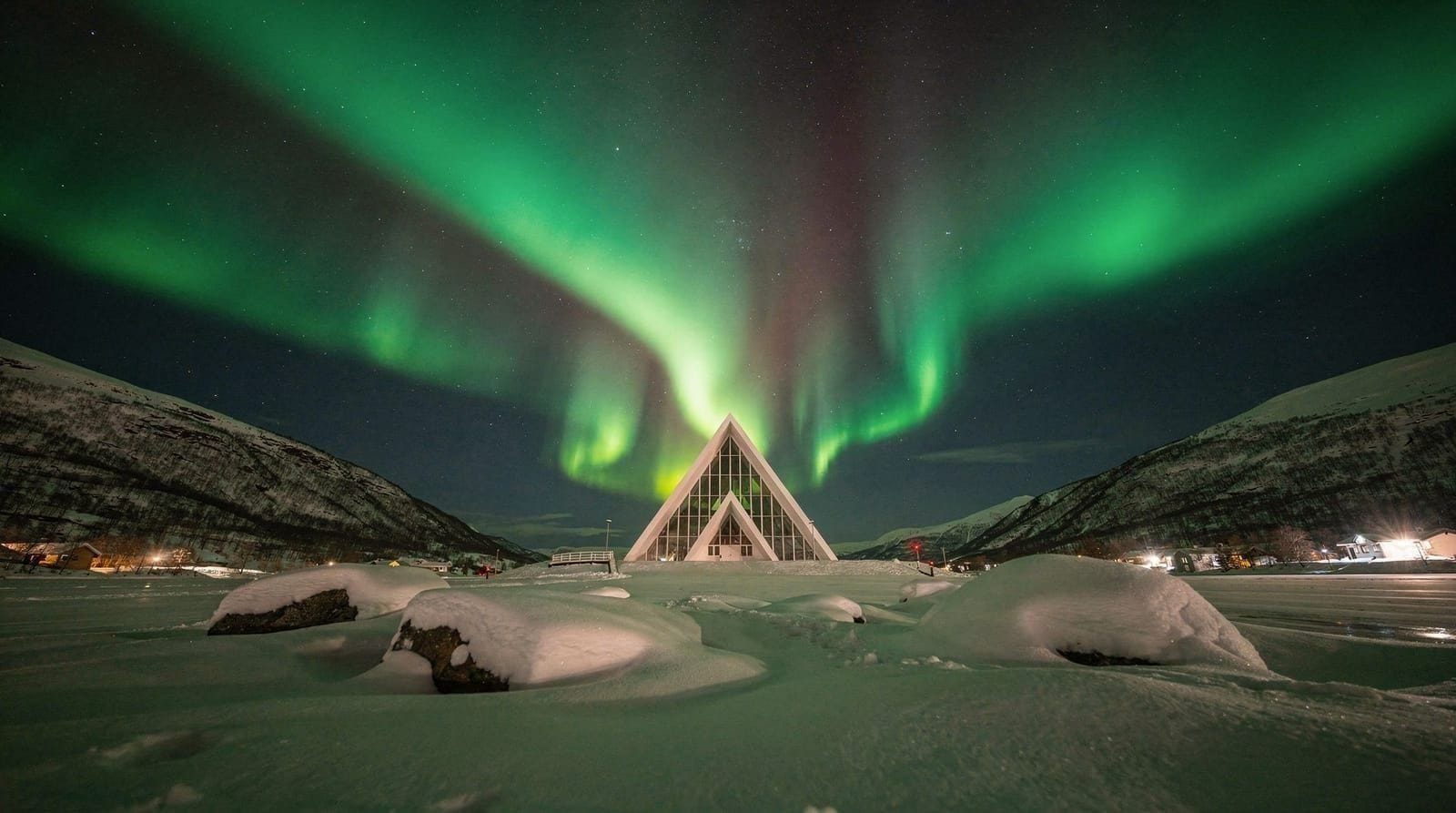
Why it works (sometimes): The low light pollution, open ocean horizon, and dramatic rock-and-sea scenery make for outstanding aurora photography when the sky cooperates. The aurora framed over the Arctic Ocean is one of the iconic Tromsø images.
Why it often doesn’t work: Sommarøy and Kvaløya sit on the western coast, exposed to the same Atlantic weather systems that affect Tromsø. When Tromsø is cloudy, these spots typically are too.
Best used in high-pressure periods when the whole region clears, or in late winter (Feb–March) when clear weather is more common.
4. Ersfjord bay — close, dark, popular
Distance from Tromsø: ~30 km west on Kvaløya
Drive time: 30–40 minutes
Why it works: Ersfjord is a classic Tromsø-area aurora spot — close to the city, reasonably dark, with a scenic fjord backdrop. Many guided tours stop here as their first location.
It shares the coastal weather downside of Sommarøy, but the short distance means you can check it quickly and drive further inland if clouded out.
5. Breivikeidet and the Malangshalvøya direction
Distance from Tromsø: ~40 km east via E8
Drive time: 35–45 minutes
Why it works: Breivikeidet is at the ferry crossing to Lyngen. Turning off the E8 here opens up darker valleys with less traffic and light pollution than the main road. Driving southeast from here toward Malangen fjord gives wide open skies.
6. Tromsø city viewpoints
Fjellheisen cable car (421 m): Accessible via Fjellheisveien, runs evenings until ~01:00 during aurora season. Lifts you above some low-level coastal mist and gives a 360° panorama. Aurora directly overhead is stunning from the viewing platform. Ticket price: 225–250 NOK return. See Fjellheisen tickets.
Tromsø waterfront (Stortorget direction north): Zero cost, no equipment needed. Faces north and northwest over the fjord. Works for KP 3+ clear nights.
Tromsøya northern tip: Drive 10 minutes north from city centre to the quiet northern end of the island. Darker than the city centre with open sky toward the Lyngen mountains.
Self-drive strategy for finding aurora
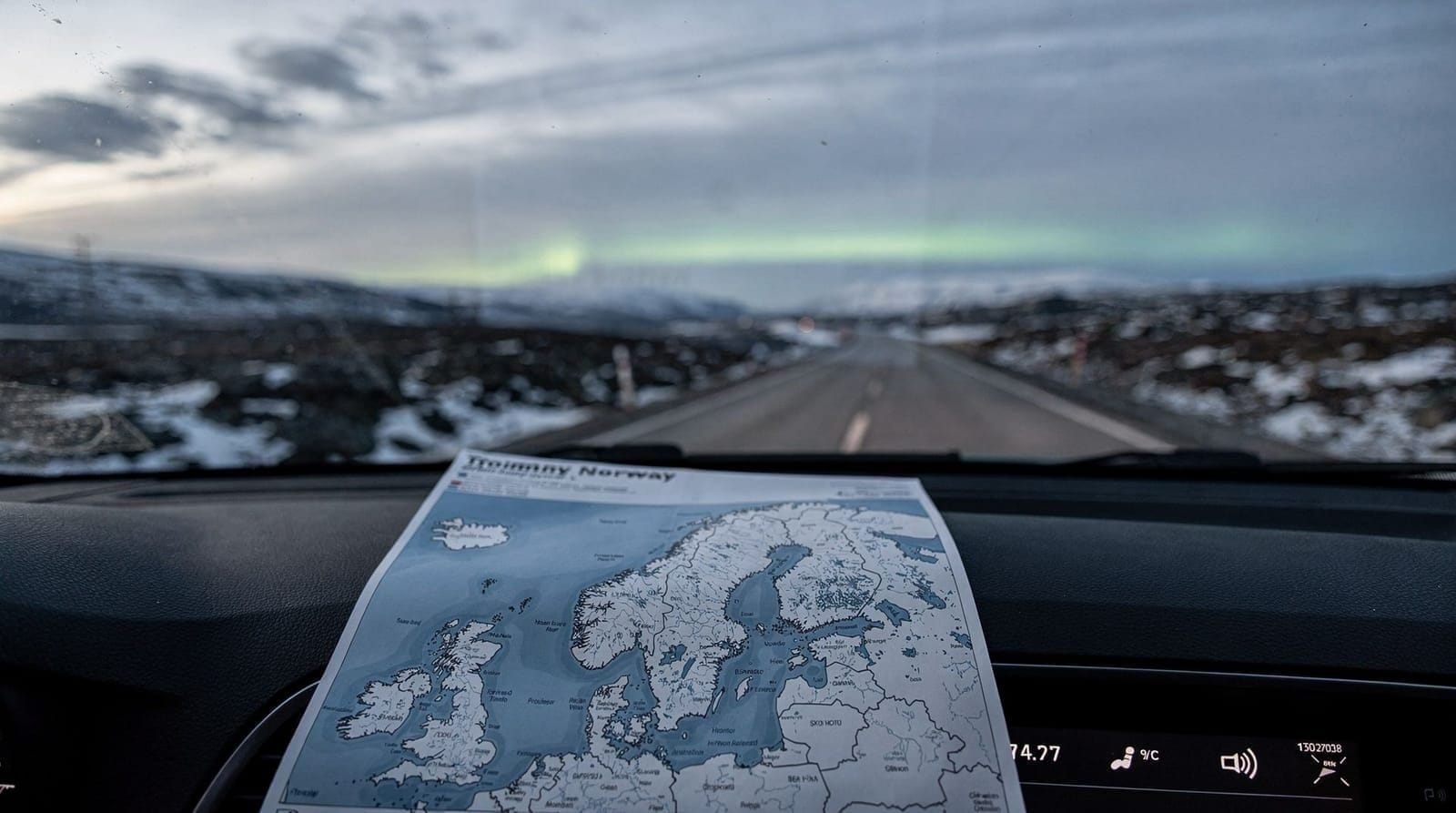
If you have a car with winter tyres (mandatory in Norway November–April), here is the cloud-escape strategy locals use:
- Check yr.no and met.no the evening before for cloud forecasts in the Tamok/Lyngen direction vs. the coast.
- If the coast is overcast, drive E8 east toward Skibotn. The Bjørnfjell pass area frequently clears when Tromsø is socked in.
- If the east is also covered, drive west to Sommarøy as a last resort — maritime cloud is sometimes thinner along the coastal strip.
- Never just sit in one spot hoping cloud will clear. Drive until you find a hole.
Read the dedicated self-drive aurora guide for full route planning.
With a guided tour — what to expect
Some operators cross into Sweden or Finland when Norwegian skies are covered — the “unlimited borders” approach genuinely means driving to a different country if needed.Standard 6–8 hour tours leave Tromsø around 18:00–20:00, stop at a pre-scouted location (often Tamok or Lyngen direction), and return by 01:00–02:00. If conditions are bad at the first location, better operators move 50–100 km.
Small-group expert-guide tours are more flexible — a group of 6–8 in a 4x4 can deviate quickly from the plan in ways that a large coach cannot.Ask any operator before booking: “How far do you drive if the primary location is cloudy?” A vague answer is a warning sign.
Photography spots vs. sighting spots
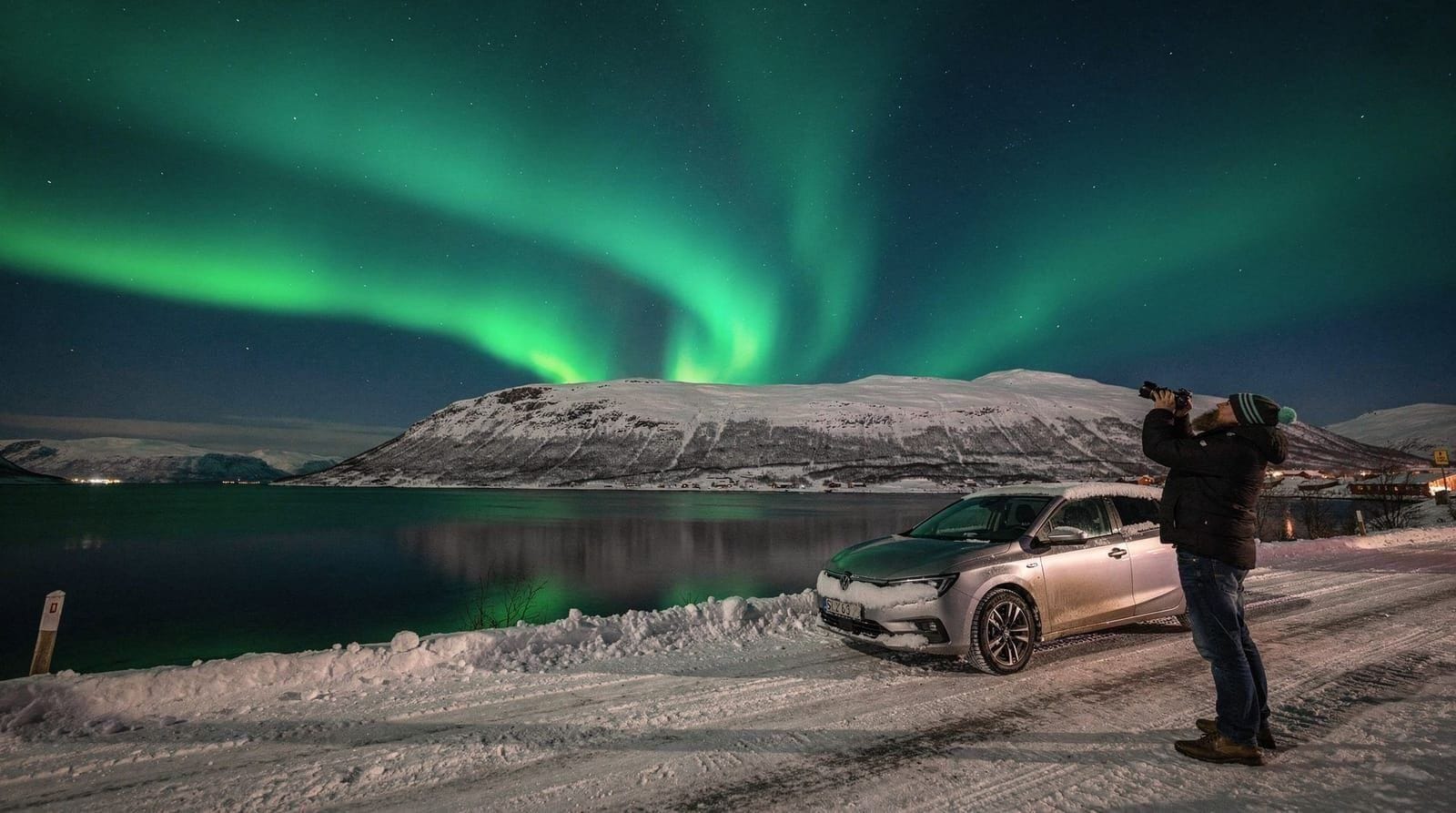
If you just want to see aurora, dark open skies are all that matters. If you want to photograph it well, foreground matters. The most photogenic foregrounds near Tromsø:
- Sommarøy — rocky coast, reflections in shallow water
- Ersfjord — valley with mountains framing the lights
- Lyngen — sharp peaks reflecting in the fjord
- Tamok — open valley with minimal light pollution for pure sky shots
See the best aurora photography locations guide for GPS coordinates and composition tips.
Camp-based vs. mobile chasing
Location strategy splits into two philosophies. Camp-based means staying at one well-scouted, sheltered site — usually Camp Tamok — with a fire, warm drinks, and shelter while you wait for the sky to perform. Mobile chasing means driving between locations as forecasts and live cloud conditions change. Neither is objectively better; it depends on your tolerance for driving in the dark and how much you value comfort versus flexibility. The chasing vs. camp aurora guide breaks down which suits which traveller, and Camp Tamok’s dog sledding and snowmobile add-ons are worth considering if you’re basing your night around that valley anyway.
Whichever strategy you use, understanding the forecast numbers themselves helps you judge whether a location decision is even worth making on a given night — see aurora forecast KP explained and best time to see northern lights in Tromsø for the seasonal and nightly timing that pairs with everything on this page.
Frequently asked questions about where to see northern lights
Is Tromsø the best place in Norway to see aurora?
Tromsø is inside the auroral oval and has the most tour infrastructure in Norway. Abisko in Sweden (3 hours east by road) has statistically clearer skies due to its position in a “blue hole” of low precipitation. For a pure sighting-probability comparison see our Tromsø vs Abisko guide.
Do I need to go far from Tromsø city to see aurora?
Not necessarily. At KP 3+ with clear city-centre skies, aurora is visible from the waterfront. For a more dramatic, unobstructed view, 20–30 km is enough. For cloud-escape purposes, 50–100 km inland is the practical minimum.
Are aurora spots accessible in winter conditions?
Main roads (E8, E6) are kept clear by snow ploughs and are generally safe with winter tyres. Smaller roads and viewpoints may require 4x4 or chains in heavy snow. Never park on a highway shoulder in the dark — use proper layby areas.
Does elevation help see aurora better?
Slightly. Higher elevation puts you above some low-level mist and coastal fog. Fjellheisen at 421 m helps in those specific conditions. But thick cloud at high altitude is unaffected by elevation — then the only solution is horizontal distance (drive east).
What are the light pollution levels near Tromsø?
Tromsø city produces visible orange light pollution visible on Bortle maps. 20 km out in any direction gets you to Bortle 3–4 skies (good). The Tamok and Lyngen areas are Bortle 2–3 (excellent). Finland border area is Bortle 1–2 (pristine) on calm clear nights.
Can I see aurora from a cruise ship near Tromsø?
Yes. Getting onto the fjord removes coastal land-fog risk. Several cruise-style aurora tours operate nightly. See our northern lights from cruise guide for the details on ship-based viewing.
What if it’s raining in Tromsø?
Rain typically means a low-pressure system covering the coast — driving 100+ km east toward the Finnish border is the best option. If the whole region is raining, the night is a write-off meteorologically. Check the 48-hour forecast before booking a tour night.
Is the aurora visible from Tromsø airport?
The airport is on Tromsøya island, about 4 km from the city, at low elevation. It is not better than city viewpoints and has security lighting that reduces contrast. Not recommended as an aurora spot.
Top experiences
Bookable activities with verified prices and instant confirmation on GetYourGuide.