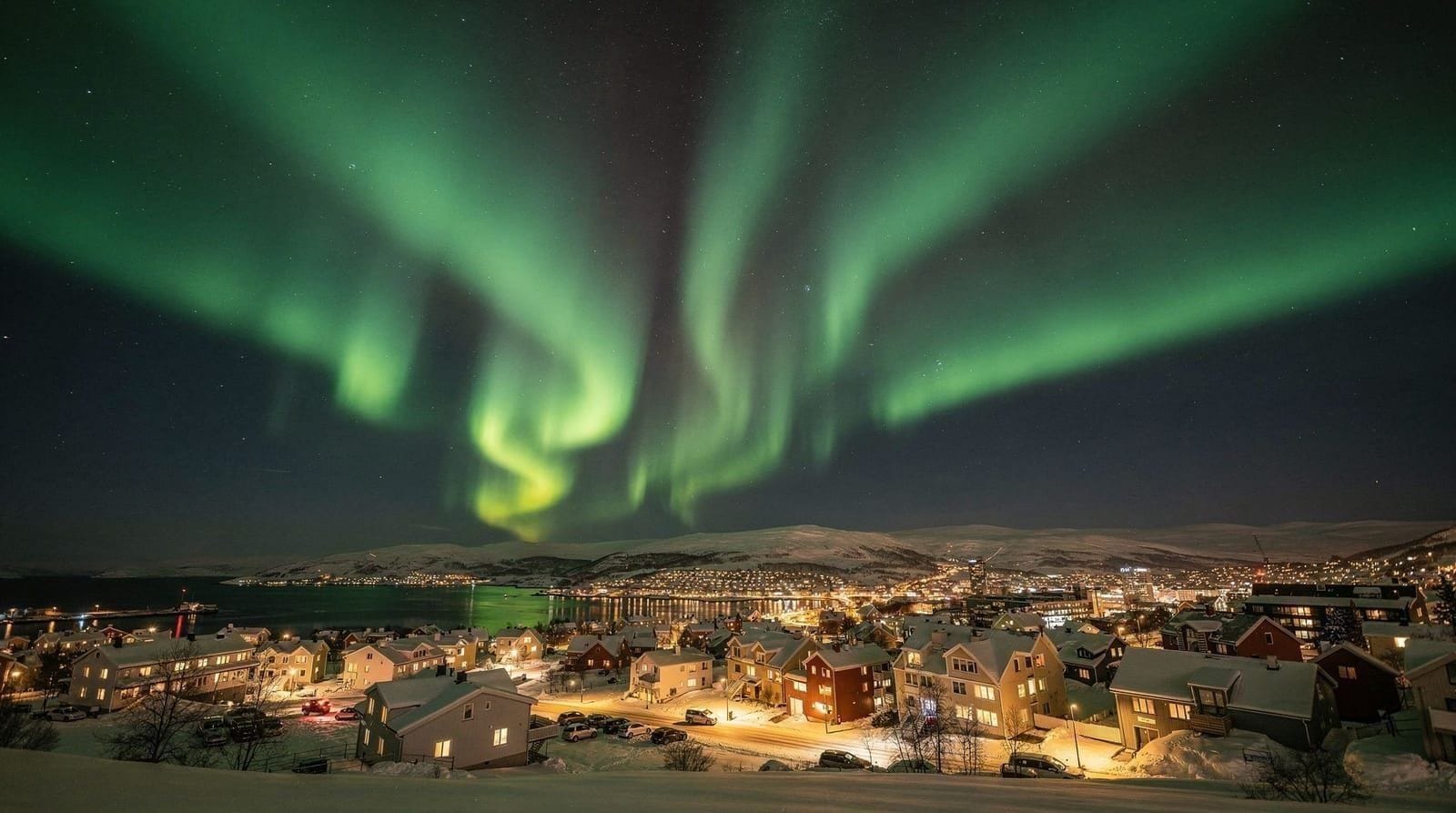
Chasing aurora vs. camping for aurora in Tromsø — which approach wins?
Tromsø: Expert Aurora Hunt - Thermal Gear, Food, Campfire
Is it better to chase aurora by driving or camp in one dark spot?
Chasing (driving flexibly to clear skies) statistically gives higher sighting rates in Tromsø's cloudy conditions. Camping in one spot gives a richer multi-night Arctic experience but depends entirely on that location being clear. Both work — your choice depends on what else you want from the experience.
Quick answer: Aurora chasing (driving to clear skies) beats camping for raw sighting probability in Tromsø’s cloudy conditions. Aurora camping delivers a richer Arctic experience and is excellent in settled weather. Most experienced visitors do one chase tour and one camp night in a 4–5 day Tromsø trip.
| Chase tour cost | around 1,700–3,500 NOK/person |
| Camp cost | around 4,000–15,000 NOK/person |
| Chase duration | 6–9 hours, back by 01:00–03:00 |
| Camp duration | 12–24 hours, or multi-day |
| Best when overcast | chasing (drives to clear sky) |
| Best when clear region-wide | camping (comfort, longer window) |
If you are only in Tromsø for a short window, our 4-day aurora itinerary shows how to slot one of each into a realistic schedule without exhausting yourself.
The fundamental philosophy difference
Two completely different philosophies underpin how you approach aurora hunting:
The chaser’s mindset: The aurora is overhead somewhere tonight. My job is to position myself under clear sky. I will drive as far as necessary to find it. The vehicle is my tool, not my prison.
The camper’s mindset: I have chosen a location with statistically good skies, set up a comfortable base, and I am giving the aurora time to come to me. Meanwhile I am living the full Arctic experience.
Neither is wrong. They suit different travellers and different weather conditions.
Aurora chasing — the mechanics and the reality
What actually happens on a chase tour
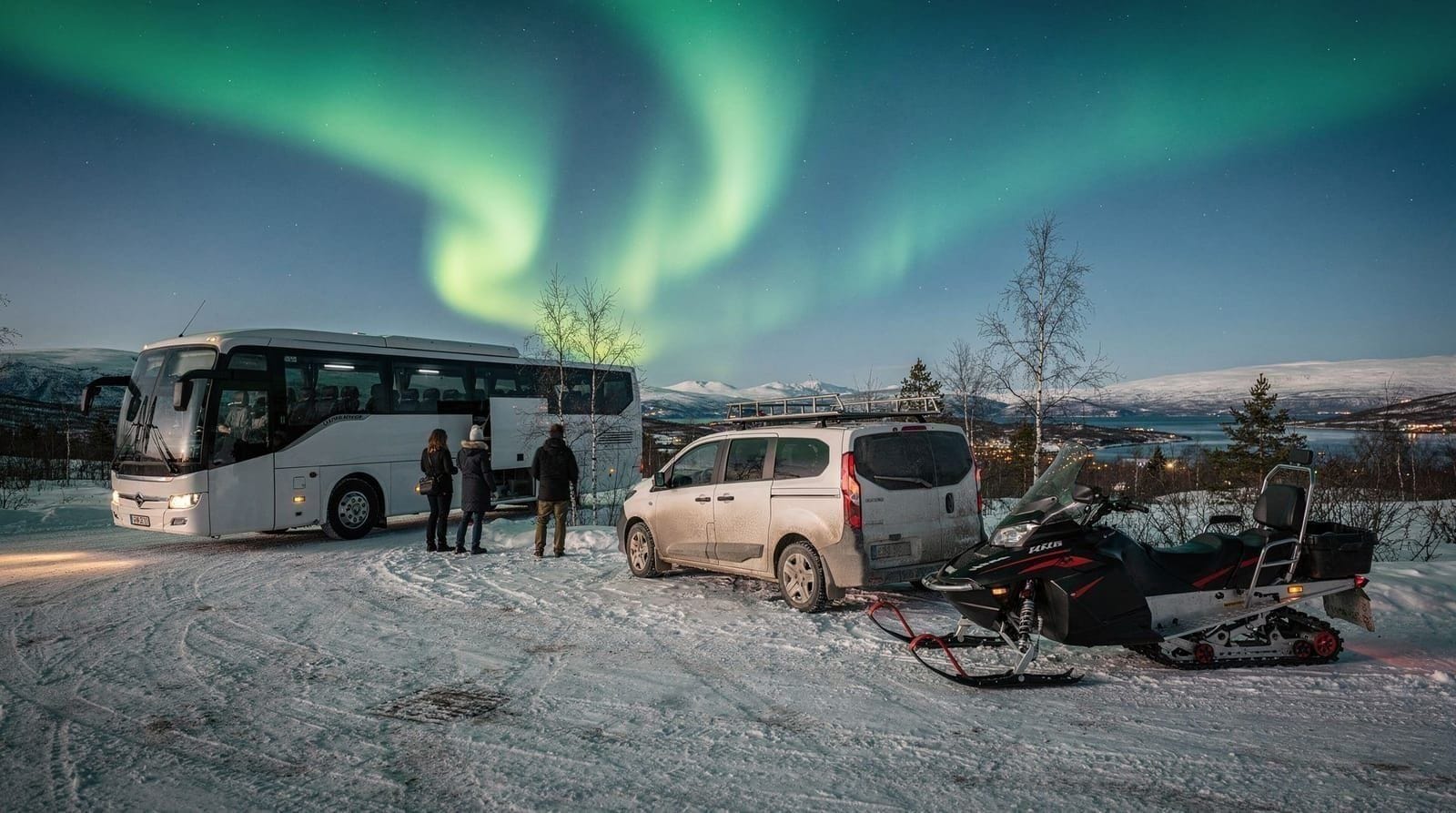
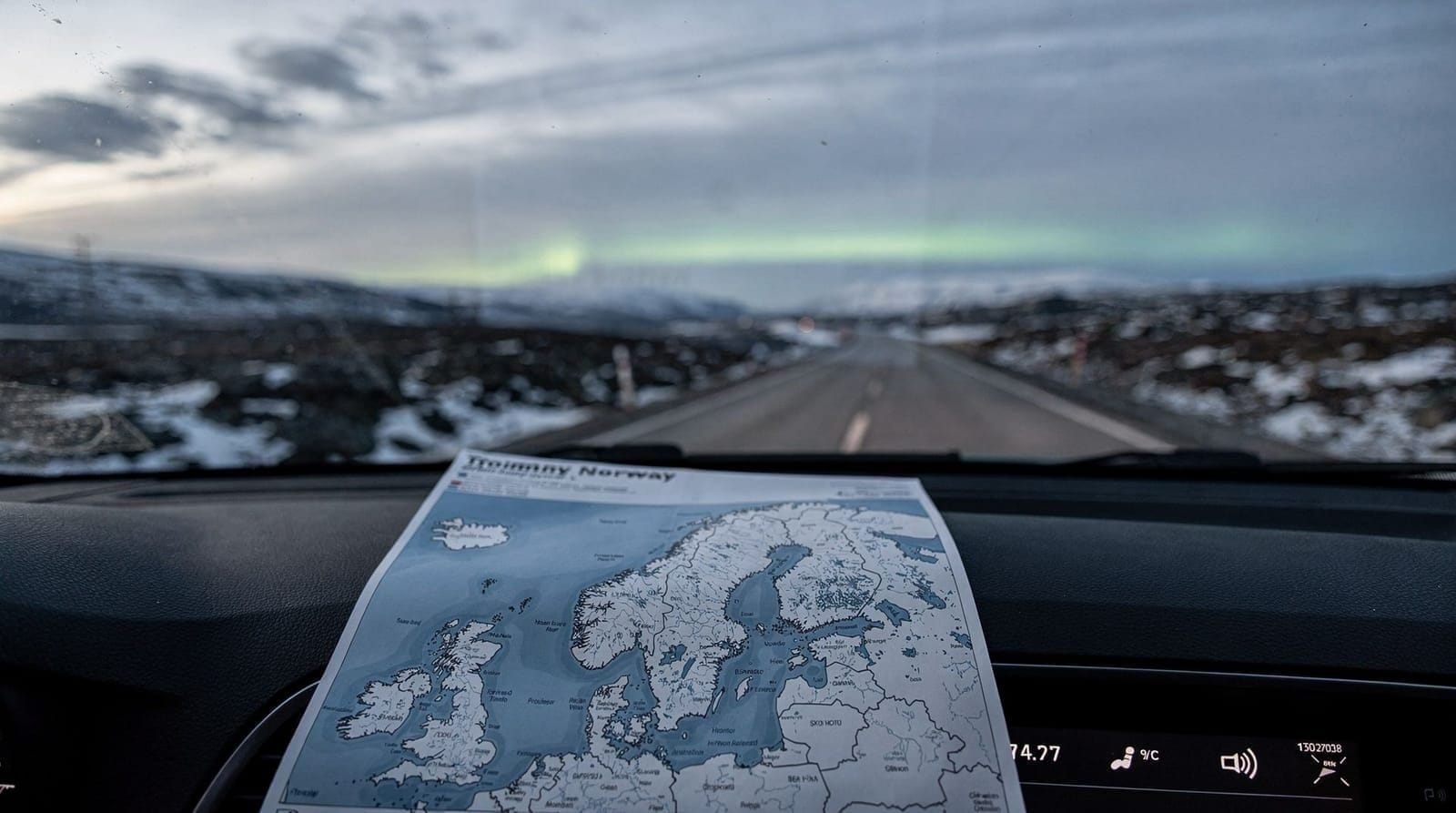
Leave Tromsø between 18:00 and 20:00. The guide has already checked yr.no, Meteoblue, and Windy.com multiple times during the afternoon. A primary destination is selected — usually the direction with the clearest forecast (often east toward Tamok, sometimes Sweden or Finland).
Driving begins. The guide monitors the sky, checks updated forecasts on their phone, and communicates with other guides via group chat sharing real-time sightings. If the primary location is still cloudy, drive further. If aurora appears, stop.
Aurora appears: the guide stops the vehicle, everyone gets out, thermal suits are available, a campfire may be lit nearby. Watching time at a single location is typically 20–45 minutes before moving to the next spot or heading back.
A full chase night covers 100–300 km. Returns to Tromsø at 01:00–03:00.
What makes a good chase tour
- Driver experience — Local guides who have driven these roads for 5+ seasons know which valleys clear, which roads are icy, and where to park safely.
- Forecast sophistication — Multiple tools, not just one app. Our aurora cloud strategy guide explains what guides are actually looking at when they check yr.no, Meteoblue and Windy side by side.
- Cross-border willingness — Operators who say “we drive to Sweden or Finland when Norway is overcast” are being honest about what cloud chasing requires.
- Small vehicle — A 7-seater 4x4 can change plans faster than a 20-person coach.
Understanding the Kp-index and how it relates to what you will actually see helps set expectations before you commit to either strategy — see our aurora forecast and Kp-index explained guide. And chase drivers do not pick locations at random: they are working from a shortlist of known clear-sky pockets, covered in our best aurora locations around Tromsø guide.
Unlimited-borders tours explicitly commit to crossing into Sweden or Finland if Norwegian conditions are poor — an honest policy that requires a genuine chase commitment.Weaknesses of chasing
- You’re in a vehicle for long periods — up to 4–5 hours of driving for 1 hour of aurora viewing.
- The campfire stop is often cold roadside, not scenic.
- On a clear night when the whole region is good, chasing loses its advantage — camping is equally effective and more comfortable.
- Solo self-drive chasing without a guide requires confident winter driving skills.
Aurora camping — the mechanics and the reality
Camp Tamok — Tromsø’s main aurora camp
Tamok Valley is 50 km southeast of Tromsø, situated behind a mountain range that blocks maritime cloud. Camp Tamok is an established wilderness venue that runs dog sledding, reindeer activities, snowmobiling, and overnight stays.
The appeal of camping at Tamok: you’re already inland where skies clear more reliably. You’re staying overnight so you have a 6–8 hour window for aurora to appear (midnight displays are common at 01:00–03:00 that standard tours miss). You’re doing other things — mushing dogs, sitting by a fire, eating reindeer stew — while waiting. If dog sledding is the daytime draw for you, see the Camp Tamok dog sledding guide for what a full day-into-night programme actually looks like.
Aurora crystal lavvo overnight stays at Lyngen combine the transparent lavvo structure for warm-weather viewing with a full night’s worth of aurora opportunities — the premium end of the camp experience.What to expect at a lavvo camp
A lavvo is a traditional Sami tent-like structure with a central fire burning throughout the night. Properly insulated sleeping bags (rated -30°C) go on reindeer hides. Interior temperature near the fire stays above 0°C even in -20°C weather.
You sleep (or semi-sleep) inside the lavvo and guides wake you when aurora appears, or you establish a personal watch rotation. The aurora-from-sleeping-bag-through-the-lavvo-smoke-hole is an iconic image from these trips.
Weaknesses of camping
- On a bad cloud night at the camp location, you have no option to drive elsewhere. You wait and hope.
- More expensive than a single chase tour.
- Less suited to those who just want “see aurora, tick box” — the full camp is a 12–24 hour commitment.
- Quality varies significantly between operators and facilities.
Comparison in different weather scenarios
Scenario A: Consistently overcast coastal weather (common in November)
Chase wins decisively. A flexible chase team can drive 150 km east to find clear sky. A camp fixed on the Tromsø coast gets nothing. Aurora camp in a good inland location (Tamok, which is already inland) mitigates this — the camp position matters enormously. This is also the pattern behind why midwinter Tromsø aurora hunting leans harder on chasing than shoulder-season trips do.
Scenario B: Clear high-pressure settled weather (common in February–March)
Camping wins on experience. When the whole region is clear, a camp gives 8–12 hours of uninterrupted aurora opportunity versus 2–3 hours on a chase tour. The comfort and richness of the camp experience dominates. Later in the season, our September aurora in Tromsø guide covers a similar settled-weather pattern paired with milder temperatures.
Scenario C: Patchy cloud with clear windows
Marginal — chase is still slightly better because it can position under clear windows in real-time.
Cost comparison
| Option | Cost per person | Duration | What’s included |
|---|---|---|---|
| Standard chase tour | 1,700–2,200 NOK | 6–8 hours | Transport, thermal suit, hot drinks |
| Photography chase tour | 2,500–3,500 NOK | 7–9 hours | Above + photo instruction |
| Overnight camp (lavvo/cabin) | 4,000–8,000 NOK | 12–24 hours | Transport, accommodation, meals, activities |
| Multi-day camp package | 8,000–15,000 NOK | 2–3 days | All inclusive |
The optimal Tromsø aurora strategy (4+ nights)
For visitors with 4–6 nights in Tromsø who have aurora as their main goal, the best approach combines both:
Night 1: Join a standard small-group minibus chase tour. Learn how guides read conditions, what aurora looks like in person, and what the region looks like at night.
Night 2: Self-evaluate. If night 1 was successful with clear skies, night 2 can be another chase or a self-drive attempt. If night 1 was cloudy and the chase drove far, consider an inland camp.
Night 3 or 4: Book an overnight stay at Camp Tamok or a Lyngen lavvo. The combination of Arctic activities during the day and multiple aurora windows overnight is the most complete Tromsø aurora experience.
For the first attempt, an all-inclusive expert hunt with thermal gear is ideal — they handle every variable while you focus on watching the sky.What about self-driving instead of a tour?
Both chasing and camping are usually sold as guided products, but neither requires a guide. Confident winter drivers can self-drive-chase using the same public forecast tools guides use, and some camps allow self-drive arrival if you book a stay without transport included. Weigh this against your own driving comfort — our self-drive vs guided aurora comparison and the more detailed self-drive aurora in Tromsø guide both cover what changes when you take the wheel yourself, including the realistic savings and the added responsibility of route-finding and ice driving in the dark.
Photography considerations for each strategy
If photography matters to your trip, the choice between chasing and camping changes your shot list, not just your comfort. Chasing rewards travelling light with a tripod that sets up fast, since you may only get 20–30 minutes per stop; camping rewards patience — you can dial in composition, test long exposures, and wait for a stronger display without packing up. Our aurora photography gear guide covers what to bring for either scenario, and photographing the aurora walks through a real night from a personal angle.
Frequently asked questions about chasing vs. camping aurora
Can I combine a day camp with a chase in the same trip?
Yes. Day programs at Camp Tamok (dog sledding, ice domes, reindeer) end by 17:00–18:00. You can return to Tromsø and join an evening chase tour the same night. Or stay overnight and do both from the camp location.
Is a lavvo camp authentic Sami culture?
Partially. Lavvo-style tents are derived from Sami tradition and many camps employ Sami guides or work with Sami cultural practitioners. However, a commercial aurora camp is a tourism product, not a ceremonial or day-to-day Sami experience. Ask operators directly about their Sami staff and cultural credentials. See our Sami culture guide for context.
What if it’s too cold to sleep in a lavvo?
The -30°C sleeping bags provided by reputable camps are genuinely warm enough for exterior temperatures of -20°C to -25°C. If you’re extremely cold-sensitive, ask operators about cabin options — most camps have both lavvo and heated cabin accommodation.
Can solo travellers join aurora camps?
Yes, camps operate as group experiences. Most Tamok programs have 8–20 guests. You won’t have a private cabin but will share the camp facilities with other travellers. Many solo aurora enthusiasts find the social aspect of camp evenings one of the highlights.
Is chasing aurora sustainable for the environment?
A valid concern. Chase tours can involve 300+ km of driving per night in diesel vans. Some operators now use hybrid vehicles or carbon offset programmes. Boat-based aurora tours eliminate road driving. Camping in an existing facility concentrates impact. Ask operators about their sustainability approach if this is important to you.
What if the aurora appears while I’m asleep at camp?
Good camps have a “wakeup call” system — guides monitor the sky and wake sleeping guests when aurora appears. Make sure your guide knows you want to be woken. Bring earplugs if you’re a light sleeper (camp environments can be active at aurora-peak times).
How many people should I expect at an aurora camp?
Commercial camps in Tromsø typically operate 8–30 guests. Camp Tamok is one of the larger operations. Smaller family-run lavvo experiences host 4–12 people. Ask before booking — the atmosphere of a 30-person operation differs significantly from an intimate 8-person experience.
Does the chase-vs-camp decision affect how I photograph aurora?
Chasing gives you diverse foregrounds (you move to different locations) at the cost of less setup time per location. Camping gives you extended time at one location to perfect composition, tripod placement, and test exposures. Photographers often prefer camps during clear settled weather, chase tours in variable cloud conditions.
Is one strategy better for families with children?
Camping suits families better in most cases — children can sleep through a quiet stretch and be woken for a display, rather than sitting through hours of driving on a chase tour past their bedtime. See our what age for aurora guide for age-specific advice either way.
Top experiences
Bookable activities with verified prices and instant confirmation on GetYourGuide.