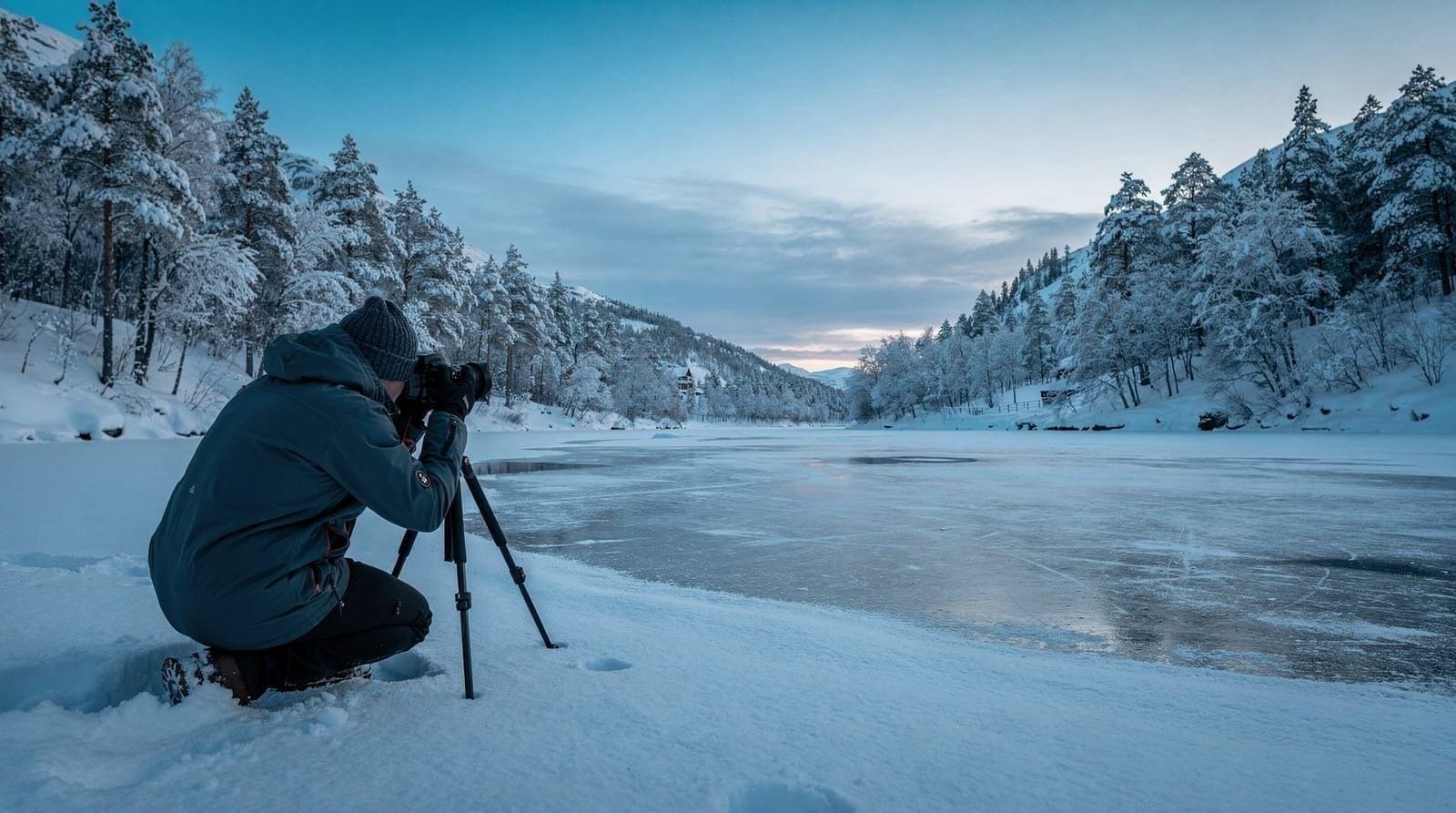
Aurora photography gear guide for a Tromsø trip
Tromsø: 4x4 Small-Group Northern Lights Photography Tour
What gear do I need for aurora photography in Tromsø?
A camera with manual mode, a wide-angle lens at f/2.8 or faster, and a sturdy tripod are the three essentials. A full-frame mirrorless or DSLR with a 14–24 mm f/2.8 or 16 mm f/1.4 lens is ideal. Budget shooters can get usable results with a crop-sensor camera and a Samyang 14 mm f/2.8 for under £400 total.
Quick answer: Three essentials — a manual-capable camera, a wide-angle lens at f/2.8 or faster, and a sturdy tripod. Everything else is useful but optional. Budget option: Fujifilm X-T30 II or Sony A6000 + Samyang 14 mm f/2.8 + Joby GorillaPod 3K. Professional option: Sony A7 IV + 16–35 mm f/2.8 GM + Gitzo carbon tripod.
| Minimum kit | Manual camera + f/2.8 wide-angle + tripod |
| Budget cost | under £400 total (crop-sensor body + Samyang 14mm) |
| Professional cost | £3,000+ (full-frame body + fast prime + carbon tripod) |
| Rental in Tromsø | 200–600 NOK/night depending on item |
| Best time to buy/rent | Before you arrive — camera shops sell out of rental stock in peak season |
The gear hierarchy for aurora photography
Aurora photography rewards gear investment more than most genres — low-light, fast-moving subjects demand high ISO performance and fast optics. However, there’s a significant gap between “minimum viable” and “ideal,” and many excellent aurora photos have been taken with modest equipment.
Here’s the honest gear hierarchy:
Level 1 — Minimum viable: Any DSLR or mirrorless from 2018 onward with manual mode + kit 18–55 mm f/3.5 at 18 mm + tripod. Produces decent results at KP 4+ with active aurora. Struggles at lower KP.
Level 2 — Good: APS-C camera + 16 mm f/1.4 or 14 mm f/2.8 prime + carbon tripod. Covers 90% of aurora sessions well.
Level 3 — Ideal: Full-frame mirrorless + 14–24 mm f/2.8 or 16 mm f/1.4 + carbon tripod. Handles low KP, produces professional results.
Cameras — what matters for aurora
The single most important camera specification for aurora is high ISO performance — how clean the image looks at ISO 3200 and 6400.
Full-frame sensors (best noise performance)
- Sony A7 IV — Excellent aurora performer, fast AF for when you’re not shooting aurora (street, wildlife), good video. Around £2,500 body-only.
- Nikon Z6 III — Outstanding sensor performance, class-leading ergonomics. Around £2,200 body-only.
- Canon R6 Mark II — Excellent in-body stabilisation (less useful for aurora but good for other photography). Around £2,200 body-only.
APS-C sensors (crop factor ~1.5x) — strong aurora performers
- Sony A6700 — Best APS-C in 2024–2026 for night photography. Excellent ISO 3200–6400 performance. Around £1,200 body-only.
- Fujifilm X-T5 — 40 MP APS-C, exceptional for detail if you can manage the 40 MP file sizes. Around £1,700 body-only.
- Canon R50 / R7 — Good entry-level to mid-range options for aurora.
Budget DSLR bodies
Older DSLRs (Nikon D750, D810, Canon 6D) remain excellent aurora cameras and sell second-hand for £300–600. If you already own a DSLR from 2015 onward, invest in the lens before a new body.
Lenses — the most important investment
A camera is only as good as its lens for aurora. The lens determines how much light reaches the sensor, which controls whether you can shorten exposure (reduce blur from moving aurora) or lower ISO (reduce noise).
Recommended lenses by budget
Budget (£150–250): Samyang/Rokinon 14 mm f/2.8 (manual focus only, all mounts). Excellent sharpness, very low distortion for the price. The standard budget aurora lens. Manual focus is not a limitation — you focus on stars manually anyway.
Mid-range (£400–800): Sigma 16 mm f/1.4 DC DN (APS-C, E/L/X mount), Tamron 17–28 mm f/2.8 (full-frame E-mount). Both excellent performers. The Sigma 16 mm f/1.4 on APS-C is one of the best value aurora lenses available.
Premium (£800–1,500): Sigma 14 mm f/1.8 Art — specifically designed for astrophotography. Field-flattened, very sharp corners, f/1.8 at 14 mm. Industry favourite among aurora photographers. Available in most mounts.
Professional (£1,500+): Sony 12–24 mm f/2.8 GM, Nikon Z 14–24 mm f/2.8, Canon RF 14–35 mm f/4L. These lenses combine autofocus (useful for other photography) with professional optical quality.
What focal length is best?
For maximising sky coverage and reducing the “500 rule” star trail concern: wider is better. 14–16 mm on full-frame, 10–12 mm on APS-C.
For including interesting foregrounds (mountains, ice formations, buildings) with sky context: 24–35 mm gives more compression and a natural perspective. Not ideal for maximum sky area but excellent for landscape-with-aurora compositions.
Tripods — non-negotiable quality level
A cheap tripod at -20°C is a liability. Aluminium legs become brittle. Lever-lock mechanisms may seize. Quick-release plates can slip when the ball head freezes slightly.
What to look for
- Carbon fibre legs: Stay flexible at -20°C, lighter to carry, don’t conduct cold to your hands as badly as aluminium
- Ball head with tension control: Pan-tilt heads are adequate but ball heads allow faster repositioning for chasing moving aurora
- Lever-lock or friction twist-lock legs: Either work in cold; avoid push-button locks that can fail in cold weather
- Load rating: At least 5 kg (your camera + heavy lens + accessories is typically 2–3 kg; headroom matters)
Recommended tripods
- Joby GorillaPod 3K (£60–80) — Flexible legs, not tall, but excellent for beach rock placements and unusual angles. Not ideal as primary aurora tripod but useful supplementary.
- Benro Mach3 Carbon TMA28C (~£200) — Solid entry-level carbon tripod with adequate cold rating.
- Gitzo GT2545T (~£700) — Industry standard for travel carbon fibre. Excellent in cold, lightweight. Popular among professional aurora photographers.
- Really Right Stuff TVC-24L (~£700-900) — American alternative to Gitzo, excellent quality.
Cold-weather accessories
Batteries — most critical accessory
Every cold session should start with fully charged spare batteries in an inside jacket pocket (body temperature). Carry 2+ spares minimum. A single charge at -15°C typically lasts 60–90 shots vs. 300+ at room temperature.
Useful products: Wasabi Power or Patona batteries (genuine-capacity third-party, tested for cold). Avoid ultra-cheap no-name batteries — they fail even faster in cold.
Remote shutter release
Wired: Hähnel HRC280 Pro (£20), JJC RM-S1 (£10). Simple and reliable in cold.
Wireless: Yongnuo YN-E3-RT remote, or your camera’s app if it works reliably in cold.
Built-in timer: Camera’s 2-second self-timer + mirror lockup is free and effective.
Lens heater straps
Aurora photographers who go out repeatedly invest in USB lens heater straps (Dew Heater) that prevent the front element fogging when temperature fluctuates. Powered by a USB power bank inside your jacket. Around £20–40. Prevents the frustrating mid-session fog.
Waterproof camera cover
A simple rain jacket for the camera (Joby UltraFit, Think Tank Hydrophobia) keeps snow off in light conditions. Essential if you’re in falling snow.
Head torch — red light essential
A head torch with a red-light mode preserves night vision. White torches ruin your own and other photographers’ dark adaptation. Petzl Tikkina, Black Diamond Spot, or similar — ensure it has red mode. Red light also prevents ruining other people’s long exposures when you walk around.
Gear tier comparison
| Tier | Camera | Lens | Tripod | Approx. total cost |
|---|---|---|---|---|
| Minimum viable | 2018+ DSLR/mirrorless, kit lens | 18–55mm f/3.5 | Any tripod | Often already owned |
| Budget | Sony A6000 / Fujifilm X-T30 II | Samyang 14mm f/2.8 | Joby GorillaPod 3K | under £400 |
| Good | Sony A6700 / Fujifilm X-T5 | Sigma 16mm f/1.4 | Benro Mach3 Carbon | £1,500–2,000 |
| Ideal | Sony A7 IV / Nikon Z6 III | Sigma 14mm f/1.8 Art | Gitzo GT2545T | £3,000+ |
Renting gear in Tromsø
Several photography shops and tour operators in Tromsø rent aurora-specific gear:
- Wide-angle prime lenses (typically Samyang 14 mm or Sigma 16 mm) for approximately 200–300 NOK per night
- Carbon tripods for 100–200 NOK per night
- Body upgrades (Sony A7 III/IV bodies) for 400–600 NOK per night
Ask at the camera shops on Storgata or contact operators directly about rental options. Rental can be significantly cheaper than buying if you’re a casual photographer.
Joining a photography tour vs. using your own gear
Photography tours provide instruction alongside your gear — a guide who knows when to use f/1.8 vs. f/2.8 for the current aurora speed can save a whole night of trial and error. Professional-photographer-led tours bring their own gear as demonstrations and let you compare your results to a working professional’s output in real-time — valuable for learning.Even with excellent gear, a photography tour on your first aurora session beats solo self-teach. The scene changes too fast, and guide knowledge of focusing technique and settings adaptation is worth more than a marginal camera upgrade.
Once you have the gear: settings and where to use it
Owning the right equipment is only the first step. The aurora camera settings guide and the aurora photography settings guide cover the exact ISO, aperture, and shutter combinations for different aurora speeds — worth reading before your first night out so you’re not learning both gear and settings simultaneously in the cold and dark.
Gear also matters less than location for the final result. The best aurora locations in Tromsø guide covers spots with strong foreground interest, which separates a memorable photograph from a technically correct but forgettable one. And if you’re deciding whether to invest in gear at all versus joining a tour, the northern lights tours compared guide breaks down which operators include photography coaching and equipment loans.
Using the same gear for daytime landscape shots
Most of the gear covered here — wide-angle lens, sturdy tripod, manual exposure skills — carries over directly to daytime winter photography. If you’re also shooting fjords, mountains, and snow scenes during daylight hours, the winter landscape photography guide covers exposure and composition techniques that use the same kit, so there’s no need to pack a separate daytime setup.
Frequently asked questions about aurora photography gear
Can I get good aurora photos with a kit 18–55 mm zoom?
Yes, at KP 4+ with bright aurora. Set to 18 mm, f/3.5 (widest at that focal length), ISO 3200–6400, 10–15 seconds. Results will show more noise than a fast prime but are publishable. At KP 2–3 with faint aurora, a kit lens struggles significantly.
Is the Sony A7C good for aurora?
Yes — the A7C and A7C II use the same sensor family as the A7 IV with excellent high-ISO performance. The compact body is a bonus for travel. Pair with the Sony 20 mm f/1.8 G or Tamron 17–28 mm f/2.8 for a compact aurora kit.
Should I rent or buy a better lens for this one trip?
If aurora is the primary reason for the trip, rent a fast wide prime for the duration. A Sigma 14 mm f/1.8 rented for 4 nights costs £50–100 at a UK camera rental shop — far cheaper than buying, with guaranteed quality. In Tromsø itself, rental is possible but advance reservation is advisable.
Does the camera need to be aligned for polar alignment aurora photos?
No. Polar alignment is for untracked star trail photography lasting 20+ minutes. Aurora exposures of 4–15 seconds don’t require tracking or alignment — stars don’t trail visibly at those durations with wide-angle lenses.
What is the best memory card for cold temperatures?
High-capacity UHS-II SD cards (SanDisk Extreme Pro, Lexar Professional 2000x) are reliable in cold. Standard UHS-I cards also work but write speeds can slow slightly at very low temperatures. Always carry a spare card in your jacket pocket.
Are smartphone gimbals or stabilisers useful for aurora video?
Aurora video at night requires very high ISO and is typically noisy on any current camera. Gimbals help with movement blur but not with sensor noise. Aurora videography is an emerging field — shoot at 8–15 second single frames if stacking video, or accept grainy footage. Not a primary use case for Tromsø photography currently.
How do I clean a lens that’s been in snow?
Use a lens pen (LensPen) to remove dust and dry snow from the front element. For wet condensation: use a microfibre cloth (dry, not with cleaning fluid). Never blow compressed air onto a cold lens (thermal shock risk). Brush off loose snow with the lens cap first, then wipe gently.
Is mirrorless better than DSLR for aurora now?
For new purchases, yes — mirrorless offers electronic viewfinder (see exposure in real-time), better battery management in some models, and more current sensor technology. If you already own a good DSLR (Nikon D750, Canon 6D Mark II), there’s no compelling need to switch for aurora alone. The lens investment matters more than body type for aurora photography.
Do I need different gear for a photography tour versus self-shooting?
No — the same camera, lens, and tripod work whether you’re on a guided tour or shooting independently. What a photography tour adds is instruction and site selection, not different equipment requirements. Bring your own gear either way if you own it.
Is a used or older camera good enough for aurora?
Yes, often. Cameras from 2018 onward with manual mode handle ISO 1600–3200 acceptably, which covers most real aurora scenarios. See the aurora camera settings guide for exact starting values that work across a range of camera generations.
Top experiences
Bookable activities with verified prices and instant confirmation on GetYourGuide.