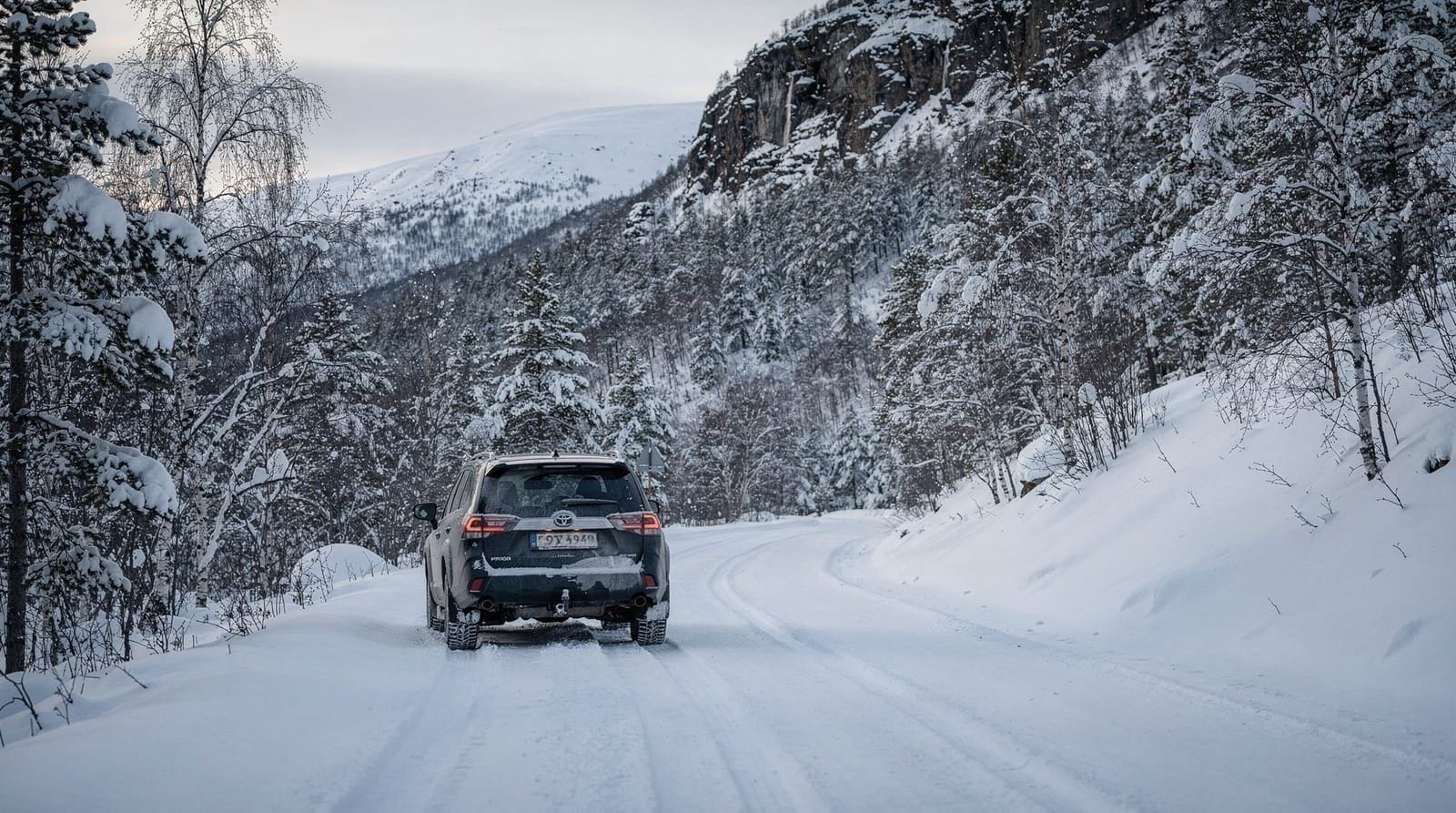
Self-drive vs guided aurora in Tromsø — which gives better results?
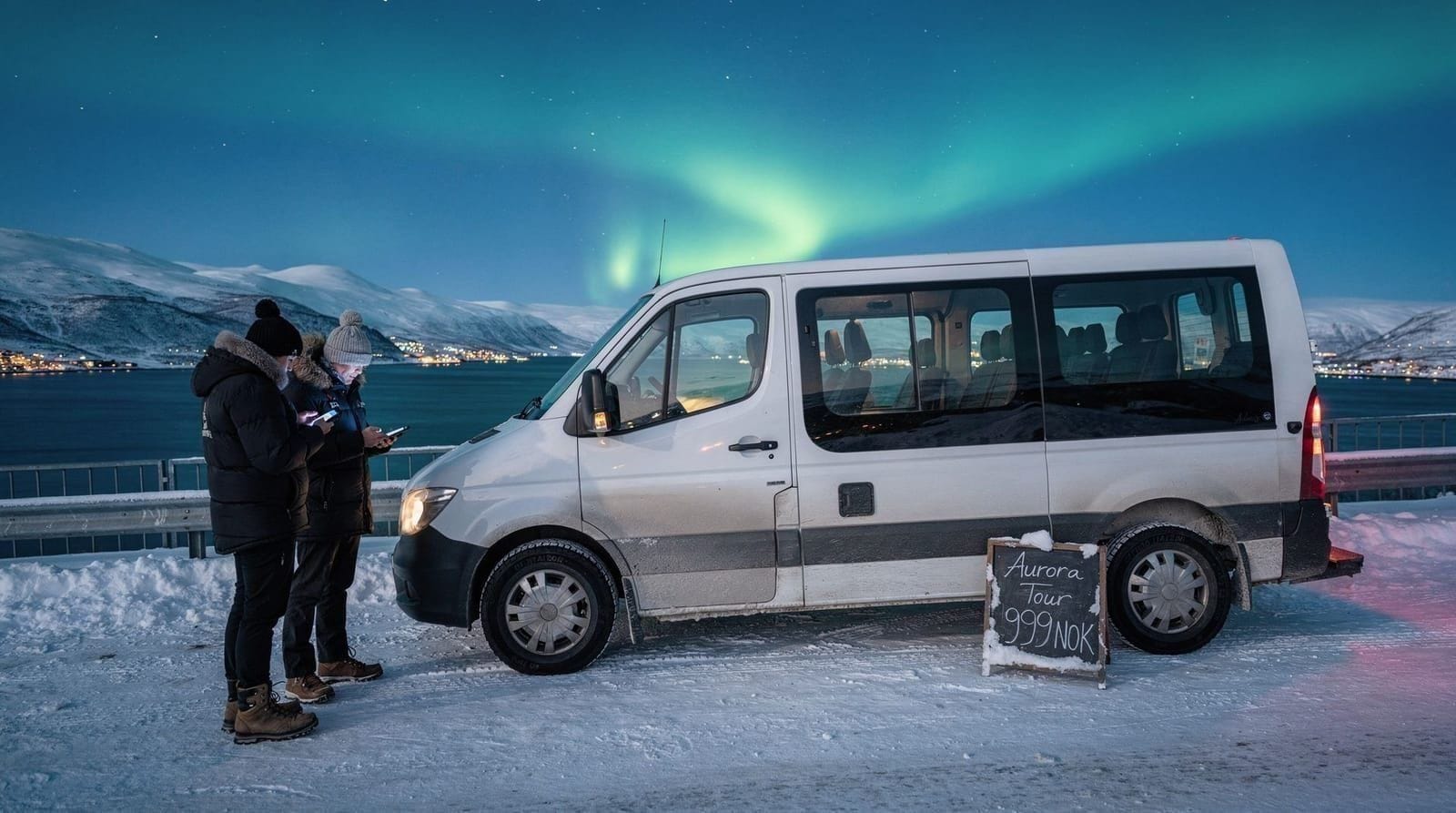
Tromsø: Small-Group Northern Lights Tour by Minibus
Is self-driving for aurora better than taking a guided tour in Tromsø?
For experienced winter drivers who are comfortable reading aurora and weather forecasts, self-drive gives more flexibility at lower cost. For first-timers, non-drivers, or those without navigation skills in Arctic winter, a well-chosen small-group tour with an expert guide offers better aurora results on average.
| Self-drive cost | around 830–1,200 NOK per night, all in |
| Guided cost | around 1,800–2,500 NOK per night, small group |
| Time needed | 4–6 hours per night either way |
| Getting there | Rental pickup at Tromsø Airport, or hotel pickup for tours |
| Best time | September–October and February–March for easier self-drive conditions |
The question that actually matters for aurora results
Many Tromsø visitors spend significant time deciding between guided and self-drive aurora — often for the wrong reasons. The debate is not about cost alone (though cost matters). It is about which approach maximises your actual probability of a meaningful aurora experience given your specific situation, skills, and flexibility.
The case for self-drive aurora
Cost: the clearest advantage
The numbers are straightforward:
| Cost item | Self-drive | Guided (small-group) |
|---|---|---|
| Rental car (24h, compact) | 700–1 000 NOK | — |
| Fuel (200 km hunting) | 130–200 NOK | — |
| Tour cost | — | 1 800–2 500 NOK |
| Total per night | 830–1 200 NOK | 1 800–2 500 NOK |
Over 5 nights of aurora hunting, this is a 4 000–6 500 NOK saving — enough to pay for a day of dog sledding or whale watching. If you are budget-conscious and plan multiple aurora nights, self-drive has compelling economics.
Flexibility: the biggest operational advantage
A guided tour operates on a schedule. The minibus picks you up at 20:30 and returns at 01:00 or 02:00. If aurora appears at 02:30, you are back at your hotel. If the guide decides to head east when your forecast analysis suggests north would be better, you follow the guide.
In your own car at midnight, you have zero constraints. If aurora appears on the drive back, you pull over instantly. If the first location has cloud, you drive 20 minutes further. If you want to stay until 04:00 because the display is building, you stay. For aurora photography specifically, this freedom from schedule is extremely valuable.
Autonomy for experienced aurora hunters
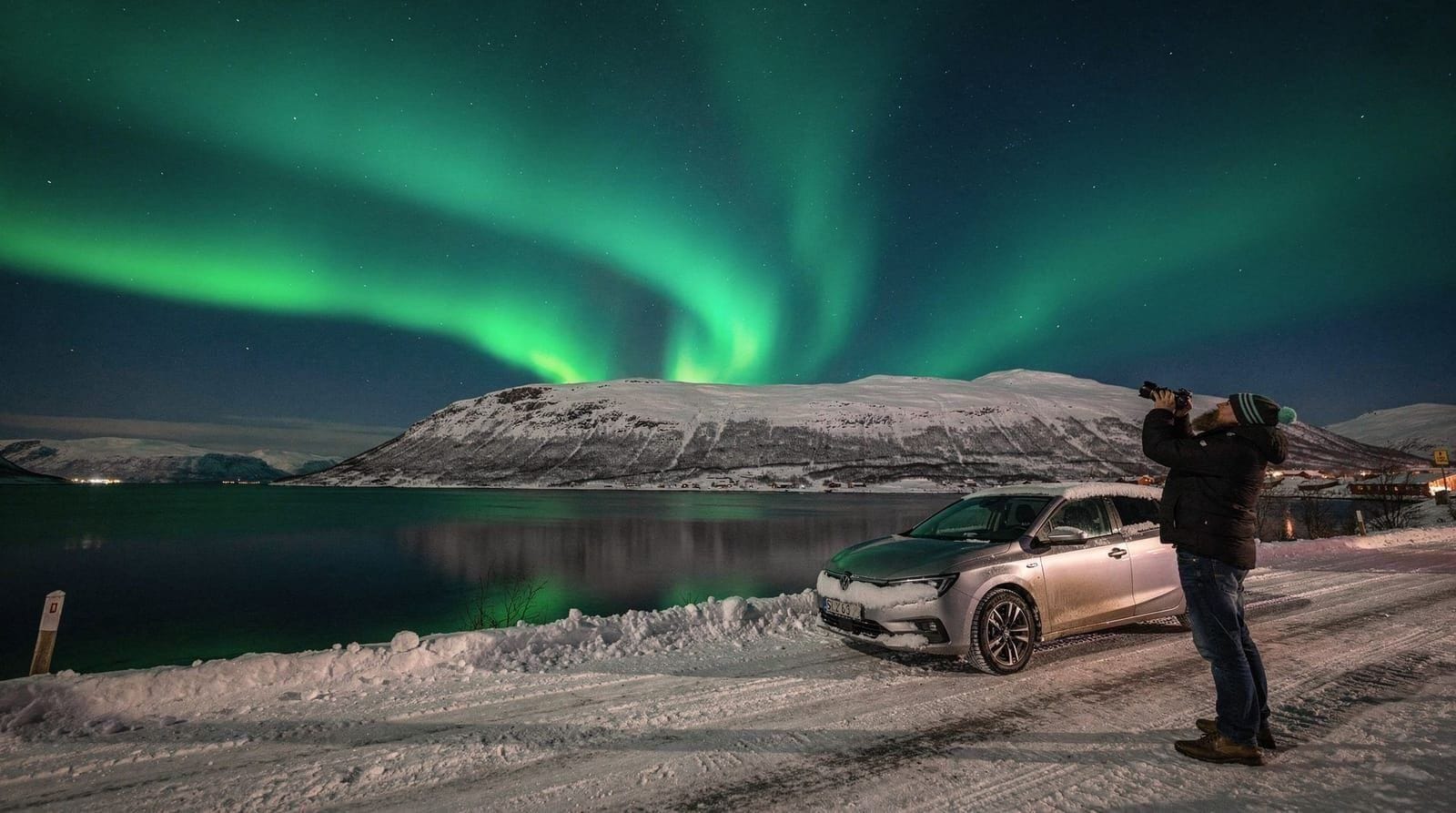
Visitors on a second or third aurora trip to Tromsø — who already know the roads, have experience reading aurora forecasts, and have a reliable car — often find self-drive more productive than tours. You develop a personal knowledge of where cloud breaks, where the road is quiet for photography, and which directions are most likely to offer clear windows. Tour guides have this knowledge professionally; repeat self-drive visitors develop it through experience.
The case for guided aurora tours
Local forecast interpretation
The single biggest advantage of a good guide is local weather knowledge. Not knowledge of the KP index (you can check that yourself) but knowledge of the specific micro-patterns around Tromsø: which cloud formations are rapidly moving through versus sitting stationary, which mountain gaps create clearing effects, and what the forecast data actually means in terms of where to drive tonight.
Aurora forecasting apps show raw KP data and cloud cover percentages. A guide who has been running tours for 3–5 seasons knows that a “60% cloud cover” forecast for tonight means the western mountains will be clouded but the E8 east will likely clear after midnight. That local pattern knowledge is not in any app.
Cross-border chasing capability
Some Tromsø operators have established relationships and permits that allow them to drive efficiently into Sweden’s Pajala area or Finland’s Kilpisjärvi when Norwegian coastal cloud is persistent. The 300 km drive east requires confidence in international winter driving, navigation in unfamiliar territory at night, and knowledge of which crossing points are ploughed.
For a first-time visitor, managing a 3-hour drive into a foreign country at midnight in −15 °C is a significant undertaking. For an established operator, it is routine.
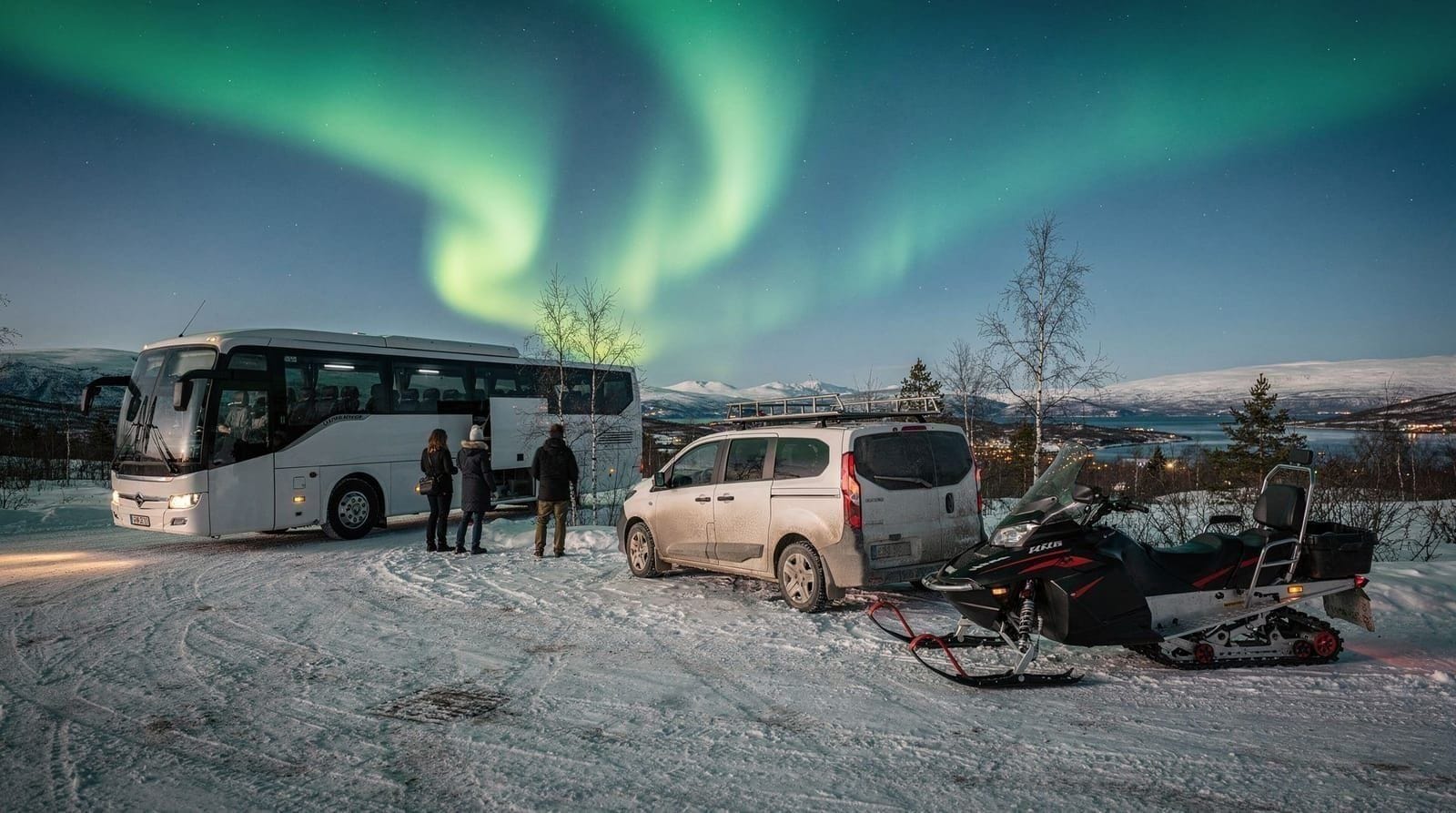
Aurora tour with cross-border cloud chasing capabilitySafety and logistics
If your rental car slides into a bank at 02:00 on a remote road in −15 °C, the situation is serious. Norwegian breakdown services (Viking, Falck) are reliable and 24-hour, but response times in remote areas can be 45–90 minutes. In a guided tour, the guide manages all safety logistics.
Additionally, thermal suits, hot drinks, snacks, and emergency procedures are managed by the tour operator. Self-drive aurora hunters need to arrange their own thermal clothing (see packing mistakes for Tromsø), their own food and drink for long waits, and their own contingency plan for vehicle problems.
Photography coaching
If you are new to aurora photography, a guided photography tour provides camera settings guidance, tripod positioning advice, and real-time coaching when the aurora appears. A self-drive hunter who does not know how to set a camera for aurora will miss much of the value of the display.
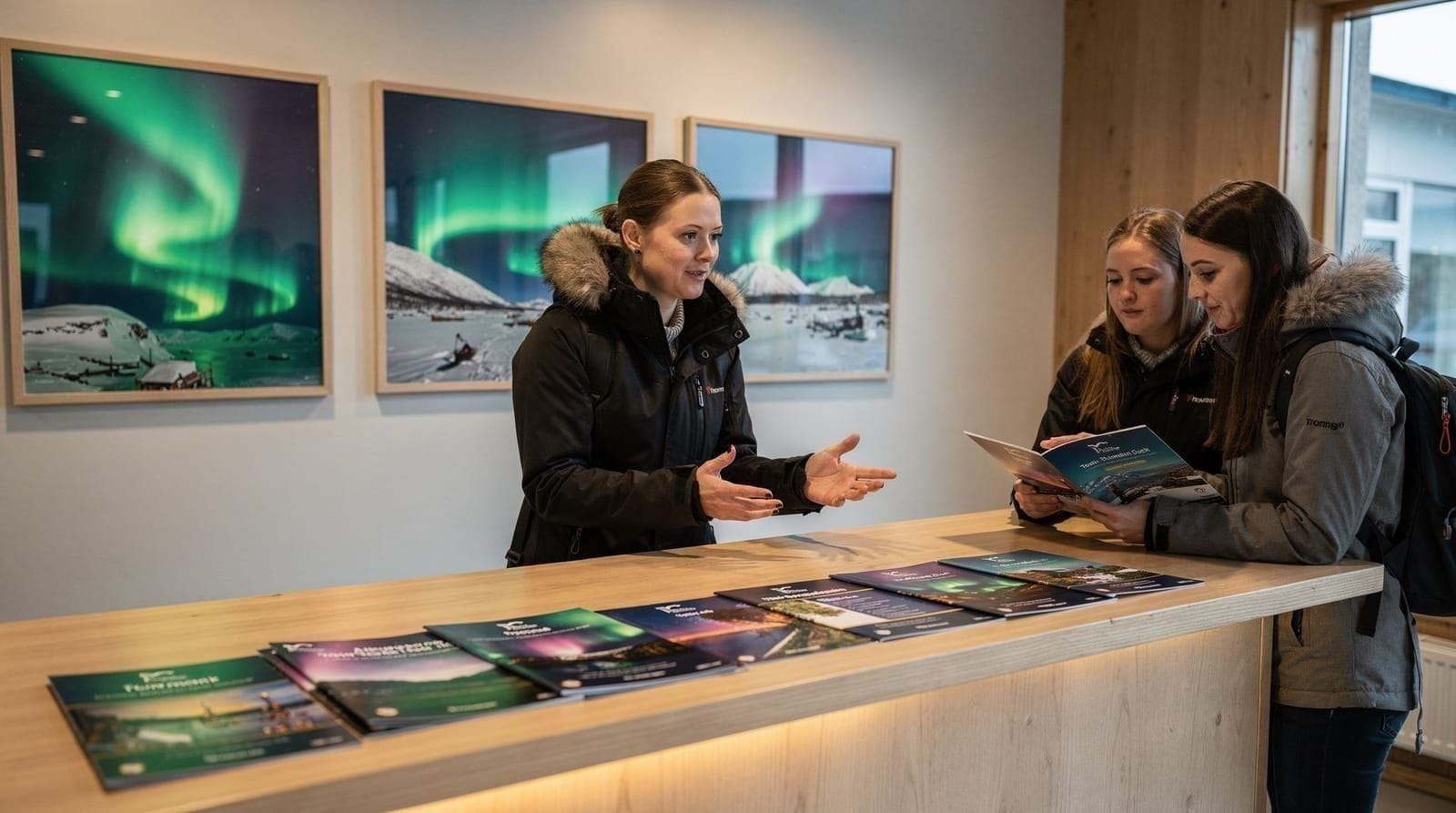
Northern lights tour with local guide and thermal suitsWho should self-drive
- Experienced winter drivers (prior experience on ice essential)
- Confident with aurora forecast interpretation (Yr.no, KP data)
- Aurora veterans on return trips who know Tromsø’s roads
- Couples or friends where everyone in the car can share navigation and lookout duties
- Photographers who want full schedule flexibility for long-exposure sessions
- Budget travellers who plan 4–5 nights of hunting and need to manage costs
Who should take a guided tour
- First-time visitors to Tromsø or Arctic winter driving
- Non-drivers or visitors from countries where winter driving is uncommon
- Solo travellers without companion for safety backup
- Visitors with only 1–2 nights who need maximum expertise to compensate for limited time
- Visitors focused primarily on the experience (warmth, community, stories) rather than the photography
- Anyone unfamiliar with aurora forecast reading
The hybrid approach: both
The most cost-effective strategy for a 5-night stay is to combine both:
- Night 1: Guided tour (learn the roads, viewpoints, and local forecast reading from the guide)
- Nights 2–3: Self-drive (apply learned knowledge, maximum flexibility)
- Night 4: Guided tour (when forecast looks particularly good, benefit from expert cloud-chasing)
- Night 5: Self-drive or guided depending on conditions
This hybrid costs approximately 3 600–5 000 NOK for the two guided nights plus 1 660–2 400 NOK for two self-drive nights — total 5 260–7 400 NOK over 4 nights (excluding the rental car base cost shared across all activities). Versus 7 200–10 000 NOK for 4 guided nights, or 3 320–4 800 NOK for 4 self-drive nights.
Small-group minibus tour — the best guided option for cloud-chasing flexibilityHow this compares to other self-drive vs guided decisions in Tromsø
The self-drive vs guided question is not unique to aurora hunting. If you are weighing similar decisions elsewhere in your trip, the logic is similar but the stakes differ:
- Self-drive aurora hunting — the detailed route-by-route guide referenced throughout this comparison.
- Self-drive vs passenger dog sledding — a related but distinct choice: here “self-drive” means steering your own sled, not a car, and the safety margin for beginners is much tighter.
- Which aurora tour in Tromsø — if you have decided guided is right for you, this picks the specific operator type.
Across all three, the pattern holds: self-directed options reward experience and flexibility-seekers, while guided options reward first-timers and those who value expertise over control.
Technical self-drive aurora guide
Forecast reading workflow
- Check Yr.no → cloud cover map for the next 6–12 hours. Look for the E8 corridor east of Tromsø — if it shows 0–30% cloud cover, drive east. If it shows 80%+ everywhere, consider cancelling or waiting for a break.
- Check Clearoutside.com → more detailed atmospheric transparency data. Good for identifying windows of clear sky within otherwise cloudy periods.
- Check My Aurora Forecast app or SpaceWeather.com → current KP index and 1-hour forecast. Do not drive out for KP below 2 unless you specifically want to photograph weak aurora.
- Cross-reference and decide direction.
Where to drive
E8 east (primary): The most productive route. Drive 30–60 km east toward Skibotn. Pull over at any point where cloud breaks and you have a clear northern or northeastern horizon. The viewpoints above the fjord between Storsteinnes and Skibotn are excellent.
South on Rv91: Secondary option. 30–45 km south toward Breivikeidet. Works when south of Tromsø is clearer than east.
West toward Sommarøy: Rarely productive for aurora as the coastal weather is worse than inland. Only viable when cloud sits specifically over the city but not the outer islands.
Photography setup for self-drive
Set up your camera before you park (do it at the hotel while hands are warm). Manual mode, ISO 1600–3200, aperture f/1.8–f/2.8, shutter 4–10 seconds. Manual focus (autofocus fails in darkness). Use a remote release or 2-second timer to eliminate vibration. See aurora camera settings for the complete guide.
Frequently asked questions about self-drive vs guided aurora
Can I go self-driving on my first night without any local knowledge?
Technically yes, but not recommended. Your first night of self-drive aurora hunting will be partly spent learning the roads, finding safe pull-over spots, and calibrating your forecast reading. Starting with one guided tour first means your first self-drive night benefits from that local orientation.
Do self-drive aurora hunters need 4WD?
AWD is preferred but not essential on the main E8 highway. Most two-wheel-drive rental cars with studded tyres handle the E8 in normal winter conditions. For driving off main roads (viewpoint tracks, farm access roads), AWD adds meaningful security. Book a compact AWD SUV if your budget allows.
What time should I head out for self-drive aurora?
Aurora is most active between 21:00 and 02:00. The peak hours are statistically 21:30–23:00 and 01:00–02:00, though this varies enormously. Drive out by 20:30–21:00, find your location while there is still some atmospheric data to work with, and plan to stay until at least 01:00 unless the sky is completely closed over.
Is it dangerous to be alone on the road at 02:00 in the Lyngen area?
The main risks are: vehicle breakdown (carry a fully charged phone, have the Norwegian AA emergency number saved), becoming stuck in snow (stay on maintained roads; never drive onto unpaved tracks alone at night), and cold exposure if the car stops working (carry a blanket and have an emergency contact who knows your location). The roads themselves are safe from crime — Norway’s rural areas have negligible criminal activity.
How do guided tours handle nights when aurora does not appear?
Most organised tours return to the city at the end of the tour window whether or not aurora appeared. The best operators stay out later when conditions are building. As a self-driver, you have complete control — go back to bed when you decide, not when the bus schedule says.
Does the hybrid approach actually save money over a full guided package?
Yes, for stays of 4+ nights. The worked example above shows roughly 2,000–2,600 NOK saved over four nights by mixing two guided and two self-drive nights compared to four guided nights, while still getting expert cloud-chasing on the nights that matter most. For 1–2 night stays, the savings are too small to offset the value of full guided expertise.
Can I switch from a booked guided tour to self-drive partway through my trip?
Yes — there’s no reason you can’t book one or two guided nights and rent a car for the remainder, or vice versa if a guided tour has last-minute availability. Many visitors decide night-by-night based on the forecast; just confirm cancellation policies on tours booked in advance.
Top experiences
Bookable activities with verified prices and instant confirmation on GetYourGuide.