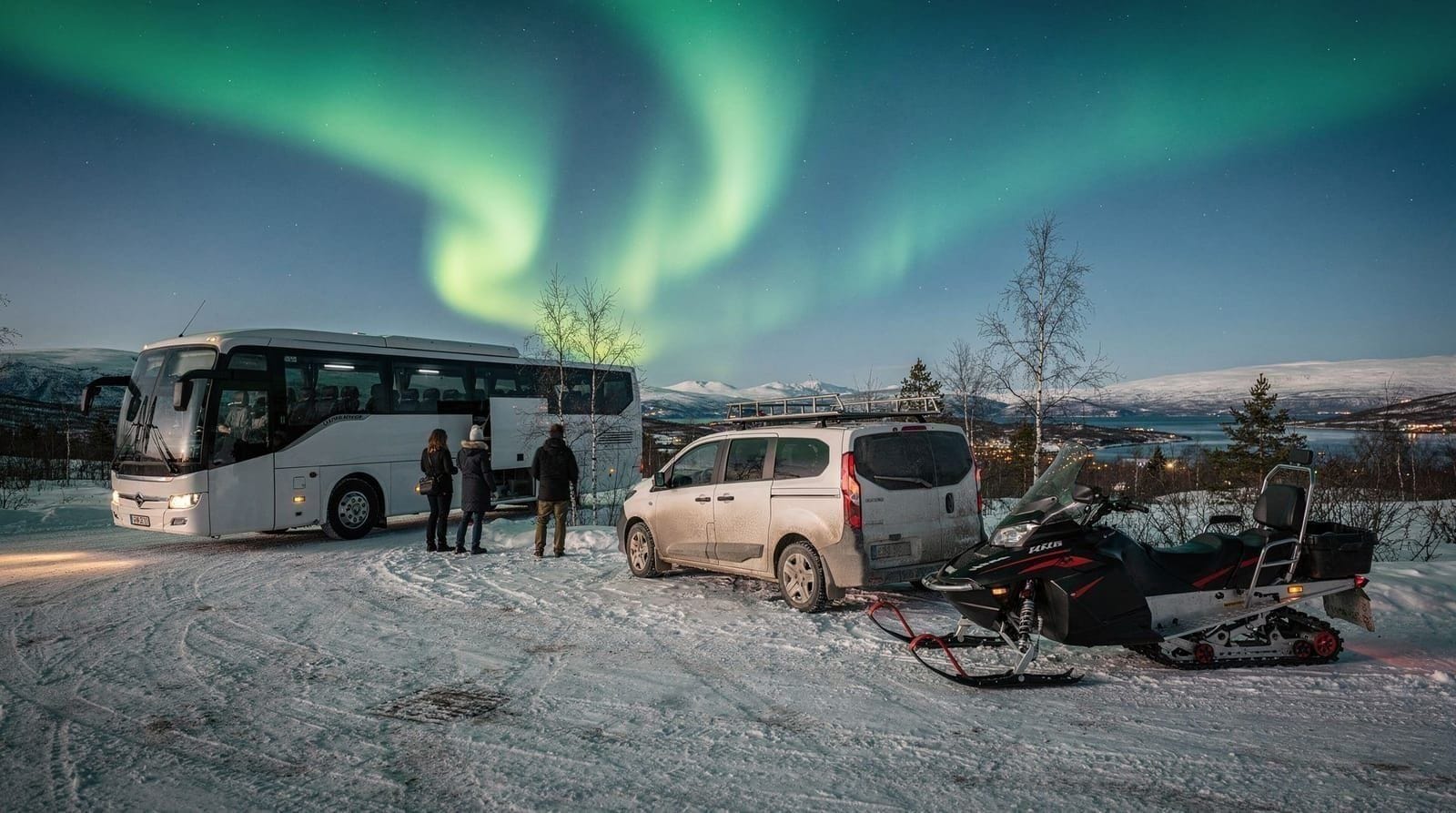
Aurora cloud strategy — how to escape clouds in Tromsø
Tromsø: Unlimited Northern Lights Chase Across Borders
How do you find clear skies to see aurora when Tromsø is cloudy?
Drive inland and east. The E8 toward Skibotn and the Rv91 to Tamok Valley take you away from the maritime cloud that covers the coast. In major overcast events, the Finnish border area 200 km east is often clear when Tromsø is socked in.
Quick answer: Drive east on E8. When Tromsø is cloudy, the inland valleys east and southeast — especially Tamok Valley (~50 km) and the Skibotn area (~80 km) — are frequently clear. For major overcast events, the Finnish border area 200 km east provides a near-certain clear-sky alternative.
| Primary route | E8 east via Nordkjosbotn to Tamok Valley, ~50 km |
| Deep-cloud option | Kilpisjärvi, Finland, ~200 km, 4+ hours round trip |
| Cost (self-drive) | around 830–1,200 NOK for car rental + fuel |
| Forecast tools | yr.no, Meteoblue cloud layers, Windy.com |
| Best strategy | check 3 locations by 18:00, drive until sky is consistently clear |
Why cloud is a bigger obstacle than solar activity
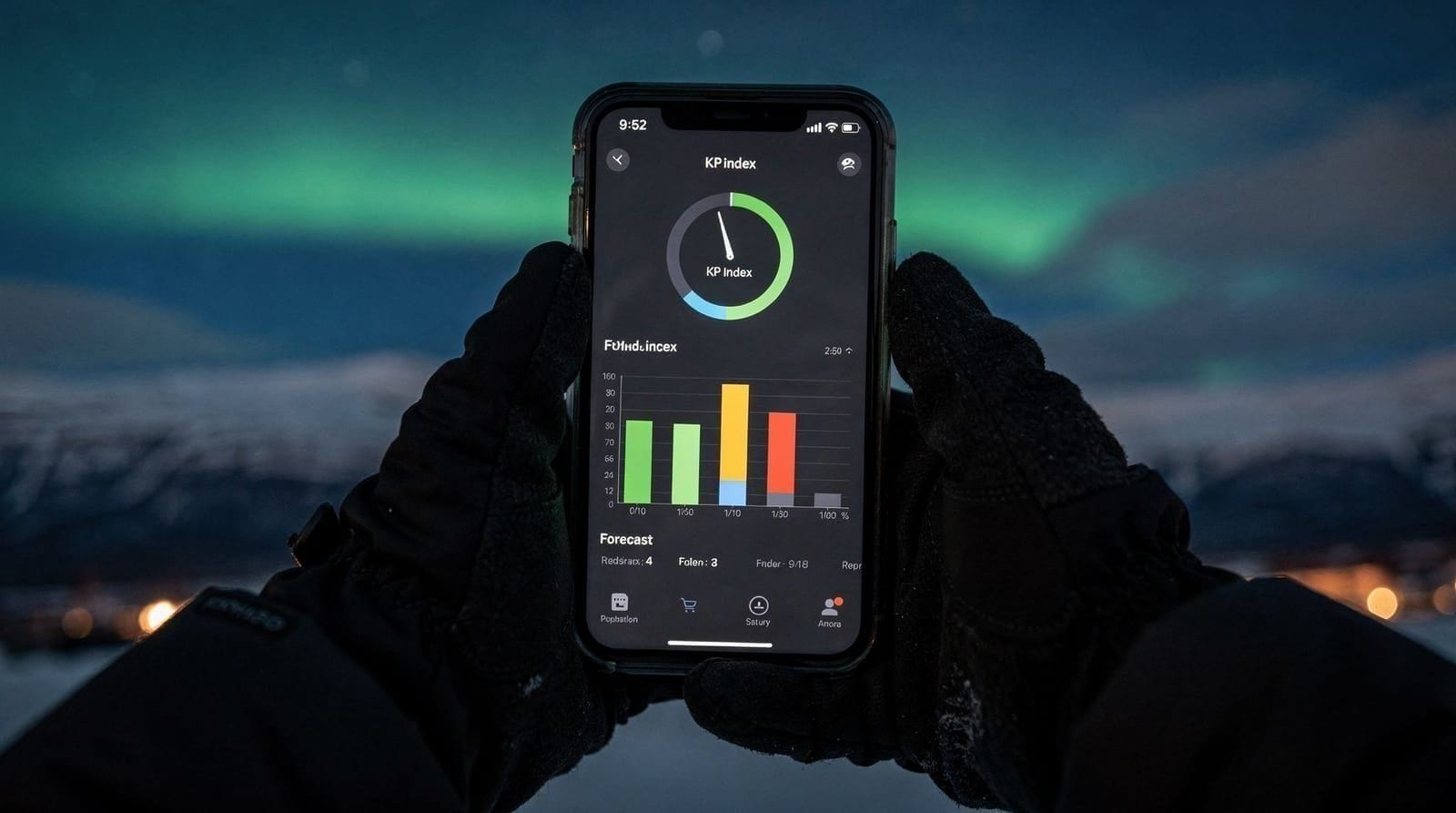
New aurora visitors often obsess over the KP index — understandably, since it’s the variable most talked about online. The dirty secret of Tromsø aurora hunting is that cloud cover kills significantly more aurora evenings than low solar activity.
The math: Tromsø, at latitude 69.6°N inside the auroral oval, has aurora visible at KP 1–2 on most clear nights during the season. At KP 3+, the display is reliably visible and dramatic. The KP is 3+ perhaps 20–30 nights per month during solar maximum. But Tromsø has roughly 14 clear or partly clear evenings per month in the best months — meaning cloud is the binding constraint more often than solar conditions.
This shifts the strategy entirely. Instead of waiting for a high-KP forecast, the most experienced aurora hunters in Tromsø spend their evenings watching cloud-cover maps and deciding where to position themselves.
The geography of cloud around Tromsø
Tromsø sits on a small island (Tromsøya) in a fjord, surrounded by fjords and mountains. This geography creates specific cloud patterns:
Coastal stratus (most common October–November): Low cloud originating from the Norwegian Sea covers the coast and lower fjord levels. The Lyngen, Tamok, and Finnish border areas may be entirely clear.
Fjord fog (common in winter during temperature inversions): Dense fog forms along the fjord surface when warm air sits above cold water. At 421 m elevation (Fjellheisen), you rise above this fog. Tamok, which is behind a mountain range, is usually fog-free.
High cloud (overcast entire region): When a low-pressure system covers the whole region, the only option is to drive far east — 150–200 km or more. These nights are a write-off if you stay in Tromsø.
Mountain cloud on peaks (common): Cloud sitting on the peaks while the fjord and valleys are clear. The aurora is visible from valley floor level; the mountains are obscured. This is actually good aurora weather.
Cloud-escape routes from Tromsø
Route 1: E8 east toward Skibotn and Tamok — primary route
Leave Tromsø heading east on E8. The road passes through Nordkjosbotn (~30 km) then continues toward Skibotn (~70 km). At Skibotn, turn south on Rv91 toward Tamokdalen (Tamok Valley, ~50 km from Tromsø total).
This route takes you behind the Lyngen/Balsfjord mountain ridge, which blocks the prevailing maritime cloud. Tamok Valley is where most professional Tromsø guides head first when the coastal forecast is poor.
Check on yr.no: Search “Tamokdalen” or “Skibotn” specifically. If the cloud layer drops to “clear” or “partly cloudy” while Tromsø shows “overcast,” this route works.
Route 2: Finnish border — deep cloud escape
Continue past Skibotn on E8 toward the Finnish border and Kilpisjärvi (Finland, ~200 km from Tromsø). This plateau region sits at 480 m altitude with a subarctic continental climate — significantly drier and clearer than the Norwegian coast.
On nights when even Tamok is cloudy, Kilpisjärvi is frequently clear. The round trip is ~400 km and requires 4+ hours driving, but for a major storm event (KP 5+) it is worth it.
Check: Enter “Kilpisjärvi” in yr.no or Google Weather. Compare with Tromsø and Tamok forecasts to see the gradient.
Route 3: Lyngen eastern shore — alternative inland
Take the E8 east and cross to the eastern side of the Lyngen peninsula (via Olderdalen ferry, if running) or drive all the way around via Skibotn. The eastern Lyngen shore faces inland and is often clearer than the fjord-facing western side. Lyngen Alps villages like Furuflaten offer dramatic mountain foregrounds with aurora.
Route 4: Sommarøy/Kvaløya — coastal but west-facing
Driving west to Sommarøy (~70 km, 1 hour) is the coastal alternative. This only helps when the cloud is coming from the east (less common) and the western coast is clear. In a typical Norwegian coastal low, Sommarøy is just as cloudy as Tromsø.
This is a poor cloud-escape route but an excellent destination on clear nights for the ocean-facing aurora backdrop.
Route comparison at a glance
| Route | Distance | Reliability | Best for |
|---|---|---|---|
| Tamok Valley | ~50 km | High for coastal stratus/fog | Standard evening, most common escape |
| Skibotn | ~70 km | High, similar to Tamok | Alternative if Tamok is busy or booked out |
| Kilpisjärvi (Finland) | ~200 km | Very high for major overcast | Deep cloud escape, KP 5+ storm nights |
| Lyngen eastern shore | Variable | Moderate, ferry-dependent | Scenic backup with mountain foregrounds |
| Sommarøy/Kvaløya | ~70 km | Low unless cloud comes from the east | Clear-night destination, not a cloud escape |
Forecast tools — how to compare locations
yr.no — local Norwegian forecasts
Go to yr.no and search specific locations:
- Tromsø — baseline
- Nordkjosbotn — 30 km east
- Skibotn — 70 km east
- Tamokdalen — 50 km east/southeast
- Kilpisjärvi (Finland) — 200 km east
Compare cloud icons for the 20:00–02:00 window. If Tamok shows clear or partly cloudy while Tromsø shows overcast, drive east.
Meteoblue cloud layer maps
Meteoblue.com provides cloud forecasts by altitude (low, mid, high cloud layers). This is crucial for understanding why it’s cloudy. Low cloud with clear high-altitude means fog — escapable by elevation or short inland drive. High cloud only means a different approach.
Select the “cloud” layer on Meteoblue’s multi-layer maps and drag the timestamp to your planned evening.
Windy.com — animated systems
Windy.com’s animated cloud and wind layers show weather systems arriving or departing in real-time. For seeing whether a pressure front is clearing away or building in, the animation is more intuitive than static forecast icons.
What professional guides do differently
The best Tromsø operators monitor 4–5 forecast tools simultaneously from the afternoon, make a driving plan, and update it in real-time as the evening progresses — often stopping mid-route to check updated forecasts and redirect.The key advantages that guides have over self-drive tourists:
- Local knowledge — they know which valleys clear first, which roads tend to have ice, and which spots have parking.
- Experience reading Norwegian forecasts — yr.no in Norwegian provides more data than the English version.
- Relationship with other guides — WhatsApp groups among guides share real-time sighting reports from locations across the region.
- Willingness to drive 4 hours — a guide whose livelihood depends on sightings will drive much further than a tourist in a rental car.
Self-drive cloud strategy
If you are self-driving for aurora, here is a practical evening workflow:
16:00: Check yr.no for Tromsø, Tamok, and Kilpisjärvi for the 20:00–24:00 window. Make a provisional plan.
18:00: Re-check the forecast. Conditions update frequently in Arctic weather. Identify your primary destination (usually Tamok if coastal cloud) and a backup (Finland border if regional overcast).
20:00: Before leaving, check Tromsø Geophysical Observatory all-sky camera (tgo.uit.no) to see current conditions directly above Tromsø.
Driving: Do not stop until you are under clear sky. A single cloud hole over a scenic spot is tempting but the aurora may disappear before it passes. Drive until the sky is consistently clear overhead, then stop and set up.
On the road: If you stop at Tamok and it’s still overcast, don’t wait. Continue driving east. Cloud systems often have a clear edge you can find by driving.
When to admit defeat
Some nights — particularly when a major low-pressure system covers all of northern Norway and the Finnish border — the cloud is too comprehensive to escape in a standard evening. These nights are a write-off unless you are willing to drive to Tromsø’s southern limit of practical day-return (~300 km each way).
Signs that you should call the night and stay in:
- All of Tromsø, Tamok, Skibotn, AND Kilpisjärvi showing overcast/rain/snow at yr.no
- Met.no showing a frontal system covering the whole region
- Rain or heavy snow in Tromsø — this means a comprehensive Atlantic low
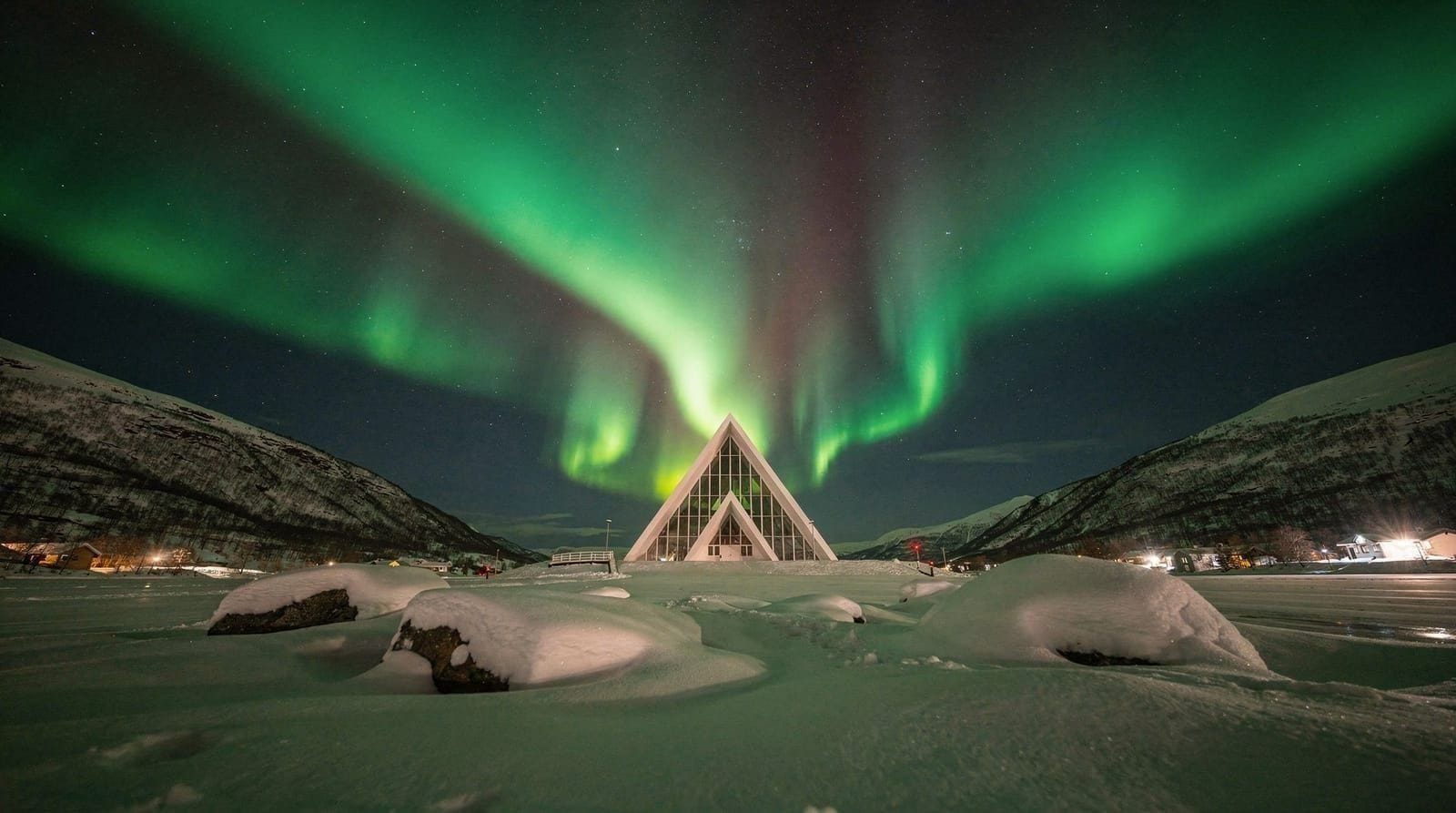
On these nights, pivot to indoor activities: Polaria aquarium, Arctic Cathedral, Ølhallen brewery, or early sleep to recover for tomorrow.
Choosing between self-drive and a guided cloud-chase
Self-driving saves money (roughly 830–1,200 NOK vs. 1,800–2,500 NOK for a small-group tour) but requires confidence on winter roads, fluency reading Norwegian forecast tools, and the discipline to keep driving rather than settle for a “good enough” partial clearing. The aurora tour overpricing guide breaks down what different tour price tiers actually deliver in terms of cloud-chasing flexibility, and the self-drive aurora guide covers the practical driving logistics in more depth than this cloud-focused guide does.
For a first Tromsø trip without local road experience, the guided option removes real risk — icy roads at night, unfamiliar route-finding in the dark, and misreading which forecast source to trust. Guides also carry the local knowledge of exactly which layby or pull-off works at each stage of the E8, which is not obvious from a map alone.
Combining cloud strategy with the KP forecast
Cloud strategy and KP forecasting are two halves of the same planning problem — a clear sky with no geomagnetic activity produces nothing, and a strong KP forecast under total cloud cover is equally useless. The aurora forecast and KP index guide explains how to read the solar side of the equation; use it alongside the cloud-escape routes here rather than checking one without the other. Evenings where both align — clear sky and KP 3+ — are the ones worth prioritising if you only have a few nights in Tromsø.
Frequently asked questions about aurora cloud strategy
Should I wait in Tromsø and hope the clouds clear?
Only if the forecast shows a short window of clearing (e.g., “partly cloudy 22:00–01:00”). If the forecast is persistently overcast, driving is more effective than waiting. Aurora windows are often short — waiting for a break you’re not sure will come is inefficient.
Is Tromsø’s weather always this cloudy?
October and November are the cloudiest months. February and March have the most clear, cold high-pressure periods. December and January are mixed. If you can be flexible with trip timing, late February and March combine good aurora activity (solar proximity to equinox) with better cloud probability.
What is a “clear sky” percentage and how much is enough?
Clear sky apps like Clear Outside rate transparency 0–100%. For aurora photography, you need at least 60–70% transparency overhead. Below 50% is marginal. The stars should be clearly visible as your personal clear-sky test — if you can easily see stars, aurora will be visible too.
Do inland locations have worse viewing in terms of aurora intensity?
No. The aurora is at 90–300 km altitude — the same aurora is overhead whether you’re on the coast or 200 km inland. Inland positions only differ in cloud probability and light pollution, both of which tend to improve inland.
Can I park safely on the E8 to watch aurora?
The E8 is a major road used by lorries at all hours. Never park on the road shoulder. Use proper laybys (off-road pull-offs), tourist viewpoints, or farm tracks with gates open. Tamok Valley has several proper parking areas near the camp facilities.
Is there mobile reception inland for checking forecasts?
Mobile coverage (Telenor and Telia networks) extends along the E8 toward Skibotn reliably. In deep valleys off the main road, coverage can be intermittent. Download the yr.no forecast for offline viewing before you leave Tromsø.
What percentage of aurora tours find clear skies?
Published statistics from operators are marketing materials, not audited data. Honest estimate: in December–January with cloud-escape strategy (driving 50–200 km), experienced operators find clear skies on approximately 65–75% of nights. Without cloud chasing (staying near Tromsø), this drops to perhaps 40–50%.
Is it worth paying more for a tour that drives further?
Almost always yes. The cost difference between a budget tour (1,200 NOK) that stays local and a premium tour (2,000 NOK) that crosses borders is 800 NOK — far less than the cost of an additional night in Tromsø if you miss the aurora.
Should I check the cloud forecast or the KP forecast first?
Check both, but cloud first if you’re deciding whether to go out at all. A strong KP forecast is irrelevant under total overcast, while even a modest KP 2–3 is visible on a genuinely clear night. See the aurora forecast and KP index guide for how to read the solar side alongside the cloud maps here.
Is it safer to book a guided tour instead of self-driving for cloud-chasing?
For visitors unfamiliar with winter roads or Norwegian-language forecast tools, yes. A guide combines local road knowledge with faster access to real-time sighting reports from other operators. The aurora tour overpricing guide explains which tour price tiers actually deliver meaningful cloud-chasing flexibility versus which just drive a fixed route.
Top experiences
Bookable activities with verified prices and instant confirmation on GetYourGuide.