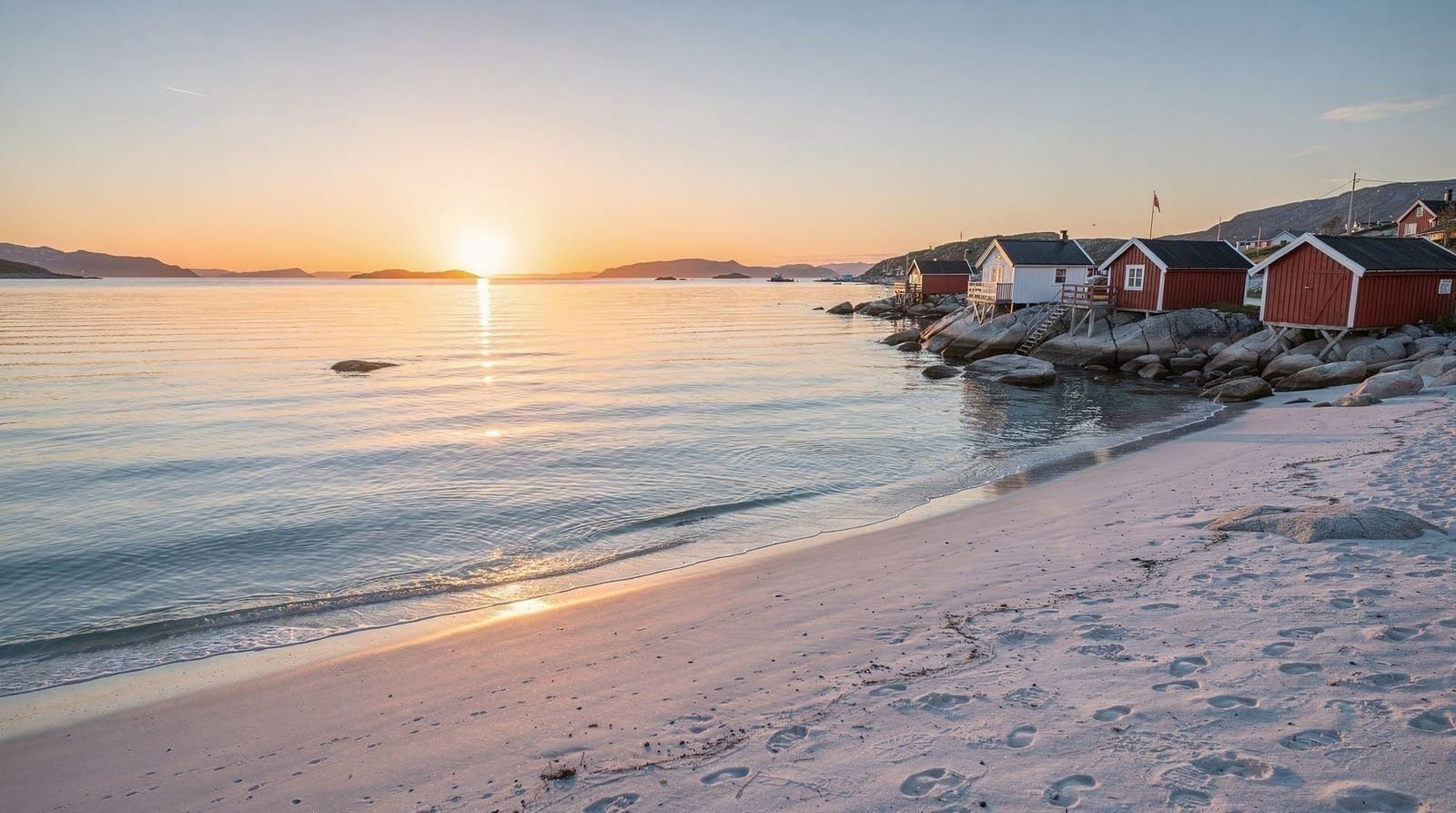
Tromsø — the Arctic capital of Norway
Honest guide to Tromsø, Norway's Arctic capital. Aurora, whale watching, dog sledding, midnight sun — real prices in NOK, no hype.
Tromsø: Northern Lights Chase with Local Guide & Free Photos
Quick facts
- Best time
- Nov–Jan (aurora + whales); Jun–Jul (midnight sun)
- Airport
- TOS — 4 km from city centre, bus 40/42 (48 NOK) or Flybuss (125 NOK)
- Drive time from Tromsø
- You are here
- Ideal length
- 4–7 days (covers city + 2-3 day trips)
Quick answer: Tromsø is a city of 78 000 people on an island in the Troms fjord, 350 km above the Arctic Circle. It is the main gateway to the Norwegian Arctic and the most accessible place in the world for northern lights tours, winter whale watching, dog sledding, and reindeer experiences. Most activities depart directly from the city centre. Flights connect Tromsø to Oslo in 2 hours, and dozens of direct European routes run in winter.
| Where | Tromsøya island, Troms fjord, 350 km north of the Arctic Circle |
| Cost | 15 000–22 000 NOK per person for a mid-range 5-night winter trip |
| Time needed | 4–7 days to cover the city plus 2–3 day trips |
| Getting there | Fly into TOS (Tromsø Airport), 4 km from the city centre |
| Best time | Nov–Jan for aurora and whales; Jun–Jul for midnight sun |
Getting to Tromsø and around
Tromsø Airport (TOS) sits 4 km from the city centre on Tromsøya island. The cheapest transfer is city bus 40 or 42 (48 NOK, roughly 4 EUR), which runs every 15–20 minutes and reaches the city in around 20 minutes. The Flybuss airport coach costs 125 NOK and drops off at major hotels. A taxi runs 200–280 NOK. A private airport transfer runs 350–500 NOK for 1–4 people — worth it with luggage in winter.
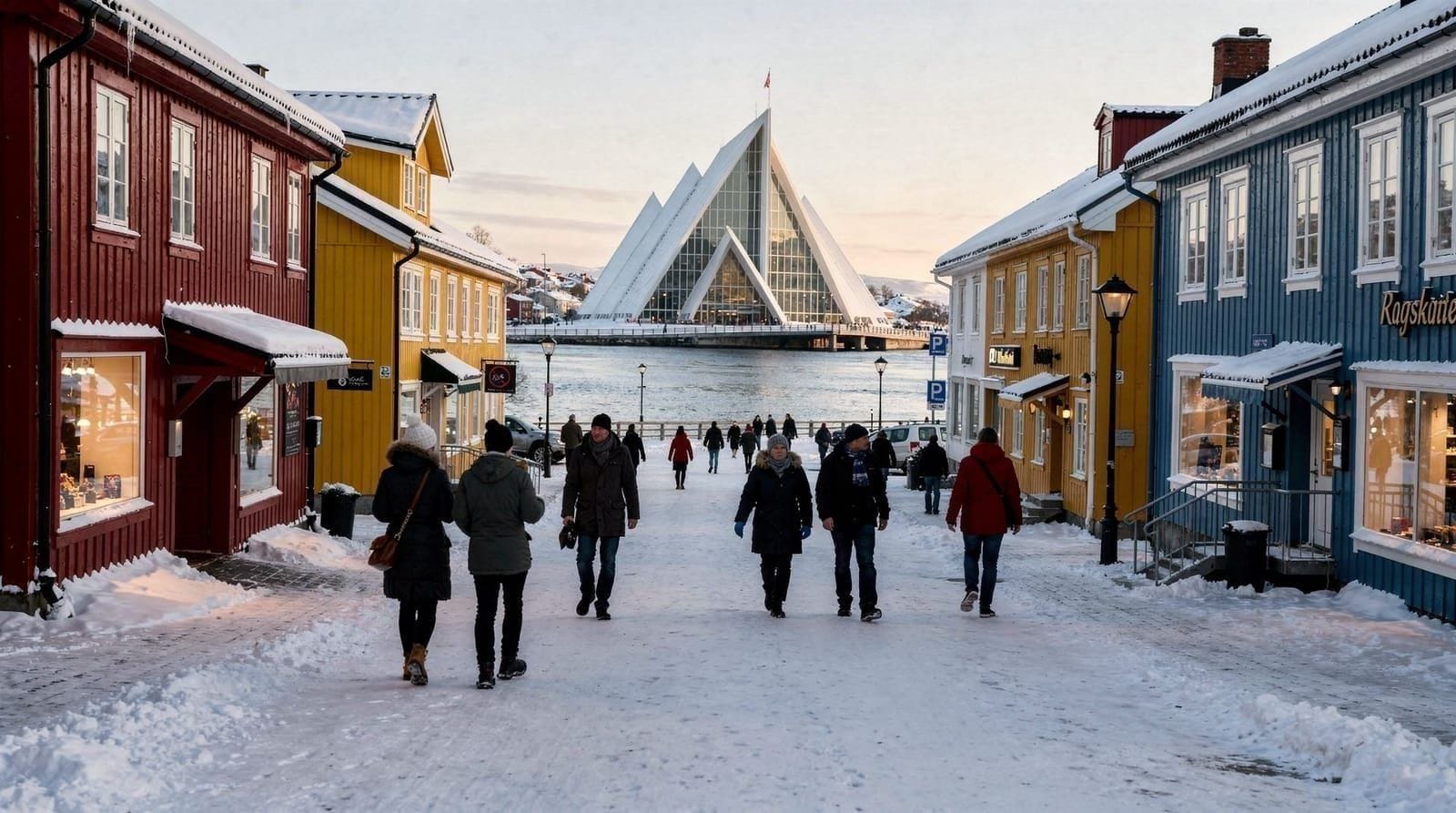
Within the city, most sights are walkable. The main drag, Storgata, and the key museums (Polaria, Polar Museum, Perspektivet) are all within 15 minutes on foot from the ferry terminal. The Fjellheisen cable car station in Tromsdalen is a 15-minute walk from the city centre across the Arctic Cathedral bridge, or a short taxi ride.
For day trips you need a car or an organised tour. Kvaløya is 20–30 minutes away. Sommarøy takes about 1 hour. Lyngen Alps is 1.5–2 hours. Senja is 2.5–3 hours. Car rental in winter requires a full licence and winter driving comfort — book early via a Norwegian company such as Hertz or Avis at TOS; plan for 800–1 200 NOK per day including mandatory winter tyres. Our car rental and winter driving guide covers what insurance to check and how Arctic roads differ from driving further south. For full airport-to-hotel details, see the Tromsø airport guide and airport transfer options.
Aurora chances by month
| Month | Darkness | Aurora chance | Notes |
|---|---|---|---|
| September | Partial night | Moderate | Shorter dark window, colourful autumn landscape |
| October | Growing | Good | Reliable dark hours begin |
| November–January | Polar night | Best | Sun stays below horizon; longest viewing window |
| February–March | Lengthening days | Very good | Still dark enough most evenings, often clearer skies |
| April | Short nights | Fading | Only early-month evenings are dark enough |
What to do in winter (October–April)
Winter is Tromsø’s high season. The polar night runs from 27 November to 15 January, when the sun does not rise at all — but the sky stays blue-grey for a couple of hours around noon, and clear nights make the aurora visible from inside the city.
Northern lights tours are the dominant product, with 20-plus operators. Most tours depart around 20:00 and return between midnight and 02:00, chasing clear skies by minibus, 4x4 or boat. Prices range from about 1 700 NOK (shared minibus, no photos included) to 2 500–3 500 NOK (small group 4x4 with a photographer guide). Boat tours, which keep you on the water away from road traffic, cost 1 500–2 200 NOK. The boat option is worth considering — you see reflections on the fjord, but you are exposed to cold.
Northern lights tour with free photos — one of the best-value small-group options departing nightly from the city centre.
Whale watching runs late October to early February, peaking November through January. Humpback whales and orcas follow the herring into Skjervøy fjord, 2.5 hours north of Tromsø. Most tours are full-day departures (11–13 hours return) costing 1 500–1 800 NOK, including transport. Tours based in Skjervøy itself are shorter and cost 900–1 200 NOK. The hybrid-electric boat option from Tromsø harbour is popular for reducing engine noise near the animals.
Whale watching by hybrid-electric boat — departs from Tromsø harbour, smaller group than the big catamarans.
Dog sledding runs December to April. Operators are based in Breivikeidet, Tamok Valley, and on Kvaløya. Prices: self-drive half-day 1 800–2 500 NOK; guided passenger sled 1 400–2 000 NOK. Camp Tamok offers the longest sled runs and the most dogs.
Self-drive husky dog sledding — you mush your own team of 4–6 dogs for 1–2 hours; guides ride ahead.
Reindeer and Sami experiences run year-round but are most atmospheric in winter. Half-day tours to a Sami camp include reindeer feeding, a traditional lavvo (tent), coffee, and often a short reindeer sled ride — budget 800–1 400 NOK. The Sami host families that run these tours are genuinely indigenous, not theatrical re-enactments.
Snowmobile safaris depart for the Lyngen Alps and Tamok Valley from January. Expect 1 500–2 800 NOK for a 2–4 hour safari; most tours include a warm meal in a wilderness tent.
What to do in summer (May–September)
The midnight sun shines from around 20 May to 22 July. The city switches from aurora tourism to hiking, kayaking, and midnight picnics. Prices drop sharply — accommodation is 30–40% cheaper than in winter peak, and the mountains are accessible without specialist gear.
Fjellheisen cable car (Storsteinen summit, 421 m) gives panoramic views of the city, fjord, and surrounding peaks. The gondola runs daily; a return ticket costs 270 NOK (adults). From the top, the hike to Tromsdalstinden (1 238 m) takes 4–5 hours round-trip and is one of the finest ridge walks in northern Norway.
Sea kayaking around Tromsøya and out to the islands of Kvaløya and Sommarøy is excellent May–September. Guided full-day trips cost 900–1 400 NOK, including gear and transport.
Midnight sun cruises on the fjord run every evening June–July. A luxury catamaran cruise costs around 900–1 200 NOK and lasts 2–3 hours. This is genuinely dramatic — the sun stays orange on the horizon at 01:00 and the mountains are perfectly reflected.
Hiking the local peaks is free. The trail up Fløya from Tromsdalen (adjacent to the Fjellheisen car park) takes 2.5 hours round-trip. Tromsdalstinden is a full-day commitment. For island trails, Kvaløya has some of the best summer ridge walks within 30 minutes of the city.
City sights and food
The Arctic Cathedral (Ishavskatedralen) is the most photographed building in Tromsø — the white aluminium triangles are visible from all over the city. Entry is 90 NOK; evening organ concerts run in summer.
Polaria — the Arctic experience centre on the harbour — has bearded seal pools, a panorama screen, and Arctic nature exhibits. Entry 195 NOK (adults), around 130 NOK (children). Worth 1.5–2 hours.
The Polar Museum (Polarmuseet) on the old wharf tells the story of the Svalbard trappers and Amundsen’s expeditions. Entry 120 NOK; budget 1.5 hours.
For food, Tromsø punches above its size. Emmas Drømmekjøkken on Kirkegata does excellent Arctic cuisine at around 350–500 NOK per main. Burgr on Strandtorget is the best burger in town at 180–220 NOK. Ølhallen, the oldest pub in Tromsø (1928), pours Mack beer from the local brewery directly below — a 0.5 L costs 90–110 NOK. Avoid the tourist-targeted seafood restaurants on Stortorget that charge 450–700 NOK for mediocre king crab without the story.
A craft beer at Arctandria or Smørtorget runs 85–120 NOK per pint. Coffee at Kaffebrenneriet or Risø costs 45–65 NOK.
Honest assessment: is Tromsø worth it?
Tromsø is expensive. A mid-range 5-night winter trip (flights from London, 3-star hotel, 2 aurora tours, 1 whale watching, 1 dog sled day, food) will cost 15 000–22 000 NOK per person (roughly 1 300–1 900 EUR). That is not cheap.
What you get for that: a functional Arctic city where most activities are professionally run, guides speak fluent English, and the infrastructure (heated transport, warm tour bases) is reliable. The aurora rate is genuinely high — Tromsø averages 80–100 visible aurora nights per year between September and April, with an additional incentive-type policy from most operators giving you a second chance if the sky is cloudy on your tour night.
What is overrated: the king crab safaris that charge 2 000–2 800 NOK to catch one crab and eat it on a boat. You can eat just as good king crab at Arctandria restaurant for 350 NOK. The overnight dog-sled experiences at 6 000–8 000 NOK are also priced for the fantasy, not the reality.
What is underrated: the city itself, the food scene, and the summer hiking. Most visitors treat Tromsø as a launchpad for tours, but the museums, the food, and the hikes up Fløya or Tromsdalstinden are genuinely world-class and cheap.
Planning your trip
Read our guide on how many days in Tromsø before booking. Budget: roughly 1 716 NOK per day at the budget end (hostel, grocery shopping, one free hike), 3 200 NOK mid-range (3-star hotel, one restaurant meal, one tour), 5 000+ NOK luxury.
For getting to Tromsø from Oslo: Norwegian and SAS fly every 1–2 hours, from around 600–900 NOK one way if booked 3–6 weeks ahead. Wideroe runs turboprops from regional Norwegian airports. Direct international routes in winter: London (Norwegian), Amsterdam, Frankfurt, Paris, Warsaw, Copenhagen, Stockholm, Helsinki.
Currency is NOK (Norwegian krone). Cards are accepted everywhere — cash is rarely needed. Tipping is not expected but rounding up is common. Norway is in Schengen.
See also: best time to visit Tromsø, where to stay in Tromsø, Tromsø packing guide.
Most visitors base themselves in or near the city centre — walkable to museums and restaurants, with tour pickups included from most hotels. Staying further out saves money but usually means relying on taxis or buses after dark for aurora pickups. If you need a sample day-by-day plan, our 4 days for aurora and 7-day Arctic itinerary both build in weather backup days, which matters more than any single tour choice.
Frequently asked questions about Tromsø
When is the best time to see the northern lights in Tromsø?
The aurora season runs September through April. The best months are November, December, and January — longest polar nights, statistically clearest skies, and the sun stays fully below the horizon around the clock in December and early January. September gives you a shorter window (it stays dark after midnight) but the landscape is more colourful and accommodation is 20–30% cheaper.
Do I need to book northern lights tours in advance?
Yes — in peak season (November–February) the best small-group 4x4 tours sell out 4–6 weeks ahead. Boat tours and large minibus tours usually have last-minute availability, but choice narrows. If you have a specific style preference (small group, photography focus, boat vs. bus), book before you arrive.
How much does a trip to Tromsø cost?
A realistic mid-range winter trip (5 nights, 3-star hotel, 2 major tours) costs 15 000–22 000 NOK per person including flights from Western Europe. The main costs are accommodation (1 200–2 500 NOK/night for a double) and organised tours (1 500–3 000 NOK each). Food is manageable if you mix one restaurant meal per day with grocery shopping (Rema 1000 and Coop are the cheapest supermarkets).
Is Tromsø safe to visit solo?
Very safe. Norway consistently ranks among the top 3 safest countries in the world. Solo travel — including solo women — is common and well catered for. The main practical concern is icy streets in winter; bring micro-spikes for your boots.
Can I see the midnight sun from the city centre?
Yes. On the longest days (around 21 June) the sun stays above the horizon for 69 consecutive days. From the city centre you can see it on any open horizon, but the best viewpoint is Storsteinen summit via the Fjellheisen cable car, or the ridge above Fløya. The midnight sun is not a tour — it is simply daylight, all the time.
Do I need a car in Tromsø?
Not for the city itself, which is walkable. You need a car (or a booked tour) to reach Kvaløya, Sommarøy, Lyngen Alps, or Senja. If you plan to self-drive aurora or want maximum flexibility, rent a car. Read our car rental guide first — winter driving in Norway requires specific preparation.
How many days do I need in Tromsø?
Three days covers the city plus one major tour (aurora or dog sledding). Five days lets you add whale watching or a day trip to Lyngen or Senja without rushing, and gives a spare night for cloud cover. Read our how many days in Tromsø guide for itinerary options by trip length.
Where should I stay in Tromsø?
The city centre is the easiest base — walkable to museums and restaurants, and most tour operators offer free hotel pickup from central addresses. Staying further out can be cheaper but usually means arranging your own transport to pickup points, which matters most for late-night aurora departures. The where to stay guide breaks down neighbourhoods and price bands.
Is Tromsø good in summer?
Genuinely excellent. The midnight sun, hiking, kayaking, and fjord cruises make summer a different but equally compelling visit. It is cheaper and less crowded than winter. The trade-off is no aurora and no snow activities. Summer (June–August) is the best time to combine Tromsø with a Senja road trip or a Lyngen hiking week.
Top experiences
Bookable activities with verified prices and instant confirmation on GetYourGuide.

Tromsø: Northern Lights Chase with Local Guide & Free Photos

Tromsø: Whale Watching Tour by Hybrid-Electric Boat

Tromsø: Self-Drive Husky Dog Sledding Adventure

Tromsø: Reindeer Sledding & Feeding with a Sami Guide

Tromsø: Arctic Fjord Cruise with Stop on Land at Fish Racks