Silent electric fjord cruise near Tromsø — what to expect
Tromsø: Arctic Fjord Cruise with Stop on Land at Fish Racks
What is a silent electric fjord cruise near Tromsø?
An electric or hybrid-electric catamaran tour on the fjords surrounding Tromsø, typically 2–3 hours. The silent propulsion means you can hear bird calls, water, and sometimes seals on rocks without engine noise. Available year-round but especially appealing in summer midnight sun and winter northern lights season.
The quiet difference: On a diesel boat, you hear the engine. On an electric catamaran, you hear the water, the birds, and your own breathing. This is not a small thing — the Arctic fjord soundscape is extraordinary and almost inaudible on conventional tour boats. Electric cruises are not longer, more expensive, or more adventurous. They are simply calmer.
| Where | Departs Tromsø harbour, fjords around Tromsøya and Kvaløya |
| Duration | Around 2–3 hours (half-day for Sommarøy extensions) |
| Cost | Roughly 900–2,000 NOK per person depending on route and catering |
| Best time | Year-round; summer for midnight sun, winter for aurora-evening cruises |
| Booking | 2–4 weeks ahead in peak summer and winter; more flexible spring/autumn |
Why silence matters on a fjord cruise
The fjords around Tromsø are ecologically rich. Sea eagles — Europe’s largest bird of prey — hunt along the shoreline. Harbour porpoise surface between fishing buoys. Eider ducks raft in great numbers on protected coves. The mountains reflect in water that, on a calm day, is the colour of pewter.
Almost none of this is experienced properly from a diesel-powered boat, because the constant mechanical noise — felt through the deck, heard below, rumbling across the water — drowns out everything subtle. The sea eagle lifts from a rock 50 metres away and you do not hear its wingbeats. The porpoise surfaces and you miss the exhalation.
Electric cruises change this. The approach to wildlife happens at low speed with no engine noise. Animals react differently — sea eagles hold their ground longer, porpoise surface closer. The guide does not need to shout over a diesel rumble. You notice things you would otherwise miss.
Silent electric catamaran fjord cruise — book hereWhat you see on a typical route
Most electric fjord cruises from Tromsø take one of three routes:
Tromsøysundet and Balsfjord: The channel between Tromsøya (the island the city sits on) and the mainland, then south into Balsfjorden. Dramatic mountain scenery, traditional fish racks (characteristic wooden frames used to air-dry cod), fishing communities, and the occasional sea eagle hunting along the shore. Classic Arctic Norway.
Kvaløya coast: West from Tromsø harbour along the southern coast of Kvaløya. More open water, exposed headlands, sea-bird colonies, and the satisfaction of watching the Tromsø skyline with the Arctic Cathedral recede behind you. On clear days the Lyngen Alps are visible across the sound.
Island circuit: A shorter loop around the islands close to Tromsø harbour, including the traditional fishing and agricultural communities that predate the modern city. Good introduction for visitors with limited time.
The specific route depends on the operator and season. Ask before booking if you have a preference for the type of scenery.
Comparing electric and diesel fjord cruises
| Aspect | Electric/hybrid | Diesel |
|---|---|---|
| Engine noise on water | Inaudible or very low | Constant background rumble |
| Wildlife behaviour | Calmer, slower to flush | More likely to flee |
| Fuel smell | None | Occasional diesel exhaust |
| Vibration on deck | Negligible | Low to medium |
| Speed | Moderate (12–18 knots) | Moderate to fast |
| Passenger capacity | 30–80 | Varies widely |
| Local air quality | Zero emissions | NOx and PM emissions |
The practical passenger experience difference is real but not dramatic. You are not going to hate a diesel fjord cruise. But if electric is available at comparable price, it is a better choice by most measures.
Seasons and what changes across the year
Winter (November–February): Polar night or short twilight. The fjord in deep winter is a landscape of dark water, ice-edged shores, and blue-black sky. Wildlife is quieter but still present — sea eagles hunt year-round. The main draw is the dramatic atmosphere, and evening cruises are popular for northern lights viewing. See polar fjord cruise in winter for the specific winter experience.
Spring (March–May): Light returns rapidly. By March there are 12+ hours of daylight and sea eagles are nesting. Migratory birds begin arriving. Snow lingers on the mountains. One of the best times for fjord cruising — calm seas, good light, increasing wildlife activity.
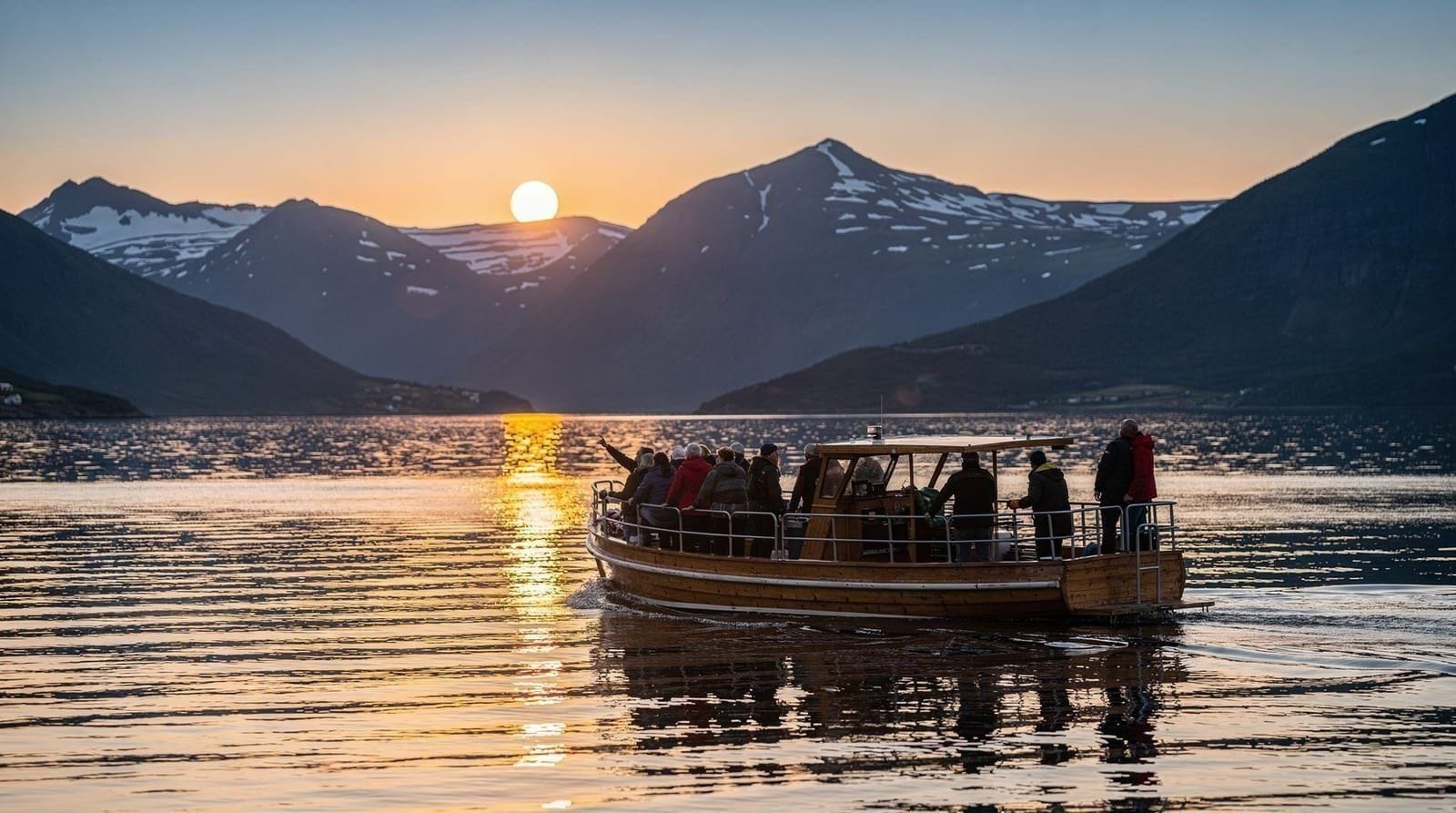
Summer (June–August): Midnight sun (20 May–22 July) is the centrepiece. The fjord at 02:00 with the sun above the horizon and the mountains lit gold is genuinely strange and beautiful. See midnight sun fjord cruise for dedicated guidance. Wildlife is abundant: puffins, Arctic terns, harbour seals.
Autumn (September–October): Whales begin appearing in the fjords (early October). Sea conditions can be rougher. Colours on the hillsides are vivid — Arctic autumn foliage is brief but striking. Northern lights season begins in September.
2-hour island cruise with snacks — afternoon departureWhat is included and what to bring
Most standard electric fjord cruises include:
- The boat trip itself
- Life jacket
- Basic snacks or drinks (varies widely — check per operator)
- Guide commentary in English and Norwegian
Not typically included:
- Transfer to/from your hotel (departure is usually from Tromsø harbour)
- Drysuits or thermal gear (on catamarans you are in a heated cabin; bring your own warm clothes for time on deck)
- Meals (unless specifically marketed as a dining cruise)
- Binoculars (bring your own)
What to bring: Warm layers, waterproof outer jacket for time on deck, binoculars, camera (telephoto helps for sea eagle shots from distance). See what to bring whale watching — the packing advice applies equally here.
The honest trade-off
Electric fjord cruises are not more adventurous than diesel ones. They are not dramatically more expensive. They are not faster or packed with exclusive wildlife guarantees.
What they offer is a more attentive experience — a cruise that gets out of the way of the environment it is taking you to see. For many travellers, this is exactly the right approach to Arctic tourism.
If you are also interested in the active/adventure end of fjord tourism, look at the king crab safari, which combines fjord cruising with hands-on fishing and cooking.
Ersfjord as a quieter alternative
If the standard harbour-departure cruises feel too popular for your taste, Ersfjord on Kvaløya offers a different angle on the same silent-water appeal — dramatic mountain walls dropping straight into the fjord, with far fewer boats. It works well as a self-drive add-on rather than a cruise itself; see the Ersfjord day trip guide for how to combine it with a morning or afternoon electric cruise from Tromsø.
Electric cruise or electric whale boat?
If wildlife is your main draw rather than fjord scenery, an electric whale-watching boat is a different product worth comparing before you book. Whale season runs October to mid-January in the Skjervøy area, well north of the standard fjord-cruise routes, so the two are not interchangeable — but both share the same low-noise, low-impact philosophy. Our silent electric whale boats guide covers the whale-specific version, and what to expect on a fjord cruise has the practical rundown of what a first-timer should anticipate on board.
Frequently asked questions about silent electric fjord cruises near Tromsø
Is a fjord cruise worth it if the weather is overcast?
Yes. The landscape features — mountains, coastline, fish racks, island communities — are visible regardless of cloud cover. Wildlife behaviour is sometimes better on overcast days (less intense light, calmer seas). Only the northern lights element specifically requires clear skies.
How far do electric fjord cruises go from Tromsø?
Most stay within 30–60 km of the harbour. The battery range of current hybrid-electric vessels is 60–150 km in electric mode, which is sufficient for the fjords immediately surrounding Tromsøya and Kvaløya.
Are there electric fjord cruises that go to Sommarøy?
Sommarøy is approximately 35 km west of Tromsø by road, but accessible by water. Some operators offer guided boat tours to Sommarøy including fjord scenery en route. This is different from the standard short fjord cruise — it is a half-day to full-day excursion.
Do I need to book in advance?
For peak summer (midnight sun, June–July) and peak winter (northern lights, November–January) periods, yes — 2–4 weeks ahead minimum. Spring and autumn have more availability. Walk-up booking at the harbour is occasionally possible but is not reliable.
Can I combine a fjord cruise with a whale watching trip?
Not on the same short-tour vessel — whale watching goes much further north (toward Skjervøy) than standard fjord cruises. However, some operators offer extended full-day expeditions that combine fjord sightseeing with whale watching in different parts of the day. See whale watching season Tromsø for context.
Are there electric fjord cruises that serve food?
Yes. Some premium tours are specifically marketed as dining cruises — a 3-course dinner served while the catamaran navigates the fjord. The aurora dinner cruise catamaran is the most common version of this. Price is higher (1,500–2,000 NOK including food) but the combined experience is distinctive.
Top experiences
Bookable activities with verified prices and instant confirmation on GetYourGuide.