Sami culture near Tromsø — what to know before you visit
Tromsø: Reindeer Camp and Sami Cultural Tour with Lunch
What should I know about Sami culture before visiting near Tromsø?
The Sami are the indigenous people of Arctic Scandinavia, with a living culture, language, and reindeer herding traditions. Ethical cultural tourism means interacting with Sami-led experiences, asking respectful questions, and understanding that you are visiting someone's living heritage — not a historical exhibition.
The most important thing: The Sami are a living, contemporary people — not a historical group preserved for tourist observation. The best Sami cultural experiences near Tromsø are those run by Sami people themselves, who can speak to both tradition and modernity. Come with curiosity and respect, not with a checklist.
| Where | Tromsø city, Tamok Valley, Malangen — reachable by transfer or self-drive |
| Cost | Cultural tours from around 1,500–2,800 NOK per person |
| Time needed | Half a day for a guided cultural experience |
| Getting there | Transfer usually included with organised tours |
| Best time | Year-round; early February for Sami National Day events |
Who the Sami are
The Sami (the name they call themselves; avoid the older term “Lapps”) are the indigenous people of Sápmi — a vast territory that does not follow national borders. It covers northern Norway, the northern portions of Sweden and Finland, and Russia’s Kola Peninsula.
In Norway, Sami people live across a wide geographic range but with the largest concentrations in Finnmark (particularly Kautokeino and Karasjok) and significant communities in Tromsø, Bodø, and as far south as Hedmark. The Sami population in Norway is estimated at 40,000–50,000, though precise numbers depend on how one defines Sami identity — which is itself complex.
Sami culture encompasses distinct languages (a family of Finno-Ugric languages unrelated to Norwegian), traditional clothing (gákti), vocal music (joik), material culture adapted for Arctic conditions, and traditional ecological knowledge accumulated over thousands of years in the Arctic environment.
Reindeer herding is the cultural practice most associated with the Sami in popular imagination, and it remains genuinely central to Sami identity — about 10% of Norwegian Sami are active reindeer herders, though the cultural significance of reindeer extends far beyond those who herd them professionally.
History: what every visitor should understand
The history of the Sami in Norway is not only one of ancient continuity but of relatively recent oppression. Norwegian state policy from roughly the mid-1800s to the mid-20th century actively sought to assimilate Sami people into Norwegian culture — a process called Norwegianisation (fornorskning).
This included:
- Prohibition of Sami language use in schools (Sami children were punished for speaking their own language)
- Norwegian-only instruction in boarding schools (internatskoler) that removed children from their families
- Restrictions on property ownership by Sami people
- Active discouragement of traditional clothing and cultural practice
The consequences of Norwegianisation are still felt. Many Sami families lost fluency in their language within a generation or two. Cultural transmission was disrupted in ways that are difficult to reverse.
Norwegian government policy shifted significantly from the 1970s onward. The establishment of the Sami Parliament (Sámediggi) in 1989 and Norway’s ratification of ILO Convention 169 in 1990 represent formal recognition of Sami rights. Language revitalisation programmes, Sami-medium schools, and legal protection of herding rights have been implemented. But the legacy of suppression shapes every conversation about contemporary Sami identity.
Knowing this history makes you a better visitor. It explains why some Sami people are ambivalent about tourism involving their culture. It explains why Sami-owned-and-led experiences are important to seek out. And it provides context for what you are seeing when you encounter a Sami cultural experience near Tromsø.
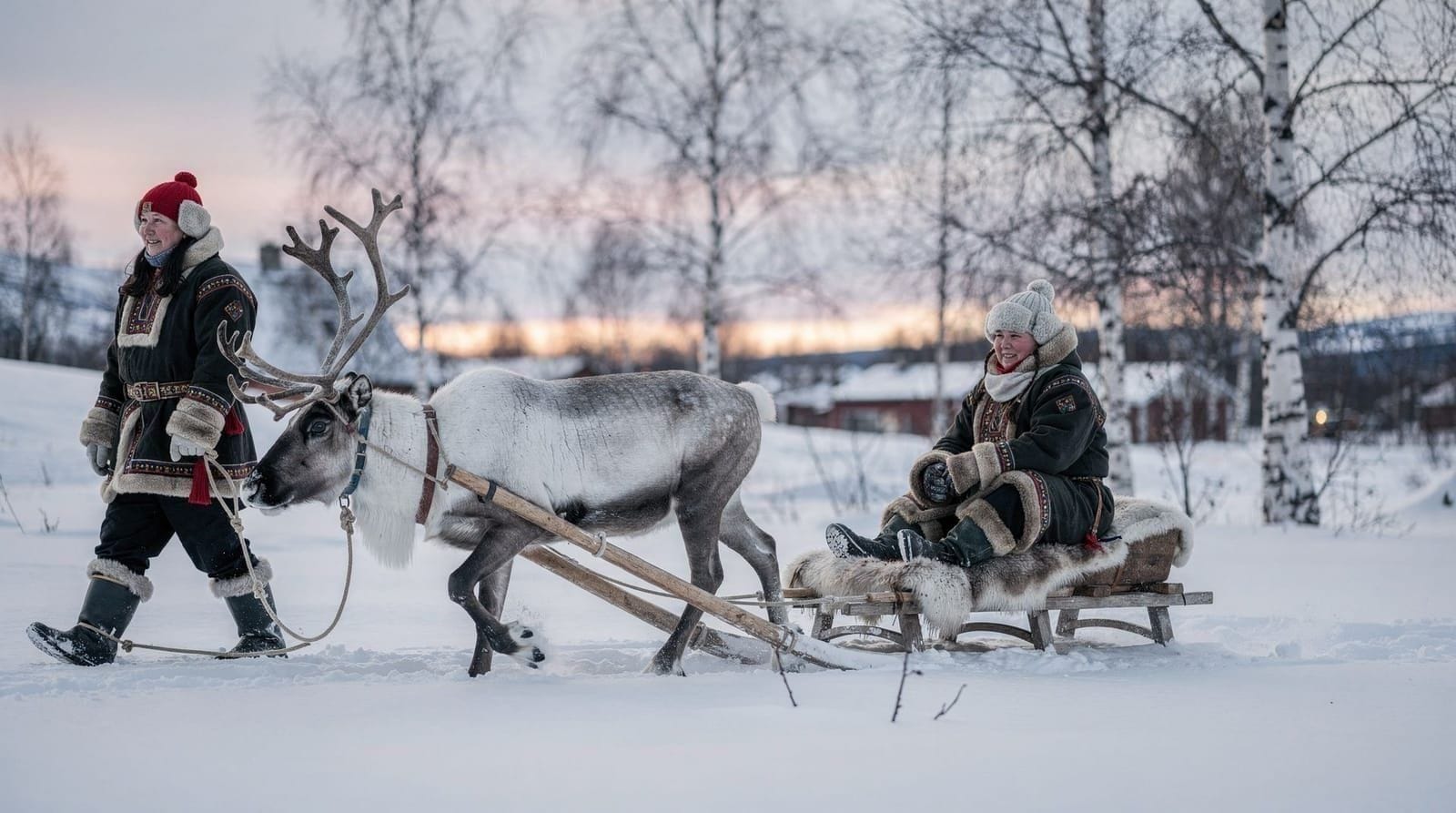
Sami reindeer camp with cultural lunch — Sami-guided experienceContemporary Sami life near Tromsø
Tromsø is one of Norway’s largest Sami centres. Many Sami people live in the city as doctors, teachers, artists, politicians, and professionals of every kind. The image of the Sami as exclusively rural, traditional nomads is outdated.
At the same time, traditional practices — particularly reindeer herding — remain economically and culturally vital. Herding families near Tromsø use the surrounding mountains and fjord-adjacent lowlands as winter and spring pasture. You may see reindeer on the main roads approaching Tromsø in winter — this is not accidental or decorative; it is working herding practice.
The Sami cultural landscape near Tromsø includes:
- Tamok Valley (Tamokdalen), an important winter reindeer pasture area where several tourism operations have been established
- The Malangen area, with reindeer operations offering tourism experiences
- Tromsø city itself, where Sami cultural institutions, artists, and associations operate
Sami tourism: the range of what exists
The word “Sami experience” covers an enormous range, from deeply substantive cultural encounters to superficial staged performances. Understanding what you might encounter:
Substantive experiences (what to seek):
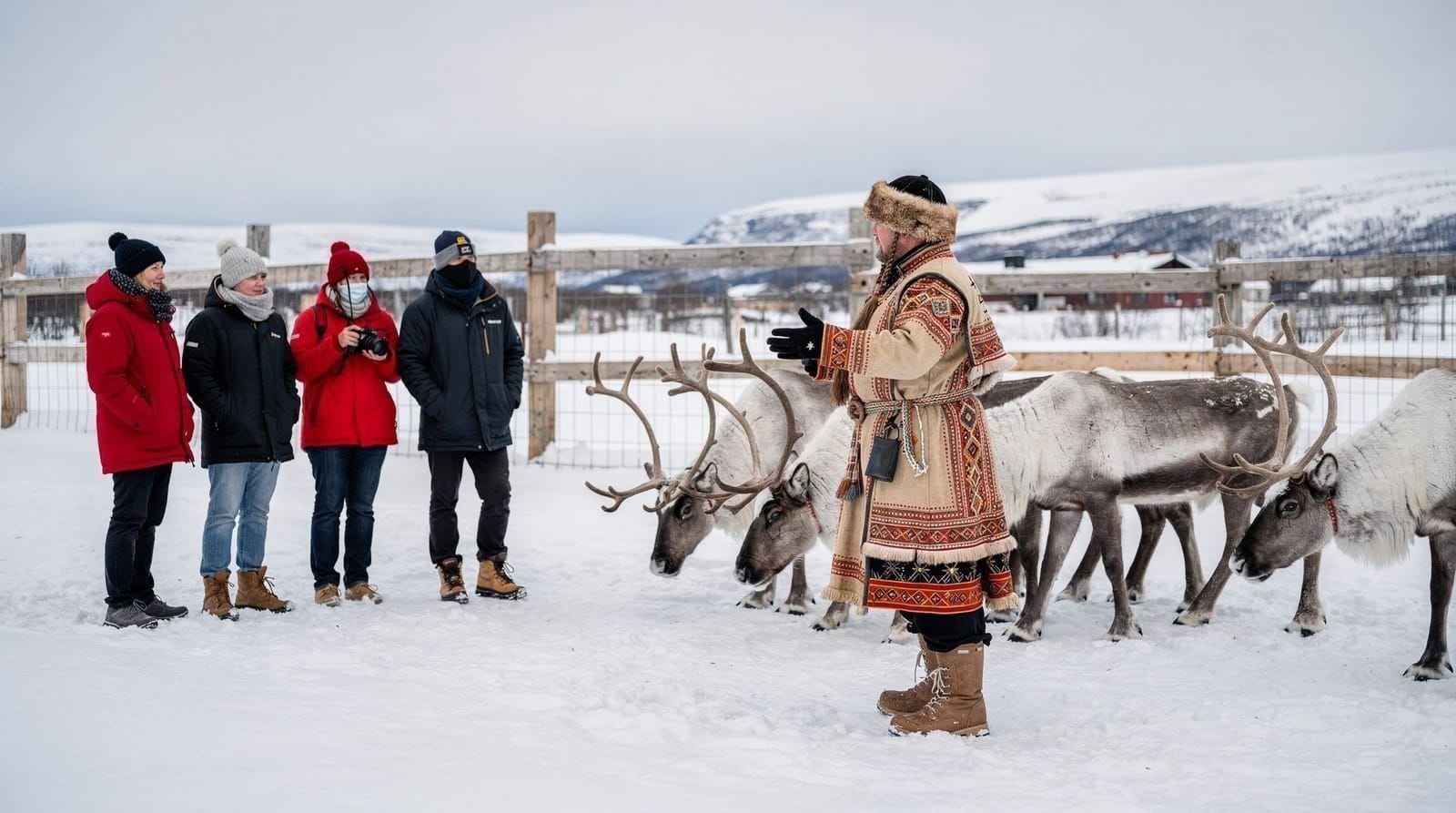
- Reindeer herding visits where you learn about the actual practice, the animals’ role in the family economy, and the challenges of contemporary herding (predator conflicts, climate change, land-use pressures from industry and recreation)
- Joik performances by actual Sami musicians, with context about the music’s meaning
- Sami food traditions — explained in terms of the cultural significance of specific dishes and preparation methods, not just served as novelty
- Conversations with Sami guides who can speak to what their identity means today, including the tensions and contradictions of contemporary indigenous life
Surface experiences (less valuable):
- Photo opportunities with reindeer and gákti-dressed guides without cultural substance
- Generic “Arctic camp” environments that use visual Sami signifiers without Sami content
- Experiences marketed as “authentic” or “traditional” without specifying whether they are actually Sami-led
See Sami tourism ethics for a full guide to evaluating operators.
Practical cultural courtesy
A few things that matter in practice:
Ask before photographing. Ask permission before photographing Sami people in traditional clothing. The answer will usually be yes — but asking demonstrates respect.
Do not touch traditional clothing or objects without invitation. Gákti is often a family heirloom with deep personal meaning.
Take joik seriously. If you attend a joik performance, it is not background music. It deserves attention.
Questions are welcome. Most Sami guides in tourism contexts appreciate genuine curiosity, including about sensitive topics like Norwegianisation and contemporary identity. “I read about the boarding school history — can you tell me more from your family’s perspective?” is a respectful way to open that conversation.
Do not conflate Sami with other indigenous cultures. Sami culture, history, and contemporary situation are specific to Sápmi. Comparisons to North American indigenous peoples are sometimes made but should be careful — the contexts differ significantly.
Sami cultural tour with reindeer sleddingA few Northern Sami words worth knowing
You do not need to learn the language to visit respectfully, but a handful of terms come up repeatedly in cultural experiences and are worth recognising rather than treating as unfamiliar noise:
| Term | Meaning |
|---|---|
| Sápmi | The traditional Sami territory spanning northern Norway, Sweden, Finland and Russia’s Kola Peninsula |
| Gákti | Traditional Sami clothing, often a family heirloom with regional-specific design |
| Joik | Traditional Sami vocal music, a distinct form rather than a “song about” something |
| Lavvo | The traditional tent used at reindeer camps and cultural experiences |
| Duodji | Sami traditional craft and handicraft, including antler and hide work |
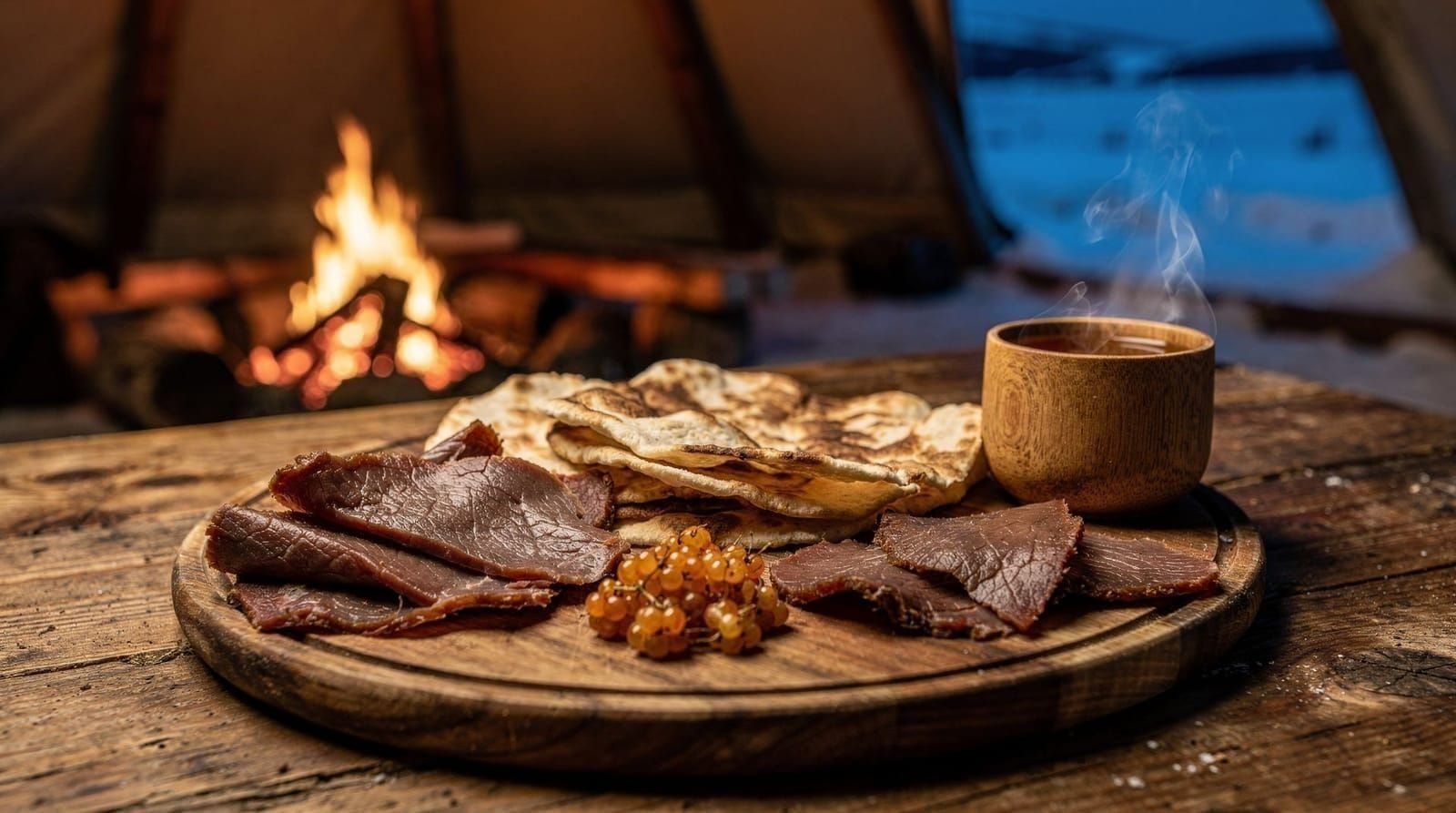
| Bidos | A traditional reindeer stew, commonly served at cultural lunches |
Using these terms correctly (and asking a guide to confirm pronunciation) is a small but genuine sign of respect that Sami guides notice.
What to see and do in relation to Sami culture near Tromsø
Reindeer experiences: Multiple operators in the Tromsø area offer reindeer visits, feeding, and sledding. See reindeer sledding in Tromsø and reindeer feeding experience.
Sami food: Several Tromsø restaurants serve traditional Sami ingredients (reindeer, bidos stew, cloudberries, siida bread). See Sami food in Tromsø.
Polar Museum: The Polaria aquarium does not focus on Sami culture, but the Polar Museum (Polarmuseet) near Tromsø harbour has permanent exhibits on indigenous Arctic life including Sami history.
Sami Week (Sámedábálvvohit): The week around 6 February (Sami National Day) sees cultural events in Tromsø including joik performances, markets, and public celebrations. Worth timing your visit if possible.
Frequently asked questions about Sami culture near Tromsø
Is it appropriate to ask a Sami person about their culture?
Yes, in most contexts. Sami people in tourist-facing roles are generally willing to discuss their culture and history. Outside of tourism contexts — encountering a Sami person in a café or shop — treat it like any other cultural encounter: brief conversation is fine, extended interrogation is not.
Why is it wrong to call them “Lapps”?
“Lapp” was an external name applied to the Sami by outsiders (from a Scandinavian word possibly meaning “patch” or “nomad”), used historically in a derogatory context during the Norwegianisation period. The Sami prefer to be called Sami (or Saami). The territory is Sápmi, not “Lapland” (though “Lapland” is still used in tourism marketing, which many Sami find problematic).
Is reindeer herding cruel to the animals?
This is sometimes asked by visitors. Reindeer in herding systems live semi-wild lives across large open landscapes and are not confined in stalls. Slaughter practices are governed by Norwegian animal welfare law. Compared to conventional livestock farming, reindeer herding is widely considered lower-impact in terms of animal welfare. The main welfare debates concern predator management (wolves and wolverines) rather than herding practice itself.
Are there Sami people in Tromsø city itself?
Yes, a significant number. Tromsø has a Sami cultural centre, Sami language instruction in several schools, and active Sami political and artistic communities. The Sami presence in Tromsø is urban and professional, not only rural and traditional.
What is the difference between Northern, Southern, and other Sami groups?
The Sami are not a single homogeneous group — there are approximately 10 distinct Sami languages and significant regional cultural differences. The Sami near Tromsø are primarily Northern Sami speakers, culturally and linguistically distinct from, for example, the Southern Sami of central Norway/Sweden. Each group has its own dialect, gákti design, and specific cultural traditions.
Can I visit a reindeer herding family independently?
Not typically — reindeer herding is a working livelihood, not a visitor attraction in its natural form. The appropriate way to engage with herding culture is through properly organised Sami-led tourism experiences. Some Sami families do offer direct visits on their own terms; enquire through the Tromsø tourist information centre about genuinely family-led options beyond the organised operators.
How do I tell if a tour is genuinely Sami-led?
Ask directly whether the operator and guides are Sami, and whether the lavvo portion includes substantive cultural content or is mostly food and photos. Genuinely Sami-led tours tend to volunteer this information unprompted. See Sami tourism ethics for the full checklist of what to look for and what to avoid.
Is one day enough to get a meaningful sense of Sami culture?
A single well-chosen, Sami-led experience — a reindeer camp visit with a real cultural lavvo conversation, for instance — can be genuinely meaningful in an afternoon. It will not replace deeper engagement, but it is far more substantive than a rushed photo-stop, and most Tromsø visitors only have that much time to give it.
Top experiences
Bookable activities with verified prices and instant confirmation on GetYourGuide.