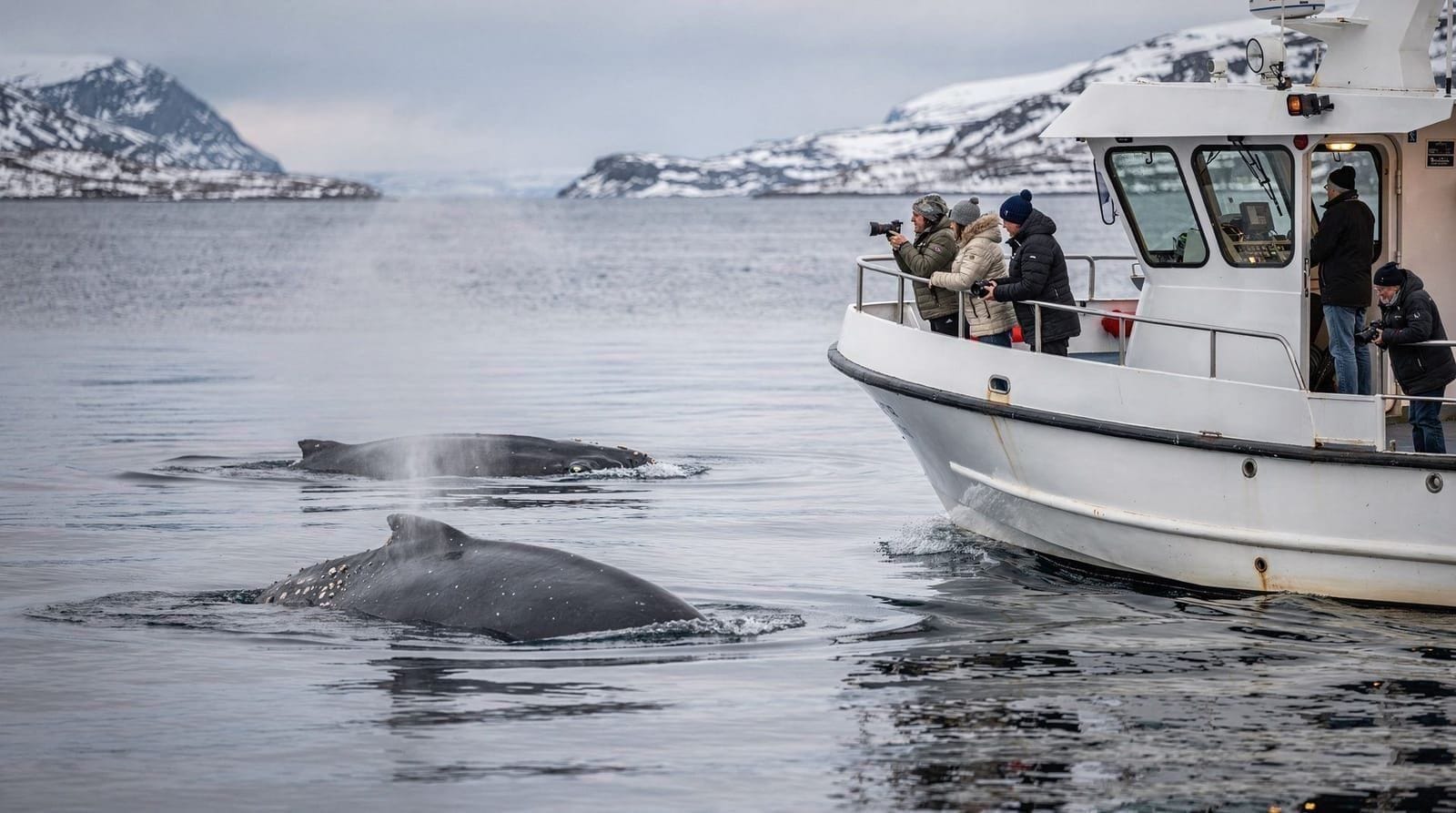
Whale watching and seasickness near Tromsø — honest advice
Tromsø: Orca and Whale Watching Heated Boat Trip
How likely am I to get seasick on a whale watching tour near Tromsø?
On a large enclosed catamaran in typical November–December conditions, seasickness is unlikely for most people. On a RIB in rougher weather, it is a real possibility. The medication that works best must be taken the night before. If you know you are prone to motion sickness, choose the largest available vessel.
Rule #1: Take medication the night before, not on the morning of the trip. Take it in the morning if it is a morning departure. The key is advance dosing — medication taken when you are already nauseous does almost nothing. Choose the largest available boat if you have any doubt.
| Best vessel if prone | Large hybrid-electric catamaran, enclosed cabin |
| Medication timing | Night before (or 30–60 min before if OTC) |
| Where to buy meds | Apotek pharmacies, Storgata or bus station |
| Worst conditions | Open RIB in Beaufort 4+ |
| If it happens | Most people recover fully within 20–30 minutes |
The honest picture of seasickness risk on Arctic whale tours
Seasickness on whale watching tours near Tromsø is not universal, but it is common enough that it should be a genuine planning consideration — not an afterthought.
The risk factors are:
- Vessel type: Small RIBs have a pitching, rolling motion that affects most passengers to some degree on any real sea state. Large catamarans with enclosed cabins are significantly more stable.
- Sea conditions: November–December is typically calmer than October or late January in Kvænangen, but no Arctic fjord is flat calm every day. Expect occasional chop.
- Individual susceptibility: Some people never get seasick; others are affected on flat-calm harbour trips. Know your baseline from previous water experiences.
- What you did the night before: Alcohol and rich food the previous evening, combined with an early departure, are a classic recipe for a miserable trip.
The good news: most people on large catamaran tours in reasonable conditions feel fine. The bad news: “fine on ferries” does not always mean “fine on a RIB in Beaufort 4.”
Choosing the right vessel
If you are remotely uncertain about your seasickness tolerance, your single most effective intervention is to choose the right boat type.
Best for seasickness-prone passengers:
- Large hybrid-electric catamaran with enclosed heated cabin
- Traditional wooden boat (MS Gabriele, MS Keiser Wilhelm style) — slower, gentler motion
- Any vessel described as having an enclosed cabin and stabilisers
Avoid:
- Open RIBs (even with drysuits — the motion is significant)
- Small inflatable boats
- Any tour that requires you to be on deck in all weather
The silent electric whale boats guide covers the hybrid and electric vessel options in more detail — these are also often larger and more stable than older diesel RIBs.
Vessel stability compared
| Vessel type | Motion | Best for seasickness-prone |
|---|---|---|
| Large hybrid-electric catamaran | Minimal pitch/roll, stabilised | Yes — top choice |
| Traditional wooden boat (MS Gabriele, MS Keiser Wilhelm) | Slower, gentler | Yes — good alternative |
| Open RIB | Significant pitch and spray | No — avoid if uncertain |
For a full breakdown of which specific operators run which vessel types, see best whale watching operators in Tromsø.
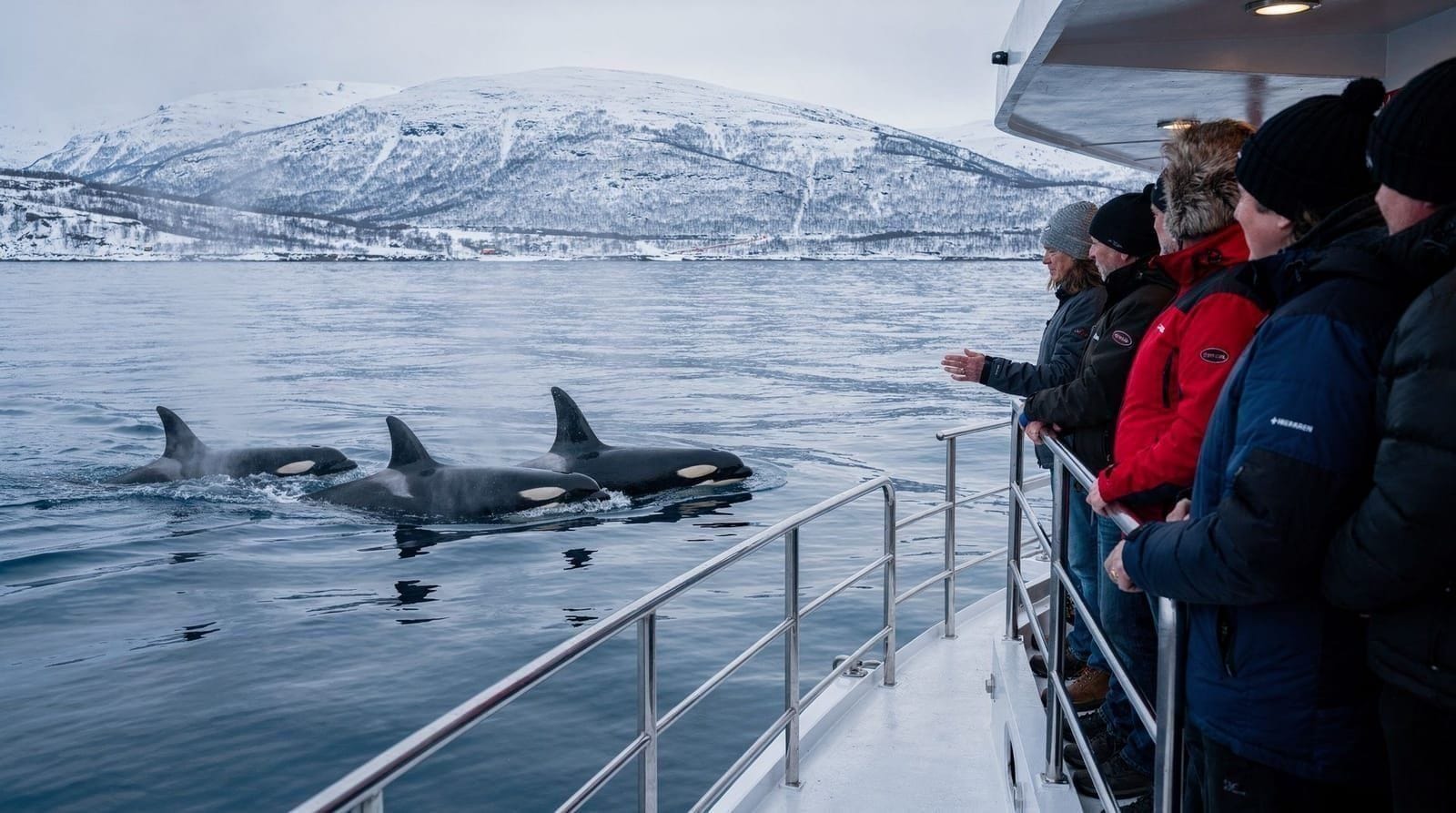
Heated enclosed whale watching boat — best for seasickness-prone passengersMedications: what works and when to take it
This is where most people go wrong. Seasickness medication is preventive, not curative. It must reach therapeutic blood levels before the vestibular stress begins. Taking a tablet when you are already green does almost nothing.
Scopolamine patch (Scopoderm): The most effective option for longer durations (6–8 hours of water time). Applied behind the ear 4–12 hours before boarding. Requires a prescription in some countries (Norway: prescription required; UK/US: prescription required). Side effects: dry mouth, blurred vision. Effective for most people including those for whom antihistamines have not worked.
Promethazine (Phenergan): Highly effective antihistamine with pronounced sedative effect. Taken 1–2 hours before boarding. Causes drowsiness, which is actually a useful side effect on a whale watching trip (you relax rather than anxiously monitoring your nausea). Available OTC in Norway (check Apotek pharmacies in Tromsø; ask for “Phenergan” or “bevegelsessyke tabletter”).
Cinnarizine (Stugeron): Available OTC in most European countries including Norway. Less sedating than promethazine. Effective for mild-moderate susceptibility. Take 30 minutes before boarding. Available at Norwegian Apotek pharmacies.
Meclizine (Bonine) / dimenhydrinate (Dramamine): Common OTC options, both antihistamine-based. Variable effectiveness. Better than nothing; not as strong as cinnarizine or promethazine for serious susceptibility.
Ginger: Standardised ginger extract capsules (1g, standardised to 5% gingerols) taken 30–60 minutes before boarding have modest evidence for mild seasickness. A safe adjunct to medication, not a replacement for it.
What to buy in Tromsø: Stop at an Apotek (pharmacy) on arrival. Describe your symptoms and destination — Norwegian pharmacists are familiar with whale watching season needs and will recommend appropriate OTC medication. Most Apotek locations are on Storgata or near the bus station.
The morning of the trip: routine matters
Night before: Light dinner, no alcohol. Take scopolamine patch (if using) according to its timing window.
Morning of: Light, easily-digestible breakfast: porridge, toast, crackers, banana. Nothing greasy or fried. No coffee on an empty stomach. Take oral medication (cinnarizine, promethazine) 30–60 minutes before boarding.
At the harbour: Fresh air, avoid enclosed spaces where possible while waiting to board. Stay in the bow of any transport vehicle rather than the rear.
On the boat: Position matters — see below.
Position on the boat
If you are on a large catamaran with an enclosed cabin:
- The most stable position is amidships (middle of the boat), as low as possible
- The bow moves more than the stern on rough water — counterintuitive but true
- Looking out through a window at the horizon helps significantly
- Do not read, look at a phone screen, or look downward for extended periods
If you feel symptoms starting:
- Move to the stern deck (outside, fresh air)
- Fix your gaze on a stable horizon point
- Breathe deeply and slowly
- Chew ginger sweets if available
- Sit or stand upright — lying down makes things worse for most people
- Do not try to fight nausea by staying inside; fresh air is almost always better
If you vomit: it is not pleasant, but most people feel significantly better for 20–30 minutes afterward. Use the provided bags (kept in jackets or by the rails), wash your face with cold water, and resume position on deck. Many people who are sick once recover and enjoy the rest of the trip.
Hybrid-electric whale watching — larger, more stable vesselWhat to do if you are genuinely miserable on board
Tell the guide. A good guide will: find you a sheltered, stable position on deck, possibly offer ginger or anti-nausea medication from the boat’s first aid kit, adjust their estimate of how long before the next whale sighting (to help you decide whether to tough it out), and arrange early disembarkation if the boat is returning to port anyway.
Do not suffer in silence. The crew on whale watching boats in Tromsø have seen seasickness many times and will not judge you.
If conditions deteriorate significantly (Beaufort 6+), the captain may decide to return to port anyway. Trust this decision — these are professional mariners who understand the difference between “uncomfortable” and “dangerous.”
Prevention vs cure: the time investment that pays off
The two hours you spend planning your medication, booking the right boat type, and eating sensibly the night before are the best investment in your whale watching trip. Many bad reviews of Tromsø whale watching tours are written by people who had a miserable time being seasick — on boats and in conditions that were completely normal for the season. Almost none of those experiences needed to happen with proper preparation.
See what to bring whale watching for the full packing checklist, including medication reminders.
Does the season affect how rough the water is?
Sea conditions vary across the whale watching season. November and December tend to be calmer than the shoulder months of October and late January in the Kvænangen fjord system, though no month is guaranteed flat calm. If you are especially prone to seasickness and have flexibility, booking within the November–December window slightly improves your odds of a smoother trip, on top of choosing the right vessel and medicating properly.
Hybrid-electric whale watching — larger, more stable vesselFrequently asked questions about seasickness on Tromsø whale watching tours
Will the operator tell me if conditions are rough before I board?
Reputable operators brief passengers on conditions before departure and specifically note sea state. Some allow passengers to opt out without penalty if conditions are genuinely rough. Ask about this policy when booking — it is a sign of a trustworthy operator.
Are seasickness bags provided on board?
Yes, on all established whale watching vessels. They are typically in the seat pockets or available from guides. You should not feel embarrassed to use them — guides are completely accustomed to this.
My child gets carsick. Will they get seasick?
Children who experience carsickness are at higher risk of seasickness. For children on whale watching trips, a large enclosed catamaran is strongly preferred over a RIB. Cinnarizine is generally safe for children over 5 at reduced doses — consult a pharmacist or your GP before travel for appropriate child dosing.
Can I take seasickness medication while pregnant?
Consult your doctor. Some antihistamines are considered acceptable in pregnancy; others are not. Ginger (food-grade) is generally considered safe. Scopolamine patches are not recommended in pregnancy. Do not self-medicate without medical advice.
Is it normal to feel fine for an hour and then suddenly sick?
Yes. Motion sickness can have a delayed onset, particularly when you move below decks and then return to deck. The cause is a conflict between your visual system and vestibular system — sometimes it builds gradually, sometimes it hits suddenly when your position changes.
Do electric boats cause less seasickness?
Not directly — their motion on the water is the same as any catamaran of similar size. However, electric boats tend to be newer, larger, and more purpose-designed, which often correlates with better hull stability. The absence of diesel fumes can also help, since strong fuel smells are a known trigger for nausea. See silent electric whale boats for more on the electric vessel options.
Is November or December calmer than other months?
Generally yes, relative to October and late January in the Kvænangen fjord system, though conditions still vary day to day. See whale watching season in Tromsø for the full month-by-month picture.
Top experiences
Bookable activities with verified prices and instant confirmation on GetYourGuide.