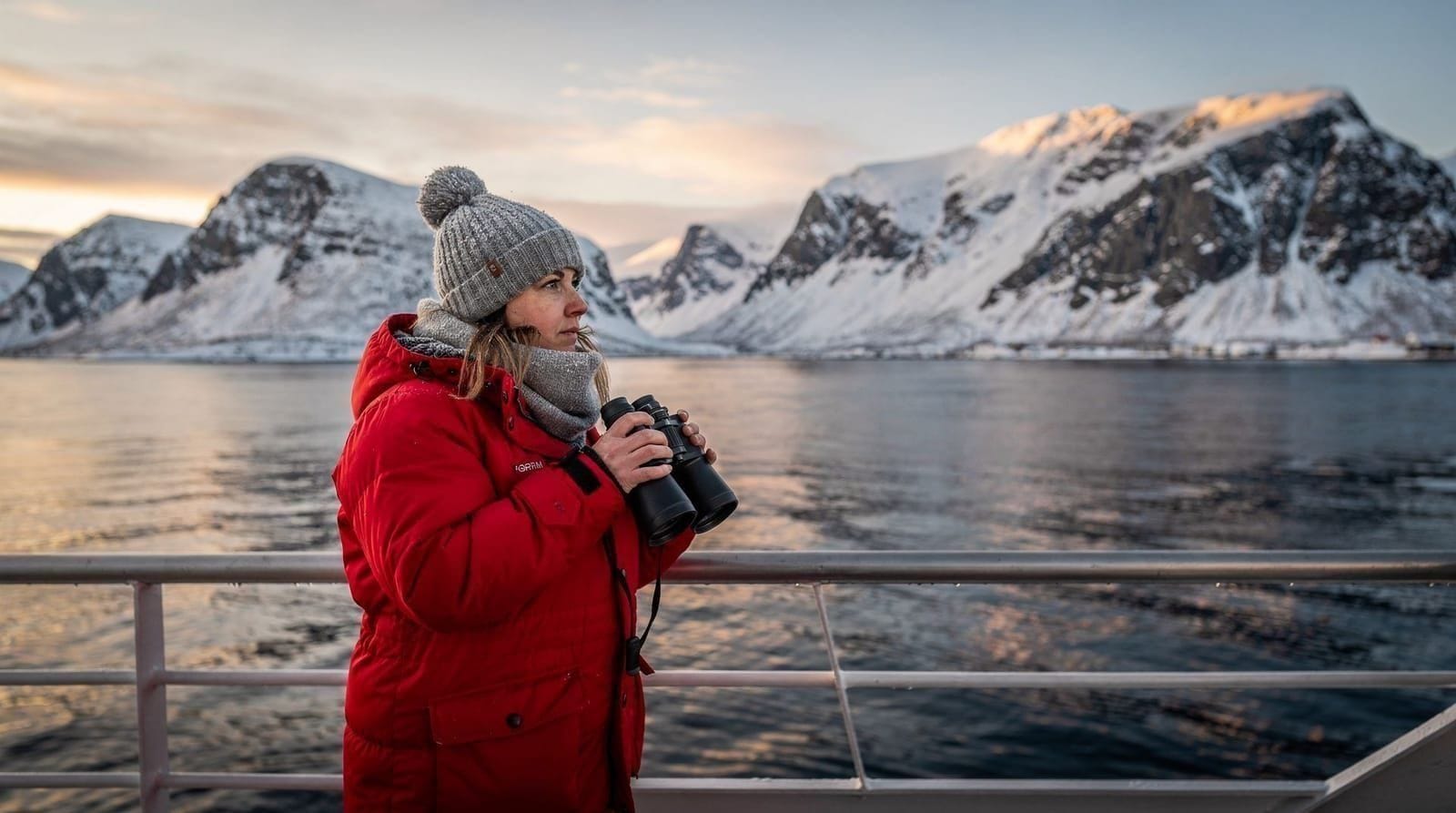
Best whale watching operators in Tromsø — honest ranked guide
Tromsø: Whale Watching Tour by Hybrid-Electric Boat
Which whale watching operator should I choose in Tromsø?
For most visitors, a hybrid-electric or large catamaran tour with an included van transfer from Tromsø works well. RIB-based operators departing from Skjervøy give more whale time for experienced travellers comfortable in open boats. Choose based on your seasickness tolerance and how much time you have — not on marketing superlatives.
The one honest recommendation: Skip any operator whose marketing relies on “guaranteed close-up orca encounters” or “you’ll be right next to the whales” language. Responsible operators know they cannot promise that, and responsible wildlife encounters do not prioritise closeness over animal welfare. Choose based on boat type, approach policy, group size, and what is included — not hype.
| Where | Departs Tromsø harbour or Skjervøy, depending on operator |
| Cost | Around 1,100–2,800 NOK per adult depending on boat type |
| Time needed | 3–6 hours from Tromsø; 2–3 hours from Skjervøy |
| Getting there | Included minibus transfer from Tromsø on most tours; self-drive or bus if based in Skjervøy |
| Best time | November–January, when orcas and humpbacks feed near Skjervøy |
The operator landscape near Tromsø
Whale watching near Tromsø has expanded dramatically over the past decade. What began as a handful of operators running converted fishing boats has grown into a competitive market with specialist purpose-built whale watching vessels, high-speed RIBs, and a range of comfort levels.
This growth is a mixed blessing. Competition has driven investment in better boats and more professional guiding. It has also meant more vessels in the feeding grounds simultaneously, which creates cumulative pressure on the orca and humpback populations. See whale watching ethics for a full discussion.
What follows is an honest breakdown of operator types and what to look for, rather than a paid-ranking list.
Category 1: Large hybrid-electric and catamaran operators
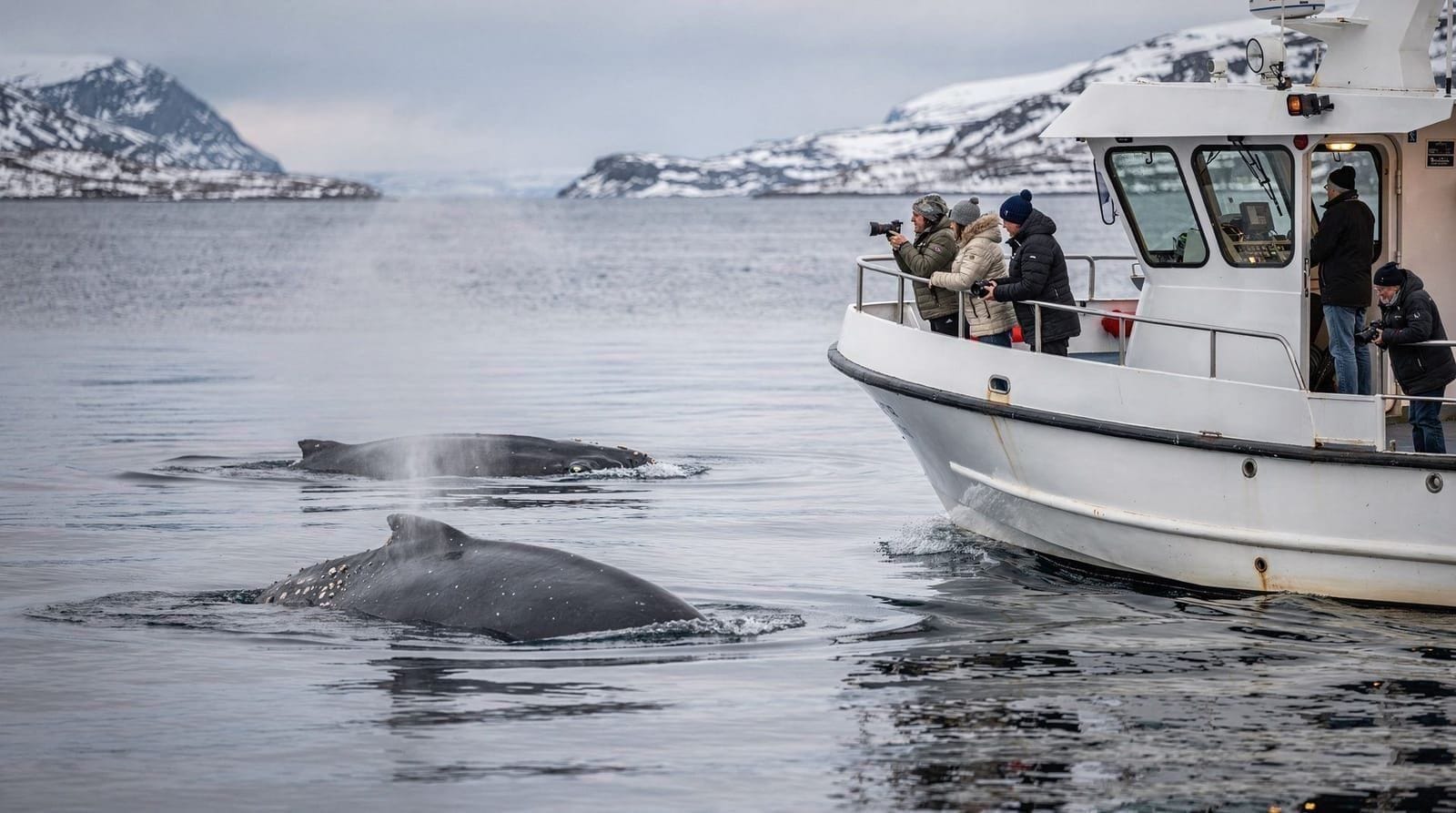
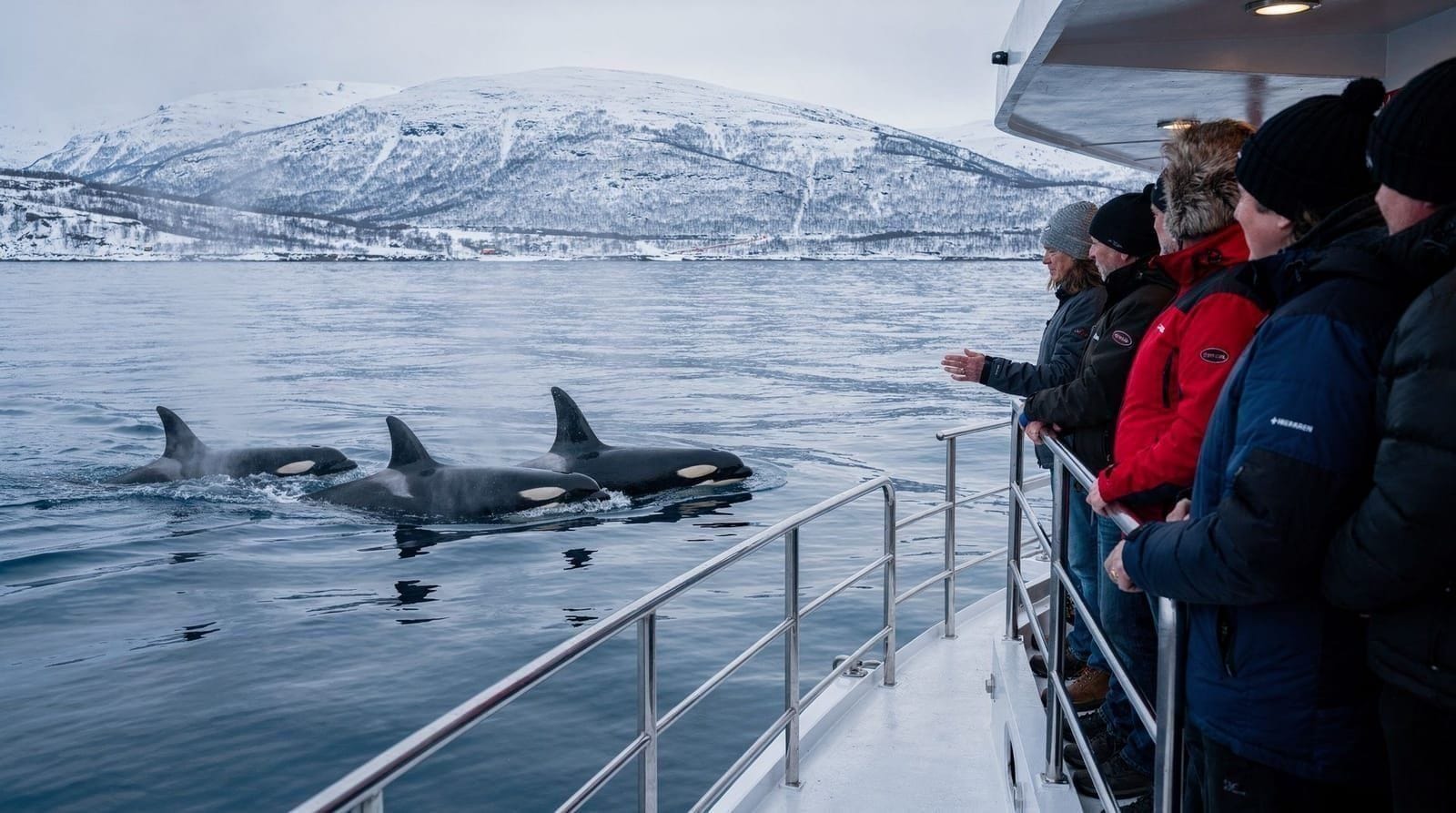
Who they are: Companies running purpose-built or purpose-converted large vessels (30–100 passengers) with enclosed heated cabins, catering facilities, and modern wildlife approach systems.
What they offer: The most comfortable whale watching experience. Passengers can move between the warm cabin and the deck freely during encounters. Staff typically include a guide, a naturalist or researcher, and a captain. Departure from Tromsø harbour usually includes a minibus transfer if whales are near Skjervøy.
Price range: 1,500–1,900 NOK per adult with transfer included.
Best for: Families with children, anyone prone to seasickness, travellers who want comfort alongside the wildlife experience, first-time whale watchers.
What to verify: Whether the boat is genuinely hybrid-electric (quieter, better for the whales) or just described as “eco-friendly.” Ask the specific model name and engine type.
Book a hybrid-electric catamaran whale watching tourCategory 2: High-speed catamaran tours
Who they are: Operators running faster catamarans, often with a mix of open deck and some enclosed space. Slightly more dynamic than large slow catamarans.
What they offer: Speed allows faster positioning when pods are moving. Group size is typically 30–60 passengers. Usually includes a heated area below deck.
Price range: 1,400–1,800 NOK per adult.
Best for: Those who want some dynamism but not the full RIB experience. A middle ground option.
What to verify: Whether they maintain approach distance protocols even when racing to a new location.
Category 3: RIB operators from Skjervøy
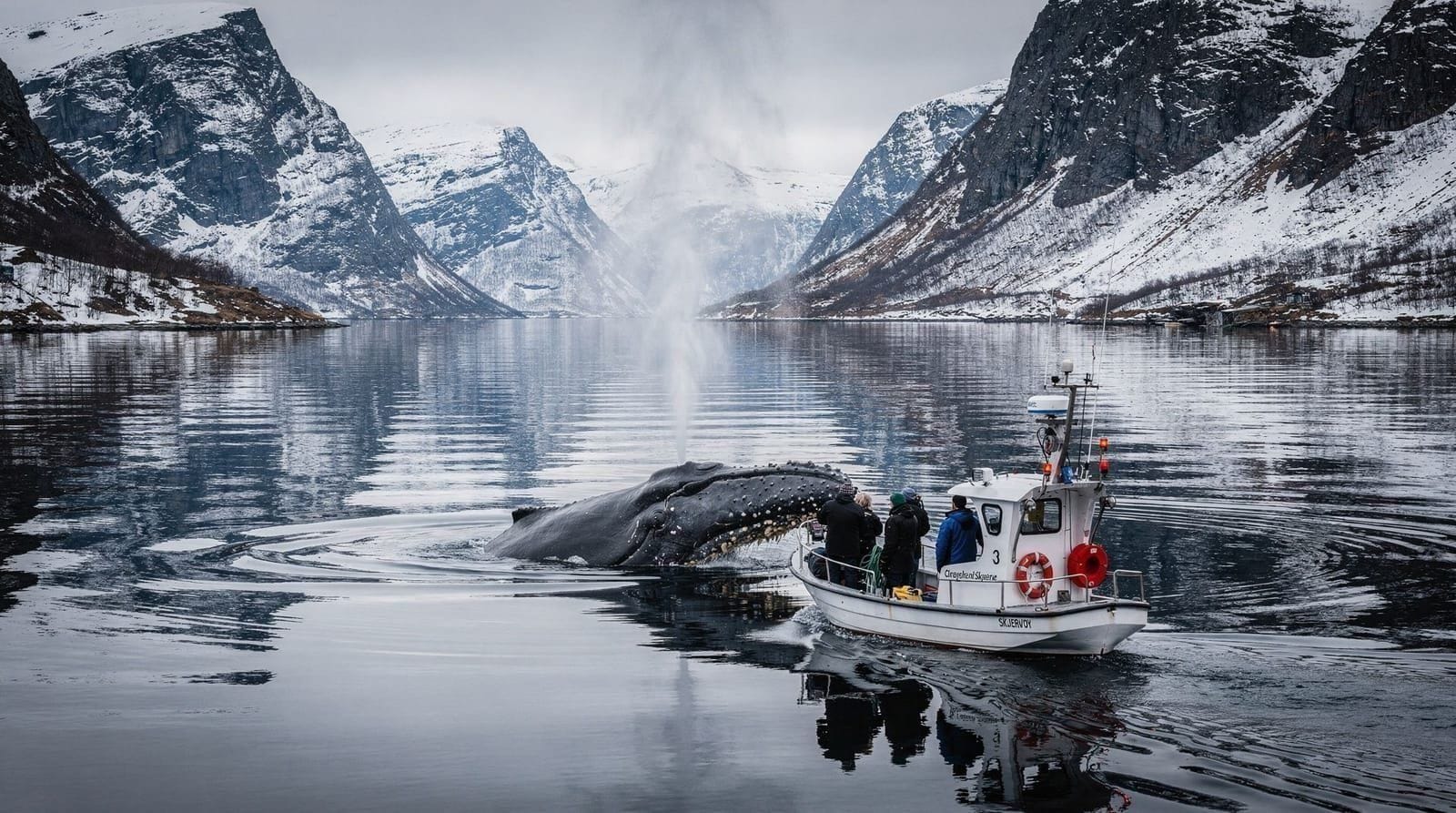
Who they are: Smaller operators based in Skjervøy running 8–12 person rigid inflatable boats. These are the closest to the original herring fishermen’s perspective on whale watching.
What they offer: Maximum time in the feeding grounds (10-minute transfer from harbour). Drysuits provided. Fast, nimble positioning. Closer-to-water experience. More intimate, smaller groups.
Price range: 1,100–1,500 NOK per person (transport to Skjervøy not included — add 600–900 NOK for car rental, or 200–300 NOK bus ticket).
Best for: Wildlife photographers, experienced adventure travellers comfortable with rough conditions, those with 2+ days available to base in Skjervøy, anyone who wants the most raw version of the experience.
Avoid if: You are prone to seasickness, have back or mobility issues, travel with young children or elderly companions, or have only one day in the region.
RIB whale watching departing directly from SkjervøyCategory 4: Traditional wooden boat operators
Who they are: Operators using classic Norwegian wooden vessels — the MS Gabriele and MS Keiser Wilhelm are well-known examples. These are not replica boats; they are genuine old vessels converted for whale watching with heating and modern safety equipment.
What they offer: Atmospheric experience, slower pace, smaller groups (typically 20–40 passengers), the feeling of a traditional maritime excursion rather than a tourism product.
Price range: 1,300–1,700 NOK per adult with transfer.
Best for: Travellers who value atmosphere and authenticity; photography-focused visitors who prefer the slow pace; those who want a less commercial-feeling experience.
What to verify: That heating is reliable (old vessels can have inconsistent cabin temperatures), and that the pace of the trip matches your expectation. Wooden boats are slower than RIBs or modern catamarans.
Category 5: VIP and premium tours
Who they are: Small-group (6–12 passengers) premium experiences, often with luxury vessels, hot lunches, and a researcher-guide ratio that enables deeper education.
What they offer: Everything a standard tour offers plus a meal, higher-quality briefing, usually a smaller vessel for more personal encounters, and sometimes pick-up from your hotel.
Price range: 2,000–2,800 NOK per adult. Lunch-included VIP tours around Lyngen can reach 2,500 NOK.
Best for: Travellers willing to pay for a step up in experience quality; anniversary trips or special occasions; those who value small groups and personalised guiding.
What to verify: That the premium price reflects genuine quality (smaller group, better boat, included extras) rather than just marketing positioning.
Green flags when evaluating operators
- Written wildlife approach policy available on request
- Contribution to Norwegian Orca Survey or similar research
- Hybrid-electric or electric vessels
- Explicit rebooking or refund policy for no-sighting days
- Naturalist or researcher on board (not just a general tour guide)
- Clear information about maximum group size per vessel
- Transparent pricing with no hidden “transfer fee” surprises
- Positive reviewer comments specifically about guide knowledge and responsible behaviour
Red flags
- Marketing language promising “very close encounters guaranteed”
- Vague or no response when asked about wildlife approach distance
- No cancellation or rebooking policy for poor conditions
- Prices that seem too cheap (often means cutting corners on safety equipment or staff)
- Multiple recent reviews mentioning boats chasing pods or crowding feeding areas
- Claims of “exclusive feeding zones” or similar — herring move and no operator controls the ocean
Price comparison table
| Tour type | Departure | Price range (NOK) | Group size | Seasickness risk |
|---|---|---|---|---|
| Hybrid-electric catamaran | Tromsø | 1,500–1,900 | 40–80 | Low |
| High-speed catamaran | Tromsø/Skjervøy | 1,400–1,800 | 30–60 | Medium-low |
| Traditional wooden boat | Tromsø | 1,300–1,700 | 20–40 | Low-medium |
| RIB safari | Skjervøy | 1,100–1,500 | 8–12 | High |
| VIP with lunch | Tromsø/Lyngen | 2,000–2,800 | 6–15 | Low |
See whale watching season guide for booking timeline advice, and what to bring whale watching for the packing checklist.
Tromsø departure vs basing yourself in Skjervøy
Most visitors join a tour departing directly from Tromsø, which includes the roughly 1.5–2 hour minibus transfer to wherever the whales are currently feeding — usually near Skjervøy in peak season. This is the simplest option and requires no extra logistics. The alternative is basing yourself in Skjervøy for 2–3 nights and joining a RIB operator directly from the harbour there, cutting the transfer to about 10 minutes and maximising time in the feeding grounds. The trade-off is accommodation logistics — Skjervøy has far fewer hotels than Tromsø, and you lose easy access to Tromsø’s restaurants and other activities. For most one-week trips, a single Tromsø-departure tour is the practical choice; the Skjervøy vs Tromsø whale watching guide covers the full trade-off if you’re considering basing yourself there.
Booking strategy and seasickness
Seasickness is the single biggest factor in whether people enjoy a whale watching tour, and it deserves more attention than boat category alone. Large hybrid-electric catamarans are the most stable option because of their size and hull design, followed by high-speed catamarans and traditional wooden boats; RIBs are the least stable, bouncing directly with wave action at speed. If you have any history of motion sickness, take medication (available over the counter at Norwegian pharmacies) the night before and morning of the tour, not once you’re already on the water. Eating a light meal beforehand and staying on deck in fresh air, rather than below in a heated cabin, also helps most people. Combine this with checking the marine forecast — swell over 1.5 m makes even large boats uncomfortable for sensitive stomachs.
Frequently asked questions about whale watching operators in Tromsø
Can I book a private whale watching tour?
Yes. Several operators offer private charter of their RIBs or smaller vessels. Expect to pay 8,000–15,000 NOK for the boat (split among your group). This makes sense for groups of 6+ who want maximum flexibility and a more tailored experience.
Are there tours specifically for solo travellers?
Standard group tours work perfectly for solo travellers — you join a group of 8–80 other passengers. There are no solo-only tours. Solo travellers often appreciate the social element and the shared excitement of encounters.
Which operators specifically work with the Norwegian Orca Survey?
Several operators have formal or informal partnerships with NOS where their guides photograph orca for the ID catalogue. Ask any operator directly; the NOS website also maintains a list of partner operators. This is not widely publicised in booking materials but is easy to find out.
Is there a way to see the whale watching boats before I book?
In Tromsø harbour (Prostneset or Tromsø havn), some whale watching vessels are visible when not in use. You can also look at operators’ websites for photos of the specific vessels used. This is worth doing — some operators show glossy stock photos of boats they do not actually operate.
Are whale watching tours accessible for wheelchair users?
Large catamarans with level boarding and wide deck access can accommodate wheelchair users. Contact operators directly to discuss specific accessibility needs. RIBs are not accessible for wheelchair users. This is a legitimate question to put to any operator before booking.
Do any operators offer combined northern lights and whale watching on the same day?
Some specialised tours offer a daytime whale watching component with an evening northern lights element, or a full 24-hour combined cruise. These are convenient but demanding — 12+ hours of activity requires good fitness and appropriate expectations. Read the northern lights tours compared guide for aurora-specific operator advice.
Top experiences
Bookable activities with verified prices and instant confirmation on GetYourGuide.