Orca vs humpback whale — what you'll see near Tromsø
Tromsø: Orca and Whale Watching Heated Boat Trip
Will I see orca or humpback whales near Tromsø?
Both species visit the fjords near Skjervøy from October to January, following herring shoals. Orca typically arrive first in October–November; humpbacks peak in November–December. On a good day in peak season, you can see both on the same trip.
Species cheat sheet: Orca arrive first (October), are faster, and display explosive carousel feeding. Humpbacks arrive in November–December, are larger, and surface predictably every few minutes. Both follow the same herring shoals in Kvænangen fjord near Skjervøy. A good winter tour often shows you both in the same outing.
| Where | Kvænangen fjord near Skjervøy, reachable from Tromsø |
| Season | October–January, following herring shoals |
| Peak overlap | November–December (both species together) |
| Boat types | Heated catamaran or faster RIB (rigid inflatable) |
| Cost | Typically 1,200–2,200 NOK per adult, operator-dependent |
Two species, one food source
The whale watching phenomenon near Tromsø is ecologically simple: Atlantic herring overwinter in the deep fjords of northern Norway, and two large predator species follow them there.
Orca (Orcinus orca) are fish specialists in this particular population. Unlike the mammal-hunting orca made famous by wildlife documentaries, the Norwegian orca that visit Kvænangen fjord eat almost exclusively herring. They travel in family pods of 5–30 animals, often covering hundreds of kilometres to follow the fish.
Humpback whales (Megaptera novaeangliae) are also herring specialists in winter. They spend summers in colder polar waters feeding on krill and small fish, then follow prey to where it concentrates. Norwegian fjords in winter represent one of the most food-rich environments available to them.
The result: both species appear in the same waters, at the same time, eating the same prey — often within a few hundred metres of each other.
Physical identification at sea
Knowing what to look for makes the difference between “there’s a whale” and genuinely understanding what you are seeing.
Orca:
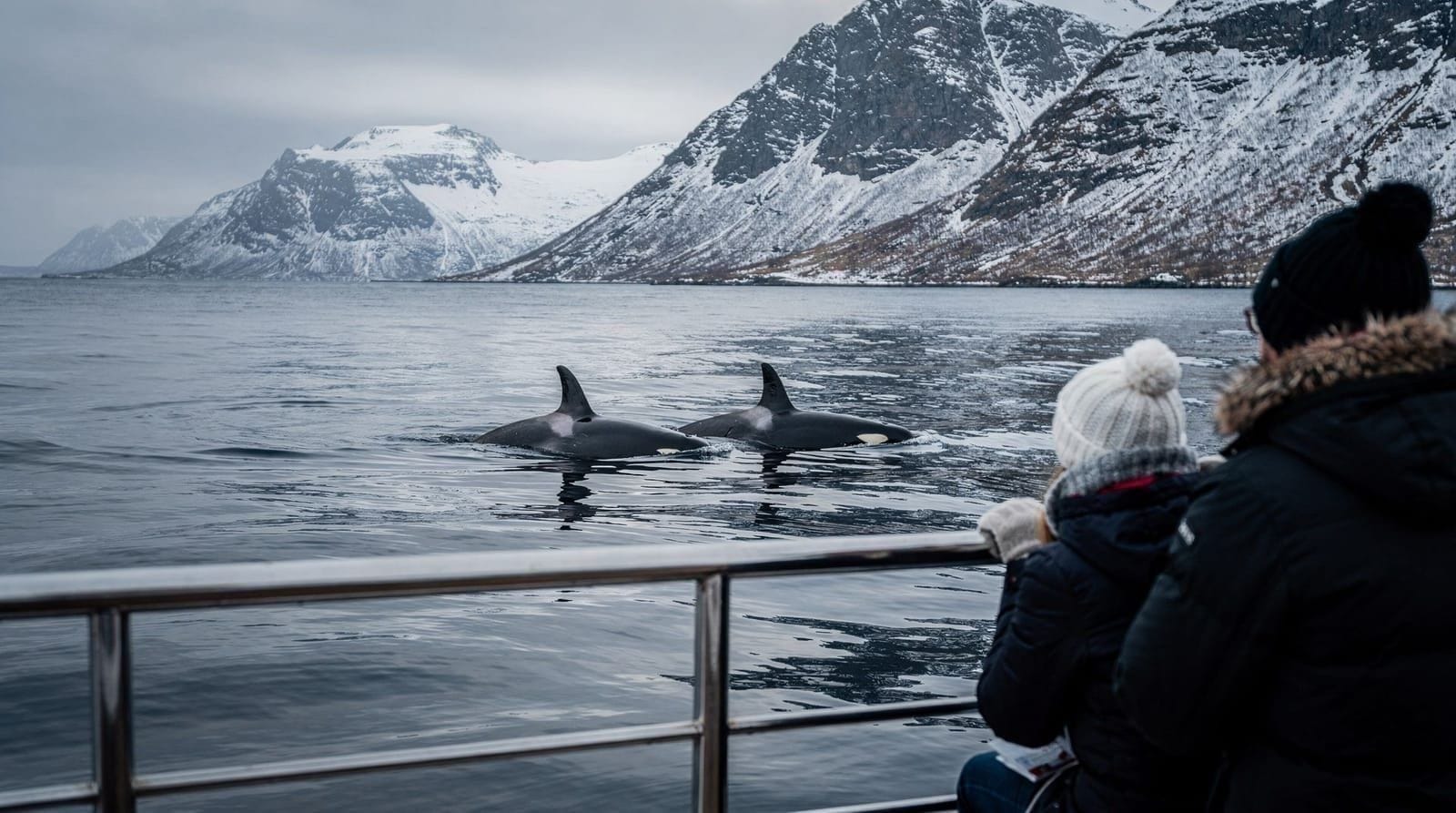
- Distinctive black-and-white colouring: jet black upper body, white underside, white eye patch behind eye
- Tall, erect dorsal fin: up to 1.8m in adult males (unmistakeable), 0.9–1.2m in females and juveniles
- Travel in pods — you rarely see just one
- Blow (exhalation spout) is low and bushy, around 1–2 metres high
- At speed during carousel feeding: constant motion, frequent surfacing, sometimes breaching
Humpback whale:
- Dark grey-black upper body, mottled white on underside of flukes (tail)
- Distinctive stubby, knobbed dorsal fin
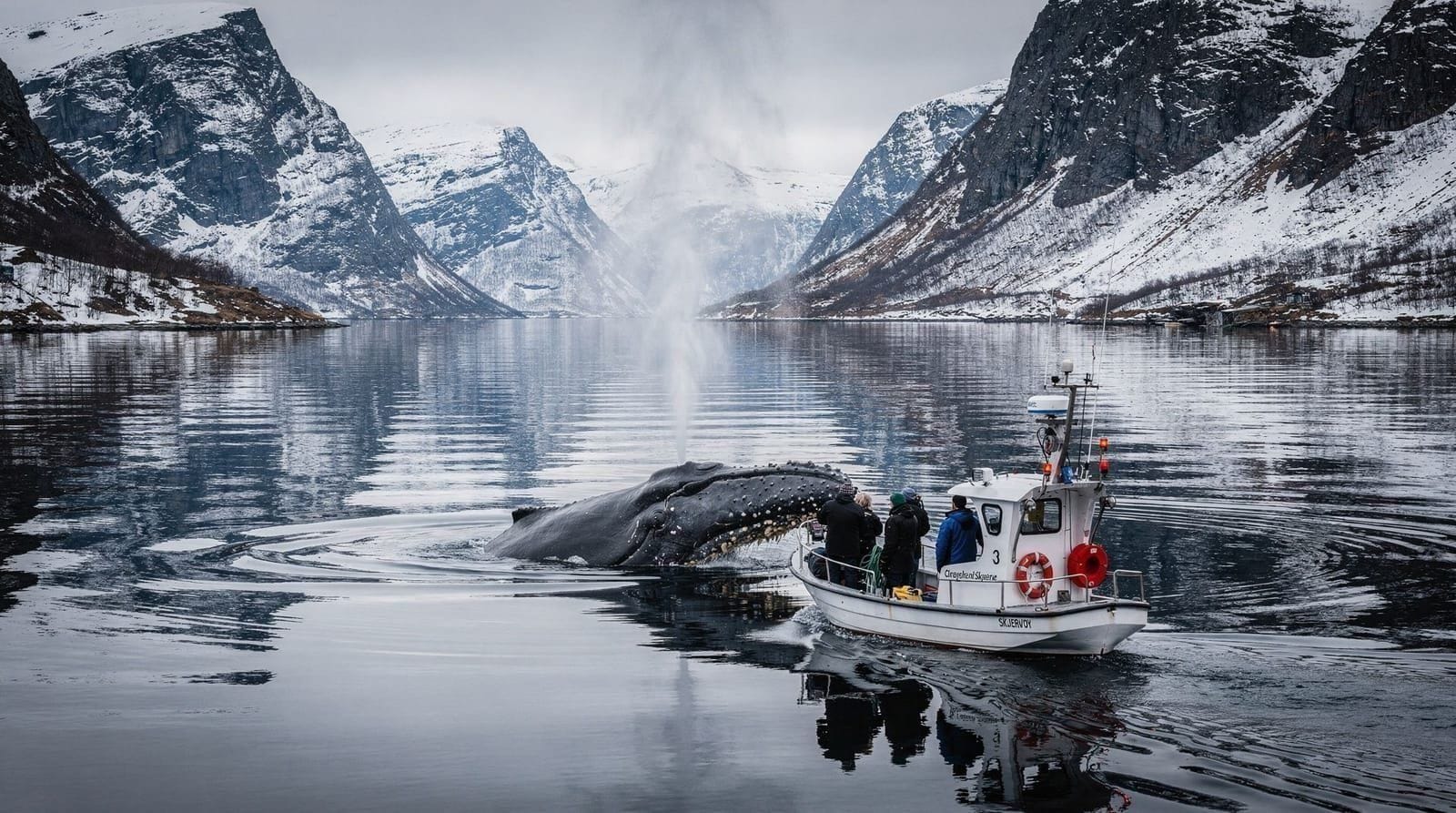
- Blow is tall and columnar, 2–4 metres high — visible from a long distance
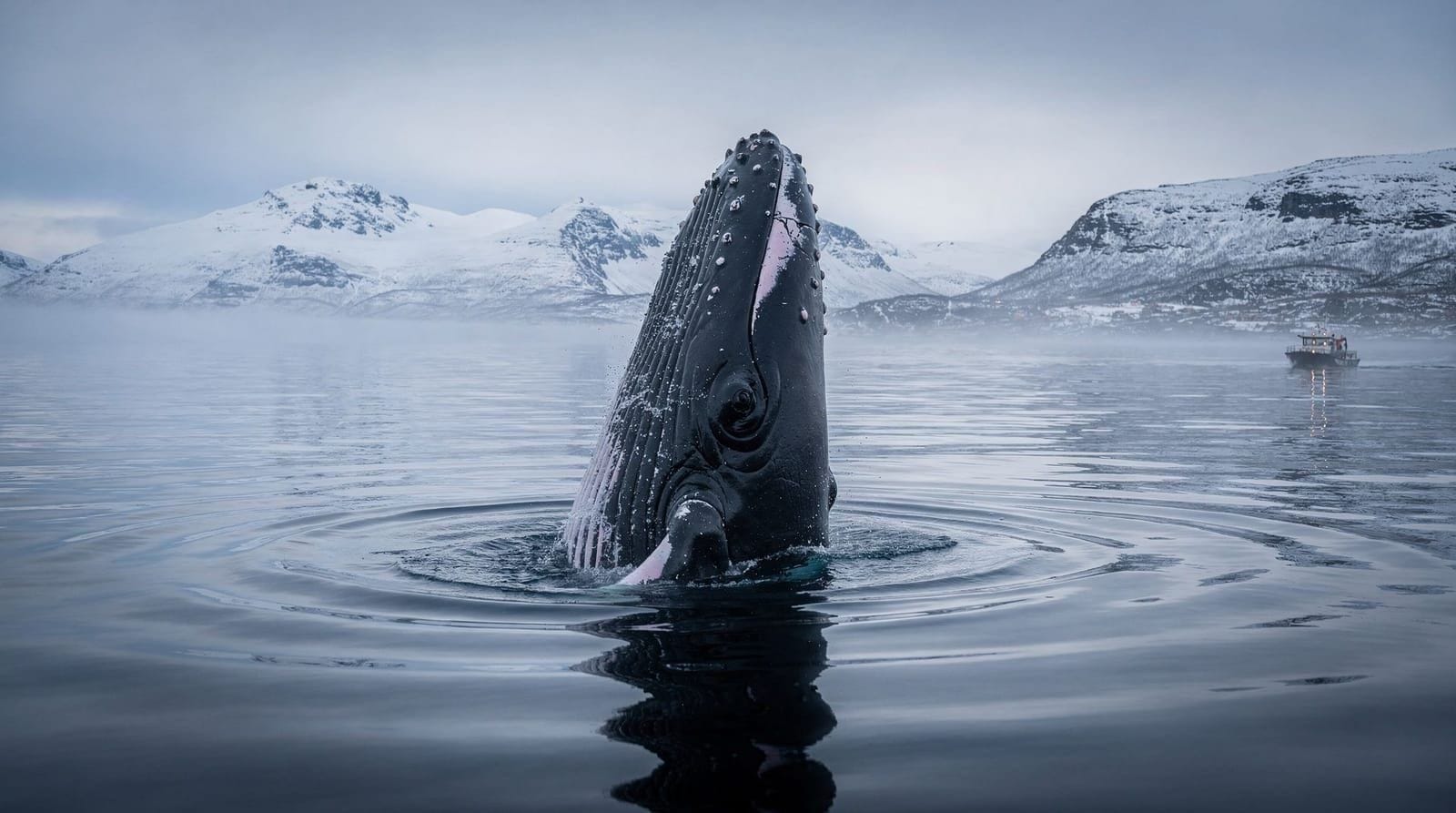
- Regularly fluke-up dives: raises its tail dramatically as it descends, giving excellent views of the underside markings (which are unique per individual, like fingerprints)
- Surface interval every 3–7 minutes before a longer dive
- Moves more slowly and predictably than orca
White-beaked dolphins are frequently spotted too: small (2–3m), dark grey with white patches, travel in groups of 10–50, highly acrobatic.
Orca whale watching on a heated enclosed boat — book hereBehaviour differences: what you will actually see
Orca: dynamic and intense
A pod feeding on a herring ball is one of the most kinetic wildlife spectacles in the world. The sequence is roughly:
- Orca locate a herring school using echolocation
- The pod works together to drive fish upward toward the surface and compress them into a tight “bait ball”
- Individual orca accelerate through the ball, slapping with their flukes to stun fish
- Each orca picks off stunned herring
- The pod disperses briefly, then reconcentrates on the next school
This process can happen close to — and sometimes directly alongside — the boat. Guides will cut the engine when orca are feeding nearby. It is genuinely loud: the slap of a fluke on water is audible from 100+ metres.
Between feeding bursts, orca cruise at 5–10 knots and may move quickly away. This is when you will see spy-hopping (head raised vertically above the water surface), porpoising (fast travel with frequent leaps), and occasional breaching.
Humpback: slow and steady
Humpbacks near the herring shoals feed by lunging upward through the fish concentration with their mouth open, taking in thousands of litres of water and fish at once. This lunge feeding is visible from the boat as a sudden eruption of water and an open-mouthed whale.
More commonly you will see:
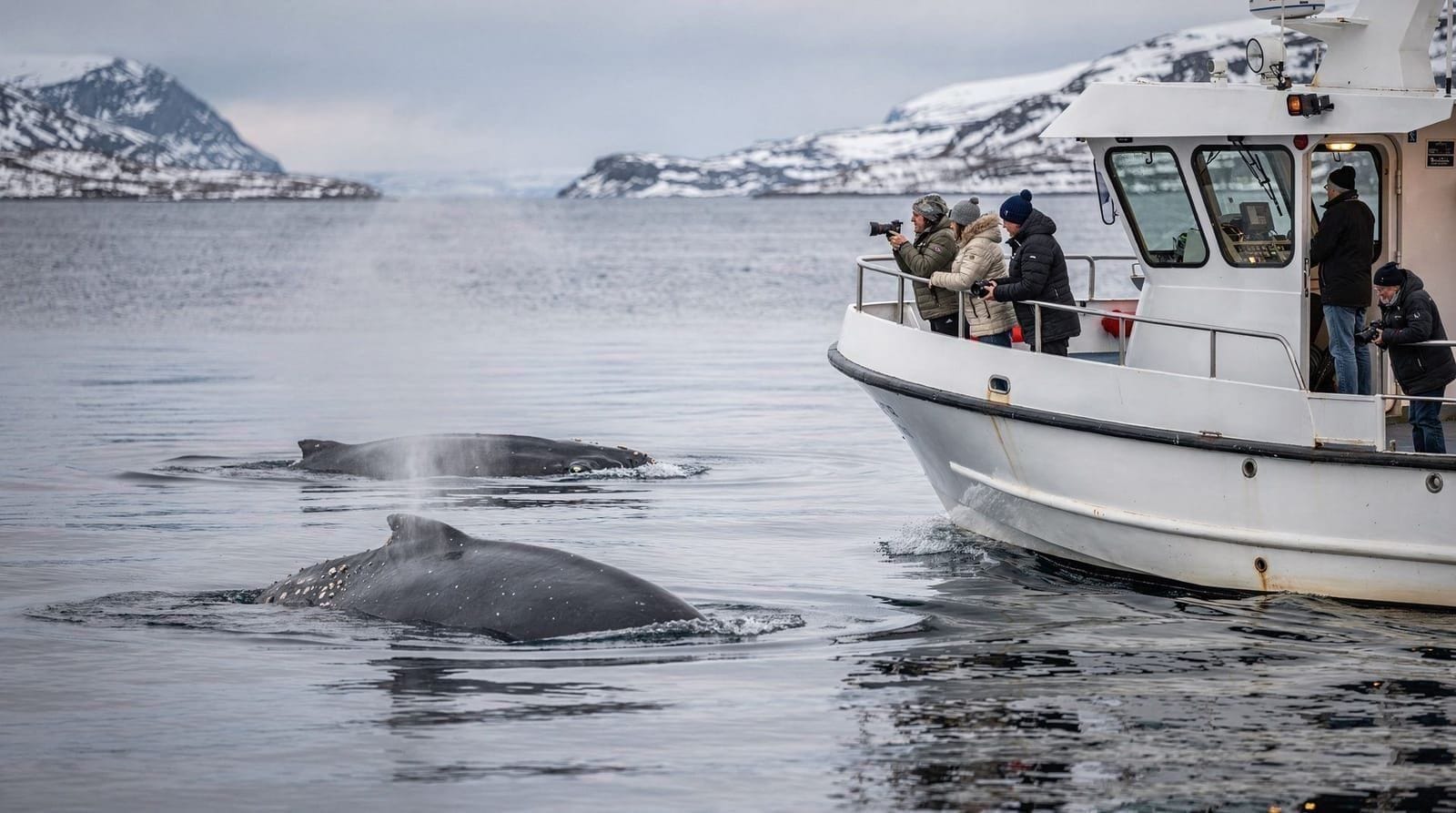
- The large, dark back rolling slowly at the surface as the whale breathes
- The distinctive small dorsal fin
- The fluke raised vertically before a deeper dive — the classic whale tail photograph
- The misty blow column, often visible before you see the animal
Humpbacks in November–December can be surprisingly close to the boat, particularly on calm days. They have been recorded rubbing their bodies on boat hulls (generally discouraged — see whale watching ethics).
Timing: who appears when
October: Orca are the first arrivals, following the leading edge of the herring migration. Humpbacks are rare or absent.
November: Peak orca activity; humpbacks begin arriving in numbers. Both species commonly seen. This is the best month to observe carousel feeding.
December: Both species well-represented. Humpback numbers often peak in December as more animals arrive from their summer grounds.
January: Declining numbers of both species as herring begin dispersing. Some years remain productive; others tail off quickly.
RIB safari specifically targeting orca near SkjervøyEthical considerations
The piscivorous (fish-eating) orca population that visits Kvænangen is classified as threatened by Norwegian authorities, primarily due to fluctuations in herring stocks. Responsible operators maintain a minimum approach distance (typically 50 metres) and cut engines when whales are nearby to avoid acoustic disturbance.
Humpback whale numbers in Norwegian waters have recovered significantly since the end of Norwegian commercial whaling in the 1980s. They remain IUCN-listed as Least Concern globally but face threats from entanglement in fishing gear.
Choosing ethical operators matters. See whale watching ethics for specific criteria to apply when booking.
Photography notes
For orca: a fast telephoto (200–400mm on full frame, or equivalent APS-C) is needed to capture animals in motion. Burst mode essential. Autofocus tracking modes are your friend — orca move fast and unpredictably.
For humpback: slightly more forgiving due to predictable surfacing. The fluke-up dive is the signature shot. Position yourself where the light comes from behind you (difficult in polar night, possible in late November twilight). A 100–300mm range covers most opportunities.
Low light is the main challenge. Polar night conditions mean ISO 1600–6400 settings even at midday. See aurora photography settings for general Arctic low-light shooting principles that transfer to whale photography.
RIB versus catamaran: which boat type suits which species
Boat choice affects your odds with each species differently. A heated catamaran is slower and more stable, better suited to humpback watching where predictable, slower-moving animals do not require a fast chase, and it keeps children and cold-sensitive travellers comfortable in an enclosed cabin. A RIB (rigid inflatable boat) is faster and more manoeuvrable, better suited to following a moving orca pod during carousel feeding, but it is fully exposed to weather and unsuitable for young children or anyone who struggles with cold, bouncing rides. See what to bring whale watching for the layering difference between the two boat types.
For a first-time visitor unsure which species will be more active on a given week, a catamaran trip is the safer, more comfortable choice; for a visitor specifically chasing orca carousel-feeding photography, a RIB departure from Skjervøy gives a real edge in speed and positioning.
Hybrid electric whale watching boat — quieter running and good all-round comfort for spotting either speciesChoosing an operator and season
Best whale watching operators in Tromsø compares the main companies by boat type, departure point, and typical sighting rates. If your dates are flexible, whale watching season in Tromsø breaks down month-by-month probability for each species across the whole winter, and Skjervøy vs Tromsø whale watching explains why most serious operators now depart from Skjervøy rather than Tromsø harbour itself, given the shorter transit time to the herring grounds.
Frequently asked questions about orca and humpback whales near Tromsø
How close do boats get to whales?
Responsible operators maintain 30–50 metres from animals. However, whales themselves may approach the boat — especially humpbacks, which are curious animals. When a whale comes within 10 metres voluntarily, guides typically cut the engine and let the encounter happen naturally.
Is carousel feeding always visible?
No. It is the highlight of a good orca day, but it requires active herring concentration. Some days orca are travelling rather than actively feeding, and you see cruising behaviour instead. This is still impressive but less dramatic. Sighting reports from operators’ social media channels give you a sense of what recent days have looked like.
Are there whale watching trips specifically targeting orca?
Some operators specifically market “orca safari” tours and focus their search on pods rather than mixed-species encounters. RIB-based Skjervøy departures are often more orca-focused because of their speed and manoeuvrability when following a moving pod.
What is the largest orca pod typically seen?
Pod sizes in Kvænangen range from 3–4 animals to 40+ during concentrated feeding events where multiple pods converge on a large herring school. Seeing 20+ orca in one area simultaneously is a documented and not-infrequent occurrence in peak December conditions.
Do orca or humpback whales breach near Tromsø?
Breaching (full-body leap from water) is uncommon but documented in both species. Humpback breaching is perhaps slightly more common; orca breaching near Tromsø is rare and exciting. More common “aerial” behaviour includes spy-hopping (orca) and pectoral slapping (humpback).
Can I snorkel or dive with whales?
In-water whale encounters are not commercially offered near Tromsø in winter — water temperatures of 4–7°C and the dynamic nature of orca feeding make this dangerous and disruptive. Some operators in warmer seasons and other locations offer snorkelling with whales, but not in this context.
Are there whale watching tours at night?
Not specifically, but polar night (27 Nov–15 Jan) means all tours depart in darkness. Some operators run morning tours that launch before dawn and are on the water during the 2–3 hours of blue twilight around midday. Others offer combined northern lights evening cruise activities after a daytime whale tour.
Do orca and humpback whales ever compete for the same herring ball?
Yes — mixed-species feeding events are documented, with humpbacks sometimes lunging through the same bait ball an orca pod has compressed. It is opportunistic on the humpback’s part rather than cooperative, and it produces some of the most dramatic sightings of the season when it happens close to a boat.
Should I book an orca-focused tour or a general whale watching tour?
If you have only one outing and no strong preference, a general tour maximises your chance of seeing either species. If orca specifically matter to you — for photography or personal interest — a Skjervøy RIB departure in November is the strongest single choice, since it is the peak month for orca carousel feeding. See best whale watching operators in Tromsø for operator-level detail.
Top experiences
Bookable activities with verified prices and instant confirmation on GetYourGuide.