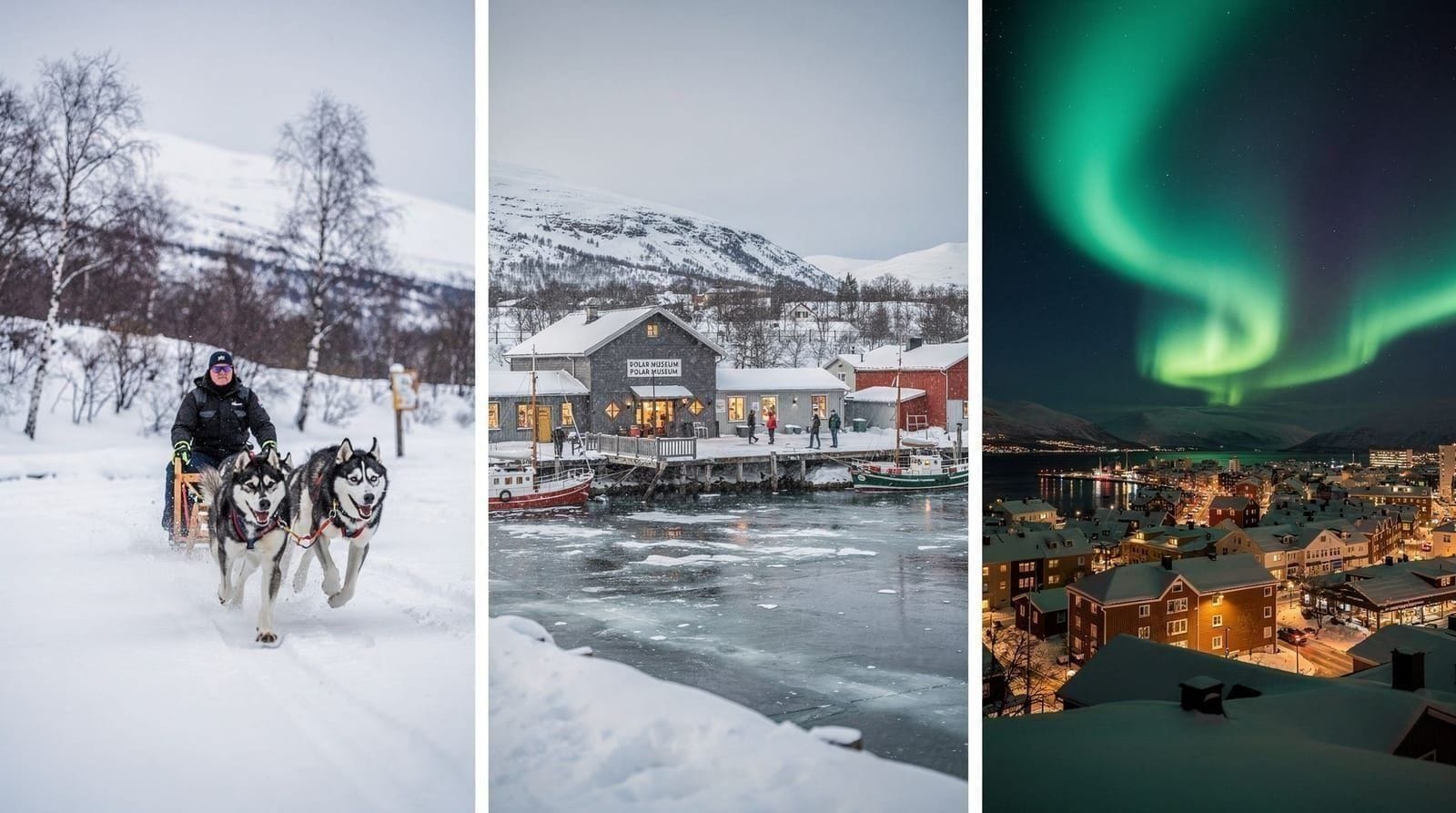
Tromsø vs Lofoten — which should you visit?
Tromsø: 1-Way Bus and Ferry Transfer to/from Lofoten
Duration: 13 hours
Should I choose Tromsø or Lofoten?
Choose Tromsø for aurora hunting, whale watching, dog sledding, and Arctic wildlife. Choose Lofoten for iconic fjord scenery, the classic rorbuer villages, and dramatic landscape photography. Both are excellent — the decision depends on whether activities or landscapes are your priority.
Two of Norway’s best destinations — not interchangeable
| Choose Tromsø for | Aurora hunting infrastructure, whale watching, dog sledding, city amenities |
| Choose Lofoten for | Iconic fjord-village scenery, landscape photography |
| Getting there | Tromsø: direct flights, 4–6hrs from hubs; Lofoten: fly to Bodø + ferry/drive |
| Cost | Similar overall; Lofoten’s rorbuer accommodation carries a premium |
| Doing both | Possible in 10–12 days; rushed in 7 |
Tromsø and Lofoten are both in the Norwegian Arctic, both served by the aurora, both surrounded by fjords and mountains, and both regularly appear on “best of Norway” lists. But they offer fundamentally different experiences, and the choice between them should not be made by flipping a coin.
The core difference
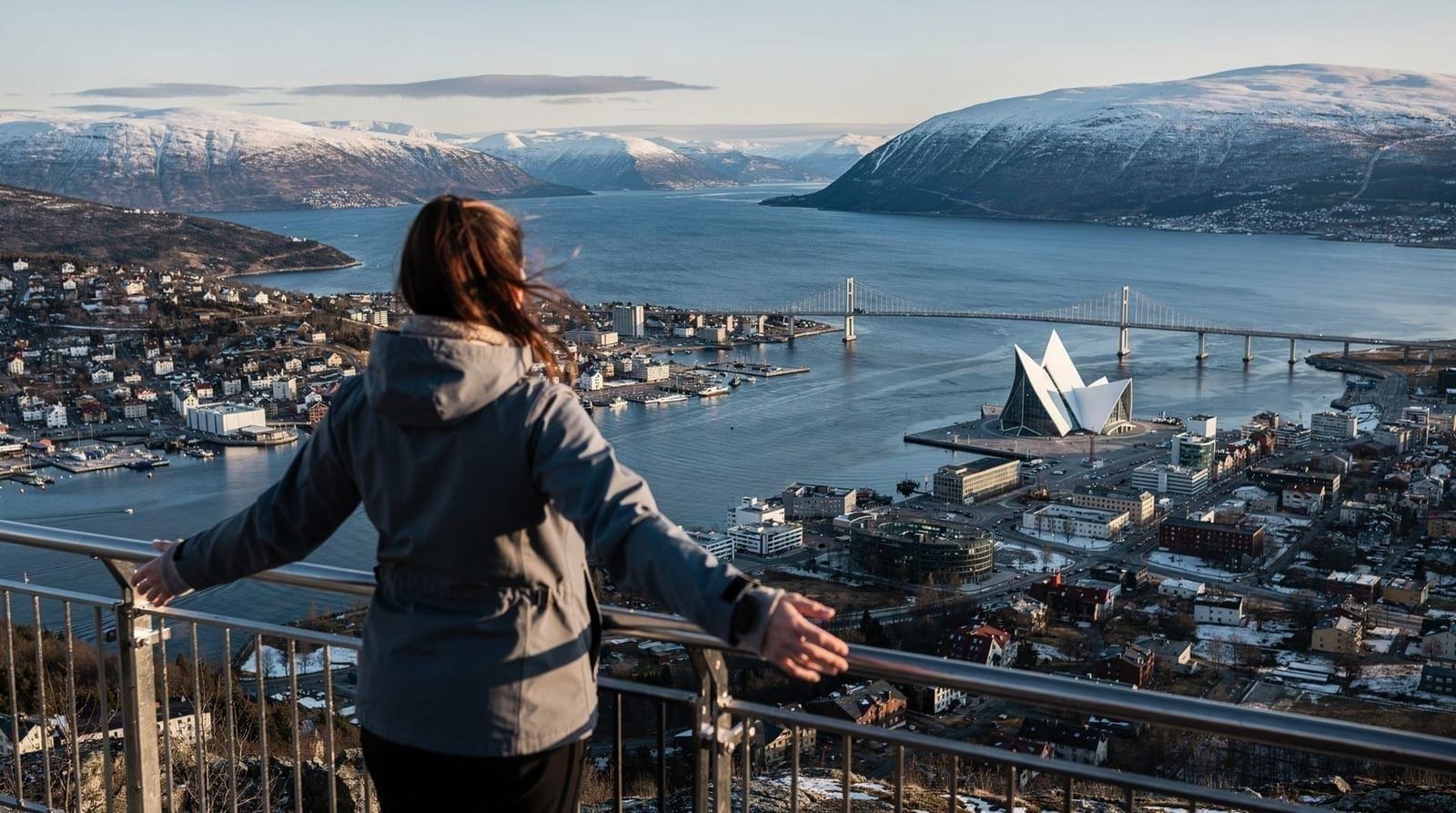
Tromsø is a functioning Arctic city (78 000 people) with excellent infrastructure, a diverse activity offering, and the best-developed aurora hunting ecosystem in the world. The wilderness is close — 20–30 minutes by car — but you return to hotel beds, restaurants, and all city amenities.
Lofoten is an island chain connected to the mainland by a single road and ferry. The iconic rorbuer (red and yellow fishing cabins perched over Arctic fjords) are the defining visual. It is quieter, wilder-feeling, and the landscape more dramatically photogenic in a classic Norwegian sense.
Aurora: the north lights performance test
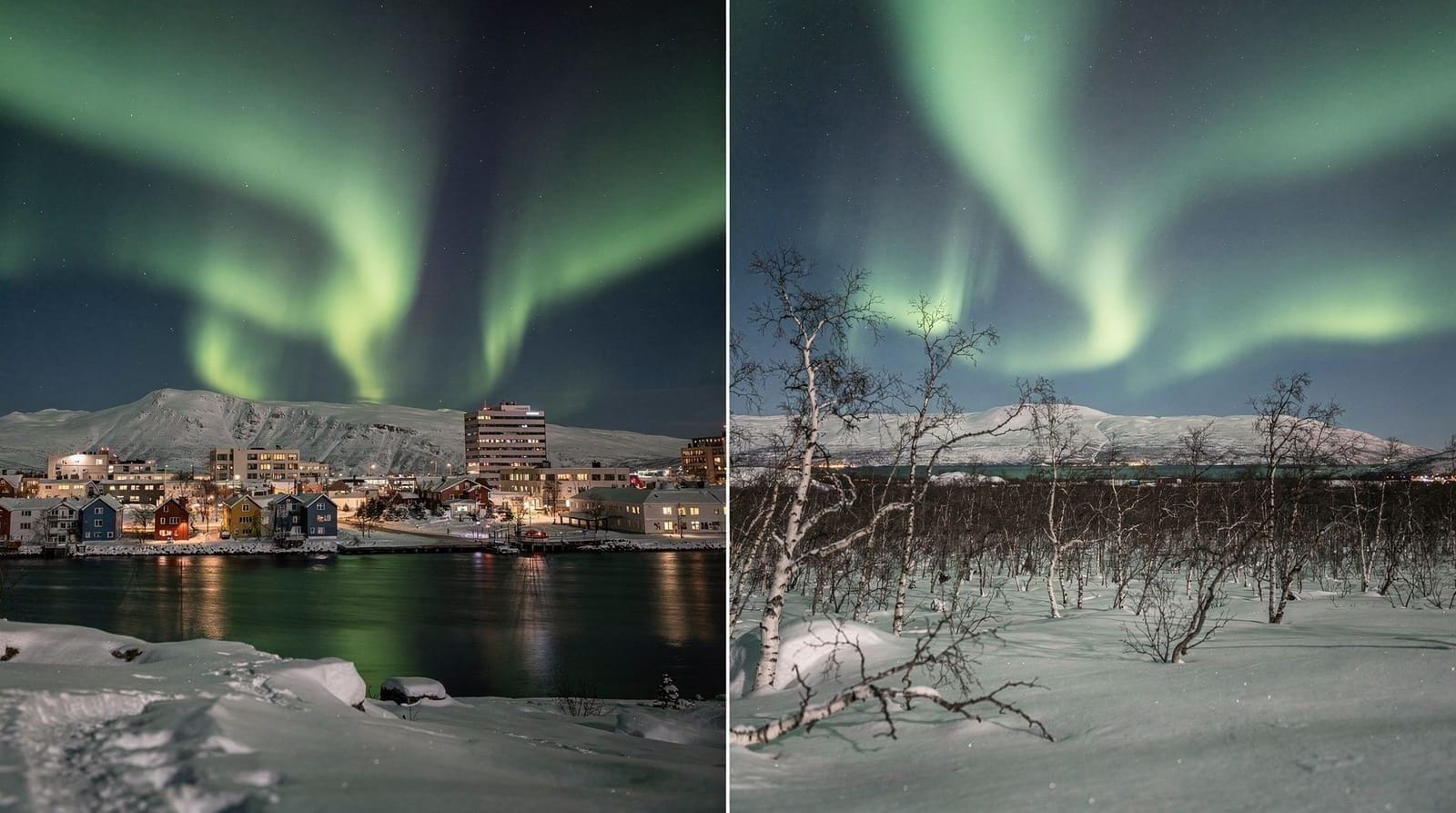
Both locations sit within the auroral oval. The question is not “where does aurora appear?” — it appears equally in both. The question is “where is it easier to find the aurora when it does appear?”
Tromsø advantages for aurora:
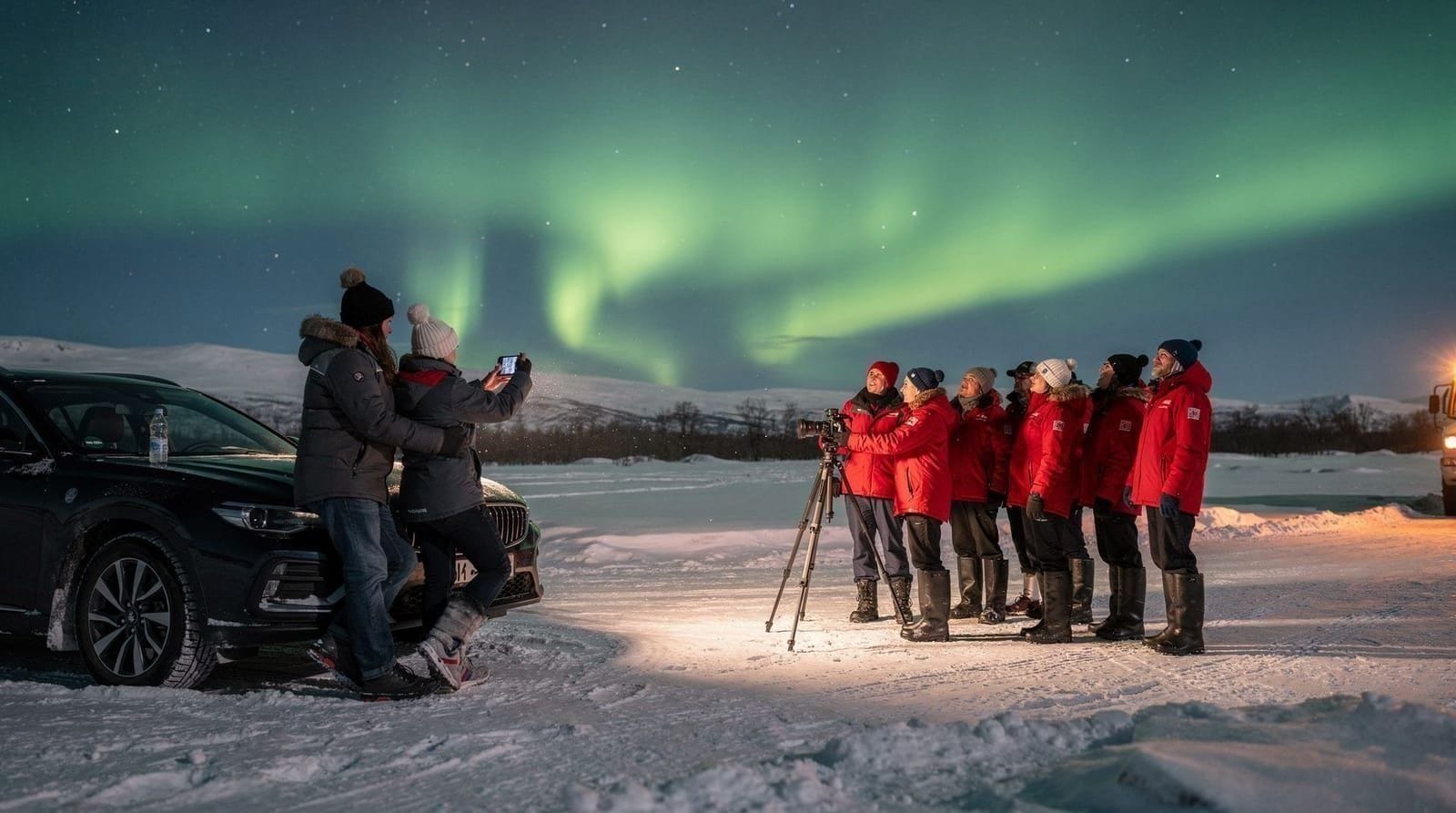
- 50+ licensed aurora tour operators with 4x4 vehicles, cloud-chasing strategies, and established viewpoints
- Ability to drive east toward Finland in 2 hours to escape coastal cloud systems
- Larger operator pool means more tour availability on short notice
- Better weather forecasting infrastructure (local guides check 6–8 forecasting services)
Lofoten advantages for aurora:
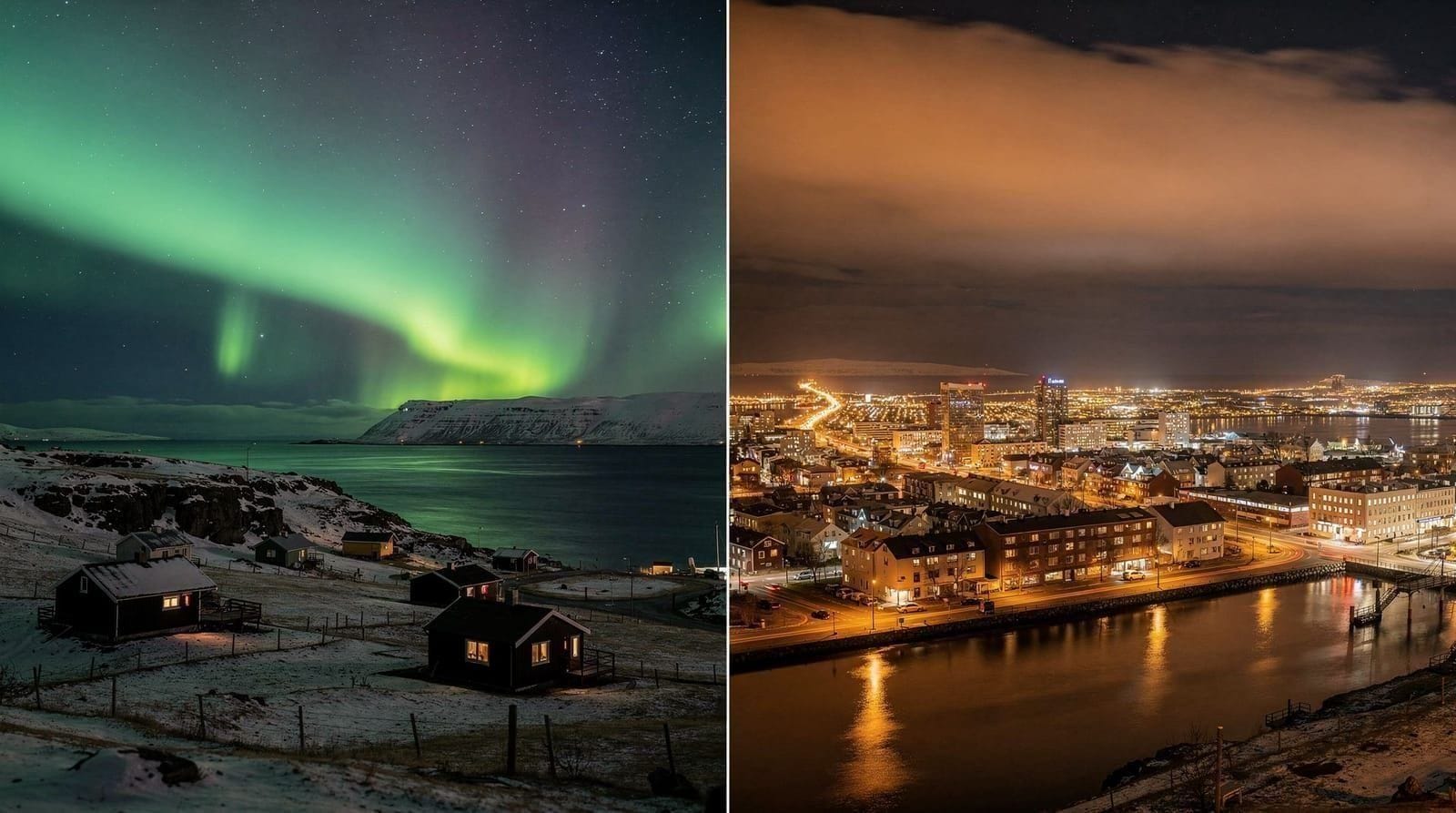
- The backdrop behind the aurora — rorbuer reflected in still fjord water, jagged mountain silhouettes — is more photogenic than Tromsø’s urban surrounds
- Less light pollution in remote Lofoten villages
- Storm-clearing can happen faster on the island chain
Verdict for aurora: Tromsø has a meaningful practical advantage for maximising aurora viewing probability. Lofoten produces better photos when the aurora does appear. If your goal is to see aurora, go to Tromsø. If your goal is to photograph it beautifully, go to Lofoten and accept slightly lower probability.
Whale watching: no contest
Whale watching is not a meaningful Lofoten activity. Orca and humpback whales concentrate near Skjervøy (north of Tromsø) following the herring stock. Lofoten occasionally has whale sightings, but not in any reliable or tour-supported way.
If whale watching is on your list, Tromsø (or Skjervøy specifically) is the only serious answer in Norway. See whale watching season in Tromsø and Skjervøy vs Tromsø for whale watching for the full picture.
Landscape and photography
This is where Lofoten wins convincingly. The combination of sheer sea-cliff mountains dropping directly into sheltered bays, traditional wooden fishing villages, and reflective fjord water produces the most photogenic coastal landscape in Norway — and arguably in Europe.
The classic shots: Reine village from above, the Flakstadøya winter beach, Nusfjord at dawn, Henningsvær reflected in the lagoon.
Tromsø’s landscape around the city is dramatic but less immediately photogenic in the concentrated, Instagram-friendly way that Lofoten delivers. The real landscape reward near Tromsø is Senja (often called “Lofoten without the crowds”) and the Lyngen Alps — both excellent, but requiring a day trip investment.
Cost comparison
| Item | Tromsø | Lofoten |
|---|---|---|
| Mid-range hotel (per night, double) | 1 800–2 800 NOK | 1 200–2 200 NOK (standard); 2 500–5 000 NOK (rorbuer) |
| Aurora/activity tour | 1 800–2 500 NOK | 1 500–2 200 NOK |
| Restaurant main course | 200–400 NOK | 180–350 NOK |
| Rental car (per day) | 800–1 400 NOK | 900–1 500 NOK (limited supply) |
Lofoten can be slightly cheaper for accommodation if you accept non-iconic accommodation. The famous rorbuer cost premium is significant. Rental car availability in Lofoten is limited, particularly in summer — book months in advance.
Getting there
Tromsø: Direct flights from Oslo (1.5h), Bergen, Trondheim, and international routes including London (SAS). Airport TOS is 4 km from the centre. Easy to get to from any Norwegian city.
Lofoten: No direct international flights. You fly to Bodø (from Oslo, 1.5h) then ferry or drive across. Alternatively, fly to Svolvær (SVJ) — small airport, served by Widerøe from Bodø and a handful of other cities. The famous Bodø ferry to Moskenes takes 3.5 hours and runs year-round. More complex to reach than Tromsø.
Bus and ferry transfer from Tromsø to LofotenDoing both: is it realistic?
For a 7-day trip, doing both is possible but stressful. Realistic itinerary:
- Days 1–4: Tromsø (aurora, whale watching)
- Day 5: Transfer day (fly Tromsø–Bodø, 1h) then drive to Svolvær (3h including ferry)
- Days 6–7: Lofoten highlights (Reine, Henningsvær, one hike)
This works but leaves both destinations feeling rushed. Better to allocate 5 days each over 10–12 days total, or choose one for this trip and return for the other. A 3-day Tromsø winter itinerary gives a sense of how tightly the Tromsø half alone can be packed before adding a Lofoten extension on top.
Senja day trip from Tromsø — a Lofoten-like landscape without the detourFrequently asked questions about Tromsø vs Lofoten
Is Lofoten better than Tromsø for a first-time Norway visitor?
Depends on the season. In summer, Lofoten is more immediately rewarding for most visitors — the landscape is world-class, accessible, and photographically striking. In winter, Tromsø’s activity offering (aurora, whale watching, dog sledding) makes it the better choice for an activity-focused Arctic experience.
Is Senja a good alternative to Lofoten?
Yes, and worth serious consideration. Senja island (2.5 hours from Tromsø) has similar sea-cliff mountain landscape to Lofoten, significantly fewer tourists, and is included in day-trip distance from Tromsø. Many photographers who visit both prefer Senja for accessibility and solitude. The trade-off is fewer facilities and services than Lofoten villages.
Can I take the Hurtigruten between Tromsø and Lofoten?
Yes. The Hurtigruten coastal steamer stops at Tromsø and at Svolvær in Lofoten on its route between Bergen and Kirkenes. The northbound journey (Tromsø to Svolvær) takes approximately 16–18 hours as the ship calls at intermediate ports. The southbound journey (Tromsø to Svolvær going south) is shorter at around 10–12 hours. This is a leisurely, scenic option but not a fast way to travel.
Which has better hiking overall?
Both have excellent hiking. The Lofoten ridge hikes (Reinebringen, Ryten, Munken) have more dramatic vertical exposure and sea views. Tromsø-area hikes (Tromsdalstinden, Lyngen Alps day routes) are more technically demanding for experienced mountain walkers. For Instagram-worthy accessible hikes, Lofoten edges ahead. For experienced hikers wanting remote terrain, Lyngen Alps.
Is Lofoten worth visiting in February?
Yes — February is actually Lofoten’s best season for landscape photography. The light is extraordinary (low-angle golden hour for hours), snow covers the mountains, the famous stockfish racks are full, and crowds are near zero. Aurora is active. The main challenge is that some tourist facilities (restaurants, accommodation) have limited winter opening hours.
Which destination gives better value for money?
This depends on what you count as value. Tromsø gives better value for activity-focused visitors — more operators, more variety, better infrastructure. Lofoten gives better value for landscape-focused visitors who primarily want to hike, photograph, and absorb a different way of life. Both are expensive. Neither is “cheap.”
If I have exactly one week, which should I pick?
Pick one rather than splitting the week. Seven days in Tromsø lets you build in multiple aurora attempts, a whale watching trip, and a day activity like dog sledding without feeling rushed; seven days in Lofoten gives enough time for the classic viewpoints and at least one or two proper hikes. Splitting a single week between both means transfer days eat into what should be experience time in each place.
Does either destination handle bad weather better?
Tromsø has the edge here simply through activity variety — a rained-out hiking day can pivot to a museum, the library, or an indoor market. Lofoten’s activity menu is thinner outside hiking and photography, so a stretch of bad weather has fewer alternative options to fall back on.
Dog sledding, reindeer, and winter activities
For Arctic winter activities beyond aurora and landscape, Tromsø has a clear advantage:
Dog sledding: Camp Tamok in the Tamokdalen valley (30 minutes from Tromsø) runs one of Norway’s best self-drive husky operations. The alternative near Lofoten involves driving to Narvik (2.5 hours from Svolvær) or booking specialty operators who visit from the mainland. Tromsø’s proximity to Camp Tamok makes dog sledding a half-day activity rather than an expedition.
Reindeer and Sami culture: The Tromsø region has several established Sami family operations offering reindeer experiences at various price points (1 200–3 000 NOK). Lofoten has limited Sami cultural tourism given its distance from the main reindeer herding territories.
Snowmobile safaris: Multiple operators in Tromsø run snowmobile tours into the Lyngen Alps. Lofoten’s snowmobile terrain exists but the operator ecosystem is smaller.
King crab safaris: Tromsø-area operators run king crab fishing experiences from autumn through spring. This is entirely absent from Lofoten’s activity offering.
For a complete Arctic winter experience beyond landscape photography, Tromsø dominates. Visitors who specifically want Lofoten’s distinctive rorbuer architecture, stockfish culture, and concentrated fjord-village aesthetic should make Lofoten their primary destination — but those wanting the breadth of Arctic outdoor activities will find Tromsø more rewarding.
Food and drink: a genuine difference
Tromsø’s eating scene is a functioning city’s restaurant ecosystem. The Tromsø food scene includes several dedicated Arctic cuisine restaurants, a craft beer culture anchored by Mack Brewery (Norway’s northernmost), king crab dining experiences, and international options. The city is large enough to sustain year-round restaurant business, so quality is maintained outside peak tourist season.
Lofoten’s eating scene peaks in summer when fishing is active and restaurants operate at full capacity. The seasonal restaurant Anita’s Sjømat in Svolvær is genuinely outstanding for fish burgers made with today’s catch. The Lofoten Rorbuer resort near Reine serves upscale Arctic tasting menus. But in January–February, many Lofoten restaurants operate reduced hours or close for renovation. Eating in winter Lofoten requires planning and flexibility that Tromsø does not demand.
The food experience that is uniquely Lofoten: eating dried stockfish (tørrfisk) in a fishing village where the racks of drying fish are literally outside the window. This is an authentic, irreproducible Lofoten moment. Tromsø can serve stockfish — but not with that context. Tromsø’s equivalent unique food experience is Arctic king crab, hauled and eaten the same day; see the Arctic cuisine guide for where to find it.
The “Instagram vs reality” question for both destinations
Both destinations have a gap between social media representation and the typical visitor experience.
Lofoten’s Instagram reality gap: The iconic shots of Reine and Henningsvær require excellent light and uncrowded timing. In summer, Reine’s viewpoints have queues of 30–50 photographers from 22:00 onward. The rorbuer villages that look wild and remote on camera are, in person, very close to the road. Beautiful still — just denser with other photographers than the lone-in-the-wilderness aesthetic suggests.
Tromsø’s Instagram reality gap: The aurora photos with dramatic curtains filling the sky are accurate depictions of KP 4–5 events — but those events occur perhaps 5–10 times per winter season, not every night. Most nights produce more subtle aurora that is still genuinely beautiful but does not match the drama of the social media versions.
Both destinations are genuinely worthwhile and live up to expectations when conditions align. The expectation management question is the same for both.
If you’re still undecided, it’s worth reading the equivalent comparisons for other common aurora bases — Tromsø vs Abisko and Tromsø vs Reykjavik for aurora — since the underlying trade-off (probability and infrastructure vs. landscape and isolation) recurs across all three.
Top experiences
Bookable activities with verified prices and instant confirmation on GetYourGuide.