Tromsø vs Abisko — aurora comparison for 2026
Tromsø: Unlimited Northern Lights Chase Across Borders
Is Tromsø or Abisko better for seeing the northern lights?
Abisko has statistically better clear-sky probability due to its unique microclimate — local experts claim 50–70 clear nights per year vs Tromsø's 40–50. But Tromsø offers far more to do if aurora does not appear, more accommodation options, better flight connections, and a complete Arctic experience. Abisko is better for aurora probability alone; Tromsø is better overall.
The core question: probability vs completeness
| Aurora odds | Abisko slightly higher (microclimate); Tromsø close behind |
| Getting there | Tromsø: 4–6hrs from hubs; Abisko: 8–12hrs via Kiruna |
| What else to do | Tromsø: whales, dog sledding, city; Abisko: mostly aurora + skiing |
| Cost | Abisko aurora experience cheaper; Tromsø overall trip pricier |
| Best for | Abisko: aurora purists; Tromsø: complete Arctic trip |
If you frame the Tromsø vs Abisko question as purely “where is the best chance of seeing aurora,” Abisko has a genuine statistical advantage. Its microclimate produces more clear-sky nights than the Norwegian coast.
But most travellers do not fly to the Arctic solely to stand in a field waiting for lights. The more useful question is: “Given a finite budget and a limited number of nights, which destination gives me the best overall Arctic experience while maximising aurora probability?”
The answer to that broader question is more complex — and frequently favours Tromsø.
The Abisko microclimate advantage: real but overstated
The Abisko microclimate is real. The Torneträsk lake (170 km long, 7 km wide) moderates local air temperature, and the Scandinavian mountain range to the west blocks Atlantic weather systems before they reach the lake basin. The result is a local weather pattern that produces significantly more clear nights than Tromsø, which sits on a coastal island exposed to Atlantic weather.
The numbers, honestly stated:
- Abisko claims 50–70+ clear nights per year
- Tromsø averages 40–50 clear nights per year in the September–March aurora window
- The difference is real but means that on a 5-night trip to either location, the probability gap is not as dramatic as the marketing suggests
The Aurora Sky Station at Abisko adds a further advantage: the cable car ascends to 900 metres, which on nights with a cloud base of 600–800 metres puts you above the clouds entirely. This is a genuine edge that no Tromsø operator can match.
However: The Abisko microclimate is most effective when Atlantic systems roll in from the west. On nights with cloud cover from the east (less common but not rare), Abisko’s advantage disappears. No microclimate beats the wrong synoptic weather pattern. For a fuller explanation of Kp values and how forecasting works regardless of location, see aurora forecast and Kp explained.
What Tromsø has that Abisko cannot match
Whale watching
The orca and humpback concentration near Skjervøy (2.5 hours north of Tromsø) is one of the world’s best accessible wildlife encounters. Abisko has no equivalent whale watching option within reasonable distance. See whale watching season in Tromsø for timing.
Dog sledding and reindeer experiences
Both are available near Tromsø with established operators, Camp Tamok infrastructure, and various tour options. Abisko has dog sledding but on a much smaller scale with less operator variety. The Lyngen Alps and Senja day trips add further variety Abisko simply doesn’t have within reach.
Infrastructure and accommodation variety
Tromsø has 78 000 residents, full city services, hospitals, 50+ accommodation options across all price tiers, and a restaurant scene with genuine variety. Abisko has the Turiststation (hostel), one small hotel, and a handful of basic cabins. There are no restaurants outside the Turiststation dining room.
Tour operator ecosystem
Tromsø has 50+ aurora tour operators in intense competition, which means aggressive pricing, quality variation, and innovation (small-group 4x4, Tesla tours, overnight camps). Abisko’s aurora experience is primarily the Sky Station gondola and unguided self-exploration.
Connectivity
Tromsø (TOS) has direct flights from Oslo, Bergen, Trondheim, and London. Abisko requires flying to Kiruna (via Stockholm only) or Narvik (via Oslo) and then ground transport. The journey from a major European hub to Abisko takes 8–12 hours; to Tromsø, 4–6 hours.
The “unlimited chase” option from Tromsø
One strategic option is to base yourself in Tromsø and, on nights with adverse cloud cover, drive east toward Abisko. The distance (300 km via E8 and E10 through Narvik) can be covered in 3–4 hours. Some Tromsø aurora operators run “unlimited chase” tours that drive into Sweden if necessary:
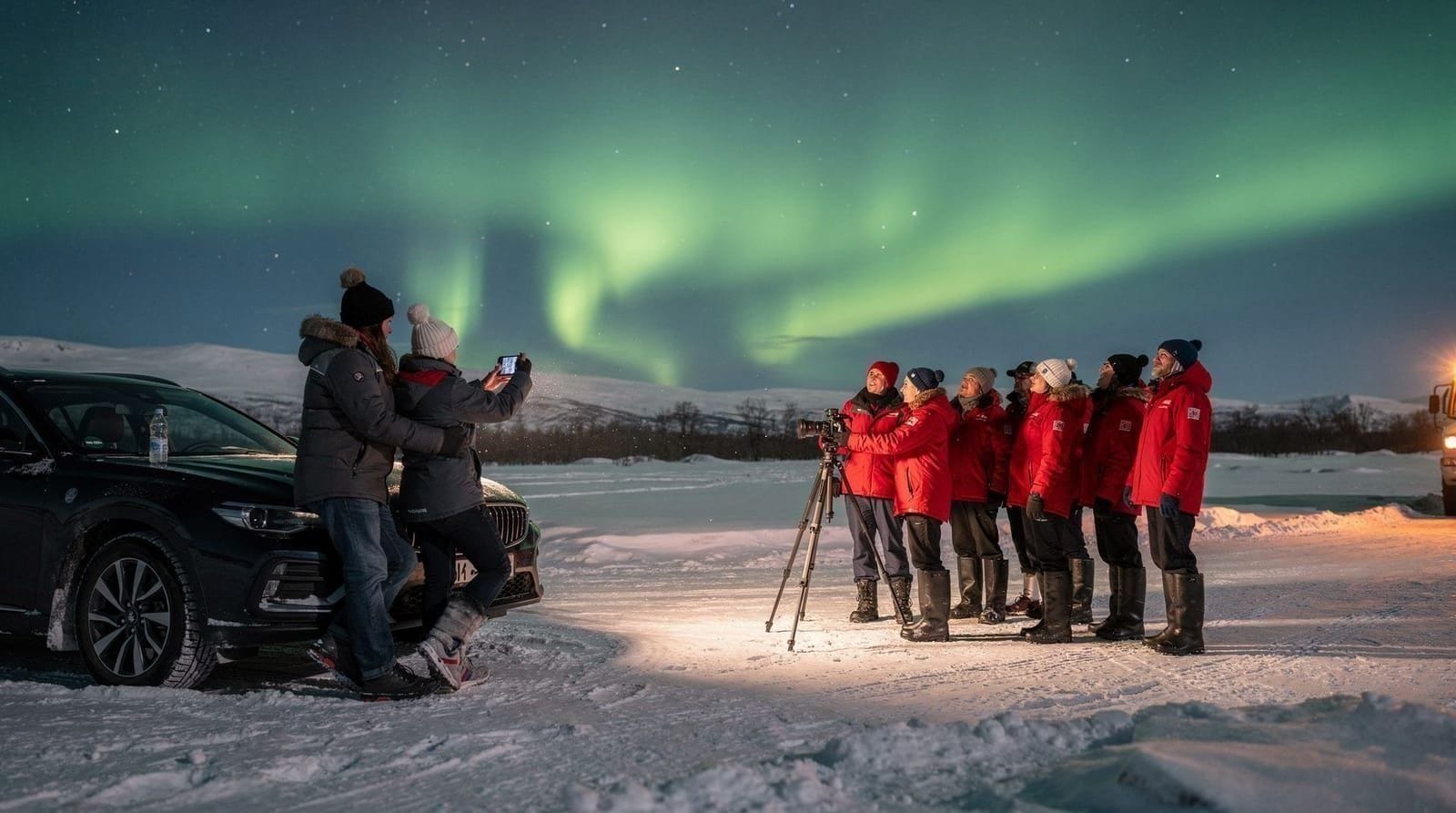
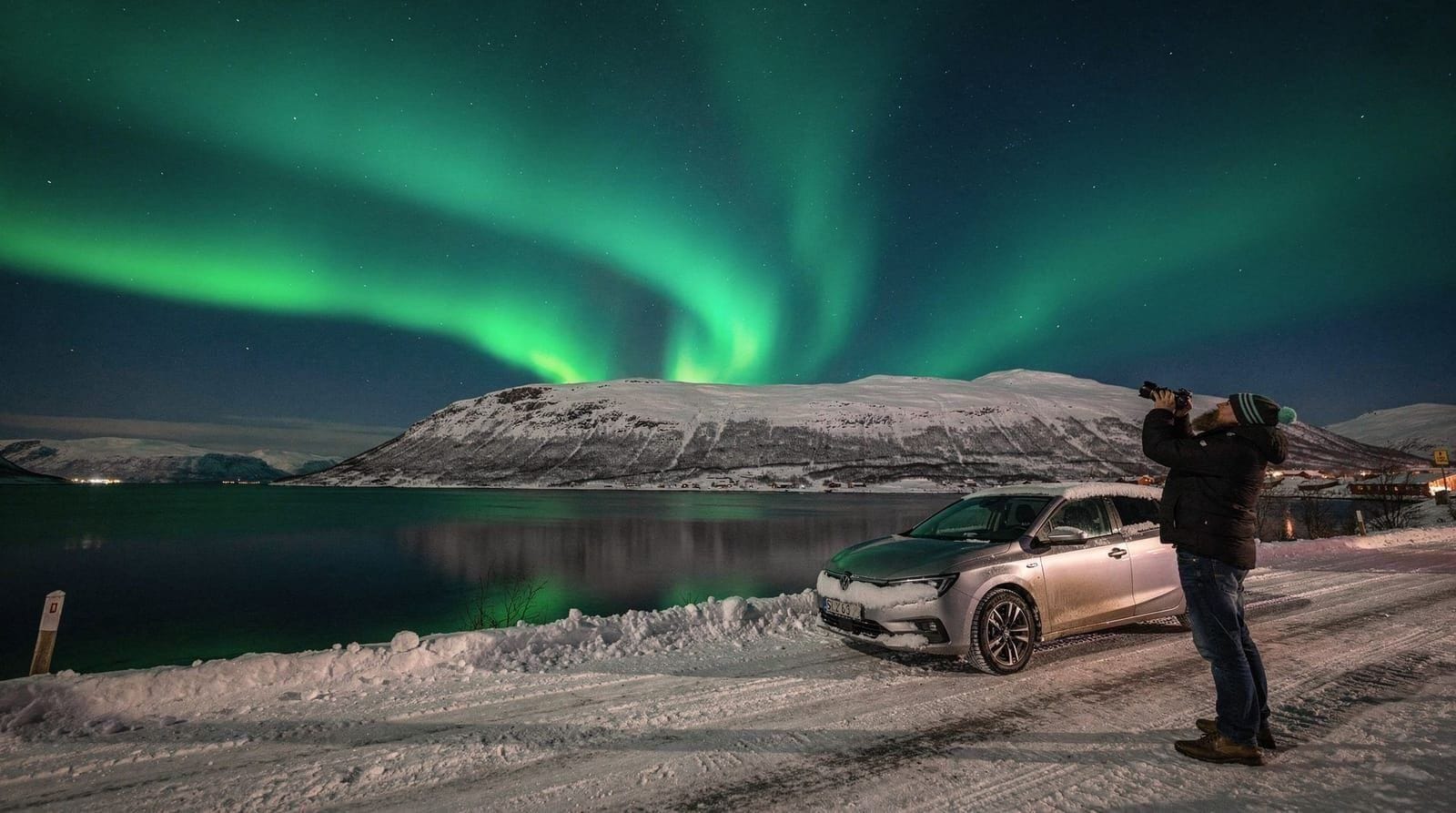
Northern lights unlimited chase across bordersThis hybrid strategy — Tromsø city base with eastward cloud-dodging into Sweden — provides Tromsø’s complete activity offering plus access to the better clear-sky statistics of the Swedish interior when Norwegian coastal cloud is thick. For the broader self-drive-versus-guided debate that applies to this kind of chase, see self-drive vs guided aurora and self-drive aurora in Tromsø.
Cost comparison: a real difference
| Item | Tromsø (NOK) | Abisko (SEK, approx.) | Abisko in NOK |
|---|---|---|---|
| Hostel dorm (per night) | 400–550 NOK | 400–650 SEK | 450–730 NOK |
| Double room (basic) | 1 200–2 000 NOK | 800–1 400 SEK | 900–1 570 NOK |
| Aurora experience | 1 800–2 500 NOK | 350 SEK (Sky Station) | 390 NOK |
| Meal (mid-range) | 200–350 NOK | 150–280 SEK | 170–315 NOK |
The Abisko Aurora Sky Station at effectively 390 NOK is dramatically cheaper than any Tromsø aurora tour. If pure cost-per-aurora-probability is your metric, Abisko wins. If you want a complete Arctic holiday with multiple activities and city amenities, Tromsø’s premium is justified.
Who should choose Abisko
- Budget travellers with a single-minded focus on aurora photography
- Visitors who find city environments distracting and prefer genuine wilderness isolation
- Photographers who specifically want altitude above clouds and uninhabited landscape backdrops
- Train travellers doing a Stockholm–Kiruna–Abisko sleeper train journey as part of a Scandinavian rail trip
- Visitors who have already done Tromsø and want a different aurora base for a return trip
Who should choose Tromsø
- First-time Arctic visitors who want a complete experience, not just aurora
- Those with family, non-aurora interested companions, or those who need city amenities
- Visitors for whom whale watching is a priority
- Anyone flying directly from an international hub (non-European visitors especially, for whom the flight to Kiruna adds a full extra day of travel)
- Dog sledding, snowmobile, and reindeer experience seekers
- Visitors who want a 1-week itinerary that works whether or not aurora appears
The hybrid approach: both in one trip
The most practical combined itinerary:
Day 1–2: Fly to Tromsø, arrive, settle, city orientation, whale watching if season appropriate Day 3–4: Tromsø aurora hunting nights, day activities (dog sledding, Senja, Lyngen) Day 5: Drive E8/E10 to Abisko (5 hours) via Narvik Day 6–7: Abisko Aurora Sky Station, snowshoeing or cross-country skiing, wilderness setting Day 8: Drive back to Tromsø (5 hours), fly home
This provides the best of both and allows you to make a weather-based decision on day 5 — if Tromsø has a clear forecast, extend there; if the Swedish interior looks clearer, drive east.
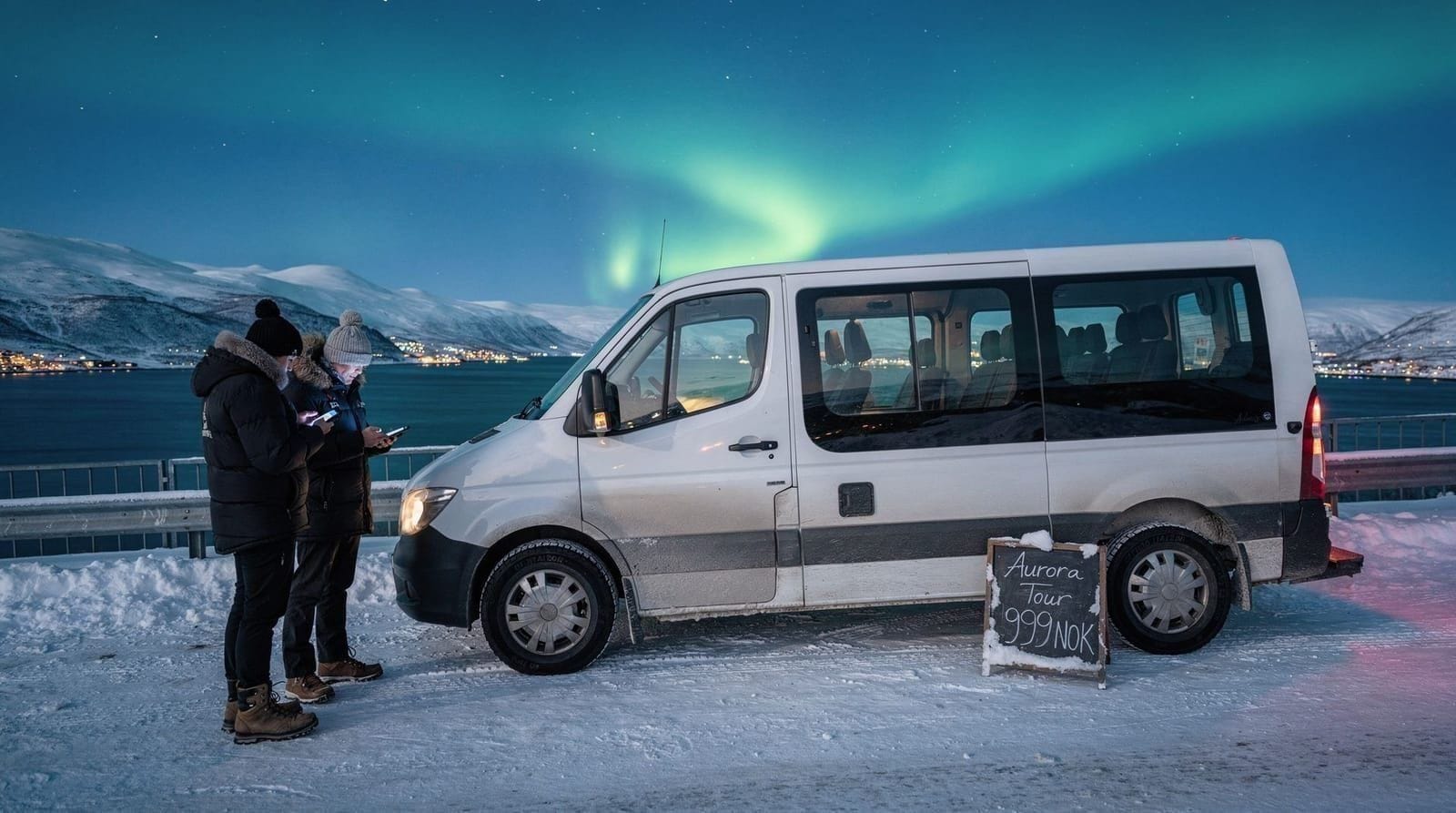
Northern lights safari with expert guides — Tromsø’s reliable small-group optionIf you’re weighing Tromsø against other aurora bases rather than Abisko specifically, Tromsø vs Lofoten and Tromsø vs Reykjavik for aurora cover the other common comparisons, and best time to see the northern lights in Tromsø sets expectations regardless of which base you choose.
Frequently asked questions about Tromsø vs Abisko
Is the drive from Tromsø to Abisko safe in winter?
The E8 from Tromsø to Narvik and E10 from Narvik to Abisko are both well-maintained in winter. The road through Narvik can be challenging on steep sections but is prioritised for ploughing. With a rental car fitted with studded tyres (standard in Norway and Sweden in winter), the drive is manageable for experienced winter drivers. The road crosses mountains and fjords — check conditions on vegvesen.no (Norway) and trafikverket.se (Sweden) before departing.
Does Abisko have aurora tours with guides?
Abisko Turiststation offers guided aurora excursions on snowshoes or by snowmobile, but the offering is more limited than Tromsø’s 50+ operators. The primary aurora experience at Abisko is the unguided Aurora Sky Station (cable car to 900 m). Self-sufficiency is more expected at Abisko than in Tromsø.
Is Abisko better for aurora photography specifically?
Abisko has advantages: altitude above clouds, dark sky (no city light), and dramatic wilderness backdrops. Tromsø offers more varied backdrops (fjord reflections, mountain silhouettes, city lights in the foreground for certain compositions) and more experienced photography tour guides. Photography preference is ultimately subjective; aurora probability at Abisko is slightly higher on average.
Can you go from Abisko to Kiruna for activities?
Yes. Kiruna (115 km from Abisko) has a genuine town infrastructure, the famous ICEHOTEL at Jukkasjärvi (10 km from Kiruna), dog sledding operations, and Sami cultural experiences. It is a reasonable 1.5-hour extension of an Abisko stay.
What if it is cloudy at both Tromsø and Abisko simultaneously?
It happens. A major Atlantic weather system can cloud both the Norwegian coast and the Swedish interior for several days. In those cases, the only option is to wait, or to drive further south toward the clearer latitudes of central Scandinavia. This is the fundamental unpredictability of Arctic aurora hunting that no destination can fully overcome.
Which is better for solo travellers?
Both are manageable solo. Tromsø has more solo traveller infrastructure (hostels, group tours, city socialising). Abisko requires more self-sufficiency — the Turiststation is friendly but the setting is genuinely remote. For solo travellers wanting to meet others on aurora tours, Tromsø’s group tour ecosystem makes socialising easier.
Is one destination clearly cheaper for a full trip, not just the aurora activity?
Not necessarily. Abisko’s aurora experience itself is cheaper, but flights are more expensive and time-consuming via Kiruna, and there’s little else to spend money on locally. Tromsø’s aurora tours cost more individually, but the wider range of activities and better flight value can even out the total trip cost depending on what you do.
Which is better if I only have 3 days?
Tromsø, generally — the travel time to Abisko alone can consume most of a day each way, leaving little time for aurora attempts on a short trip. A 3-day Tromsø visit gives you multiple aurora nights plus city activities as backup if the sky doesn’t cooperate.
Top experiences
Bookable activities with verified prices and instant confirmation on GetYourGuide.