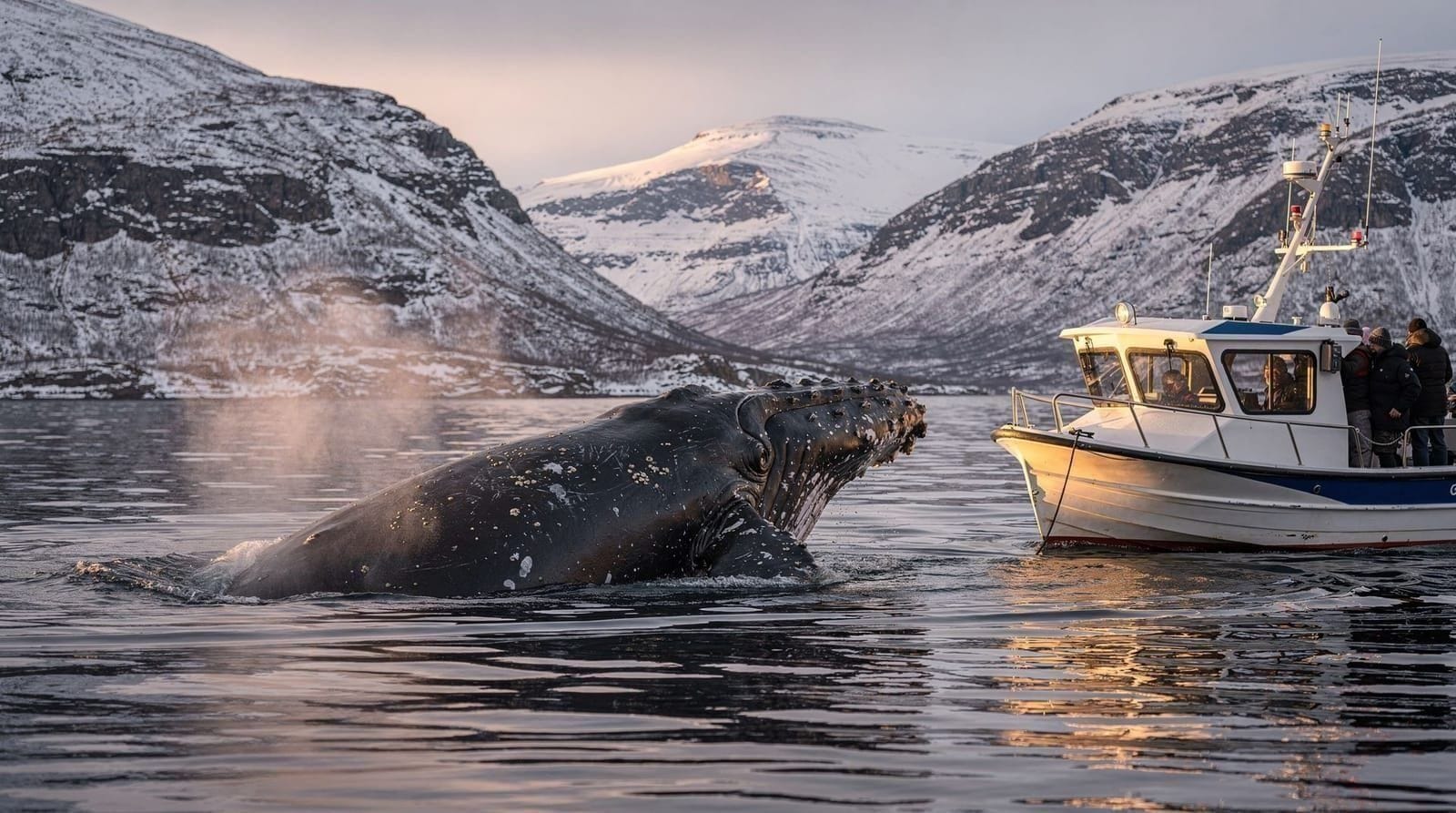
Whale watching at Skjervøy — honest review for 2026
From Tromsø: Skjervøy Whale Watching RIB Boat Tour
Duration: 12 hours
| Location | Skjervøy, ~130 km / 2h north of Tromsø |
| Duration | 3–5h on the water; 10–13h full day from Tromsø |
| Cost | around 800–3,500 NOK depending on format |
| Best months | November–December peak; January still good |
| Boat type | RIB (fast, close) or larger enclosed vessel (comfort) |
Why Skjervøy is the best place for whale watching near Tromsø
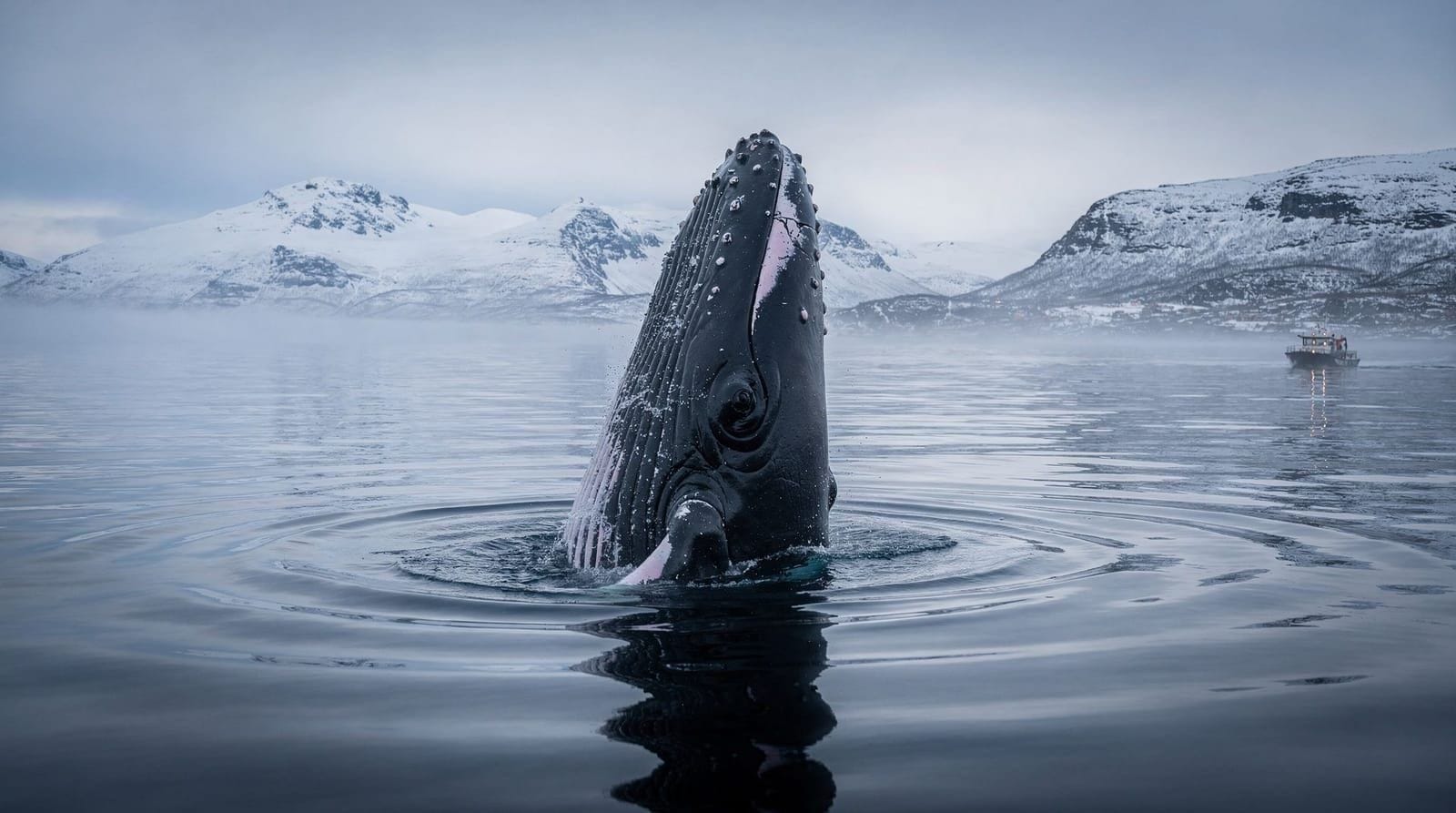
Skjervøy is a small fishing town about 130 km north of Tromsø, connected by E6 and a short bridge. It sits at the entrance to the Kvænangen fjord system where the Norwegian Sea’s Atlantic herring (norsk vårgytende sild) spend the winter. Orca follow the herring. Humpbacks follow the orca. The concentration of cetacean activity in this 30-km stretch of fjord during November–January is among the highest in northern Europe.
This is why serious whale watching operators either base themselves in Skjervøy or run dedicated day trips from Tromsø specifically to reach this area — not simply the fjords immediately around Tromsøya island.
The journey from Tromsø to Skjervøy by road takes roughly 2 hours. Tours that include this transfer in the package price are more expensive than local operators based in Skjervøy, but if you’re making the trip as a day trip from Tromsø, the bundled transport is convenient.
RIB versus catamaran: the real comparison
The choice between a rigid inflatable boat (RIB) and a larger motorized catamaran or vessel dominates the planning process for most visitors. Here is the honest breakdown:
RIB boats (inflatable hull, twin outboards)
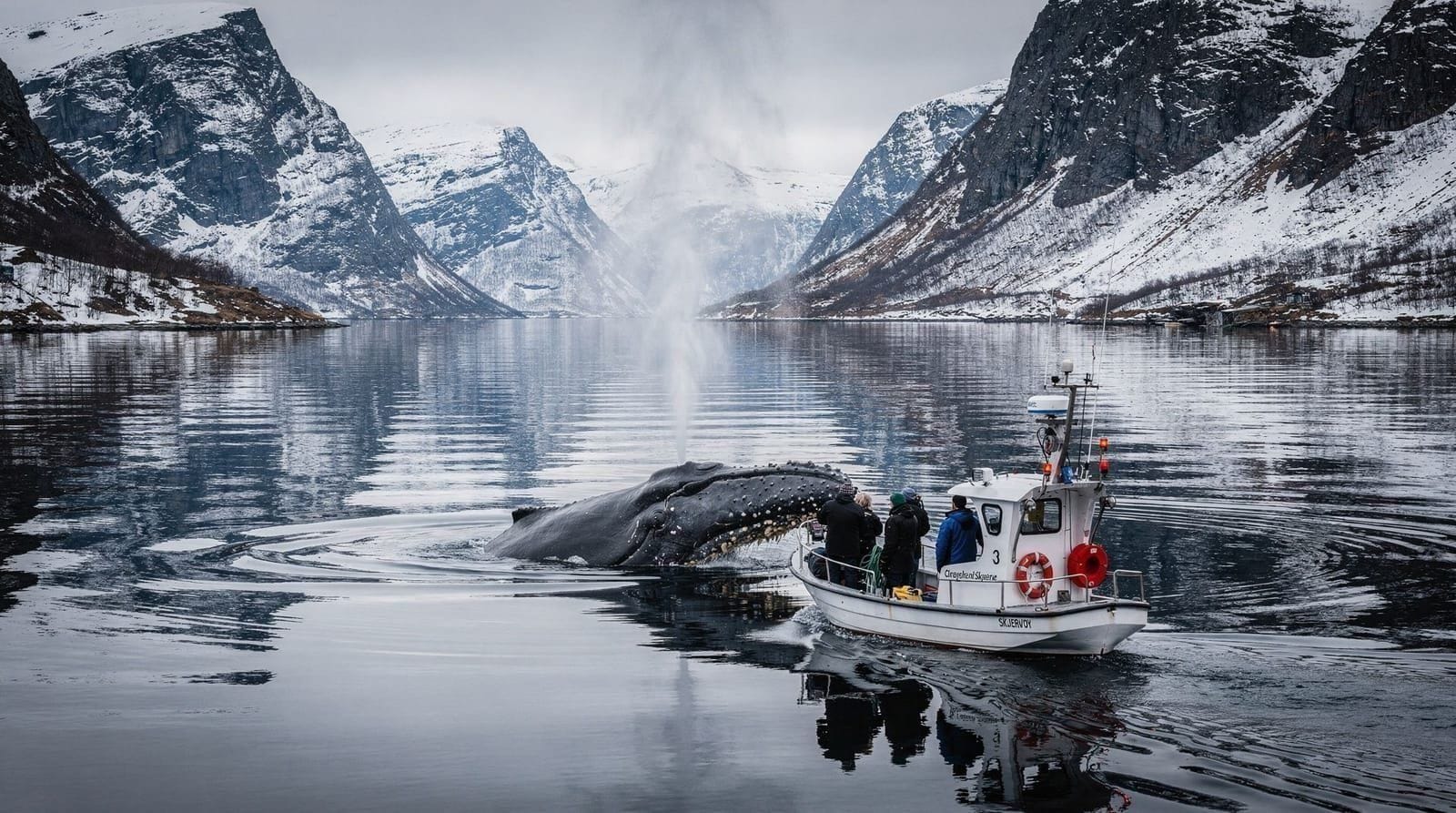
- Travel at 40–60 knots, closing distance to whale activity in minutes
- Typically seat 8–14 passengers in survival suits
- Survival suits (dry suits with thermal lining) are mandatory and provided
- The experience is physically intense: spray, vibration, cold even in dry suits
- Superb for photography — you can approach whale groups more closely
- Not suitable for anyone with back or joint problems (slamming over waves)
- Excellent operators have radio contact with multiple RIBs to triangulate whale positions
Larger enclosed vessels
- Slower but much more comfortable: heated interior, deck space to move around
- Suitable for families, older visitors, anyone prone to seasickness
- Less agile — cannot close on a whale pod as quickly or get as close
- Whale encounters are observed at greater distance
- Some operators run hybrid-electric boats that are significantly quieter — this reduces disturbance and sometimes allows closer approach before whales sound
What a full-day Skjervøy tour looks like
Most full-day tours from Tromsø depart 06:00–07:00 to reach Skjervøy by 08:30–09:30, maximizing time on the water before the short winter day ends around 14:00. Total duration is typically 10–13 hours including the drive.
On arrival at the quay you receive a briefing, put on the dry suit or heavy flotation gear, and board. Time on the water runs 3–5 hours depending on conditions and whale activity. If a large orca pod is found, the guide will hold position nearby as long as the animals stay active at the surface.
Sightings are common but never certain. On good days with active pods, you may spend 2 hours within 50 meters of multiple orca families. On quiet days you find a pod briefly, observe them for 20 minutes, and spend the rest of the time scanning. The whale watching season guide explains what drives variability.
A warm lunch is included in most premium day tours — typically Norwegian fish soup or reindeer stew. Budget tours provide a sandwich.
Prices in NOK — what you actually pay
From Tromsø (transport + whale watching)
- Economy day trip (large bus + boat): 1,500–1,700 NOK
- Small-group tour with RIB: 1,800–2,200 NOK
- Premium private or guided: 2,500–3,500 NOK
Local Skjervøy departure (if you drive yourself)
- RIB 3–4h on the water: 900–1,300 NOK
- Larger vessel: 800–1,100 NOK
The math on self-driving: car rental in Tromsø costs 800–1,200 NOK/day in winter for a 4x4. Petrol for the 260-km round trip adds roughly 350 NOK. So self-driving and booking a local Skjervøy tour works out comparable to or cheaper than a bundled day trip if there are two or more people sharing costs.
The E6 north is well-maintained and salted, but black ice forms between midnight and 08:00. Winter driving skills matter. The winter driving guide covers what to expect.
From Tromsø: whale watching in magic SkjervøyThe ethics of whale watching
Norwegian whale watching operates under a voluntary code of conduct that most professional operators follow: minimum approach distances (within 50 m for orca is controversial — 100 m is safer), maximum time near a pod, no chasing surfacing animals, and no feeding. RIBs that sprint to intercept surfacing whales stress the animals and disrupt feeding behavior.
A simple quality signal: ask whether the operator has a marine biologist or trained naturalist on board. Operations with naturalists provide better educational context and tend to be more careful about approach behavior. The whale watching ethics guide covers what responsible operators actually look like.
What to bring on a whale watching tour
- Thermal base layers (merino, not cotton) under the provided dry suit
- Wool hat that fits under the dry suit hood — the hood alone is not enough
- Camera with a long lens (200mm equivalent minimum for orca at distance, 400mm preferred)
- Extra camera batteries (cold drains them fast)
- Seasickness medication taken 1–2 hours before departure, not on the boat
- Snacks, since even tours with lunch have gaps of 4–5 hours without food
The full packing list is in the what to bring whale watching guide.
Comparing Skjervøy-based options
The catalog includes several distinct Skjervøy whale watching formats:
| Tour format | Boat type | Duration on water | Group size | Best for |
|---|---|---|---|---|
| RIB from Skjervøy | RIB | 3–4h | 8–12 | Photographers |
| Day trip from Tromsø (RIB) | RIB + minibus | 3–4h on water | 12–16 | All-inclusive convenience |
| Day trip from Tromsø (vessel) | Large boat | 3–5h on water | 20–30 | Families, seasickness-prone |
| Local guide Skjervøy | RIB | 3–5h | 6–8 | Small groups, local knowledge |
Seasickness and who should choose which boat
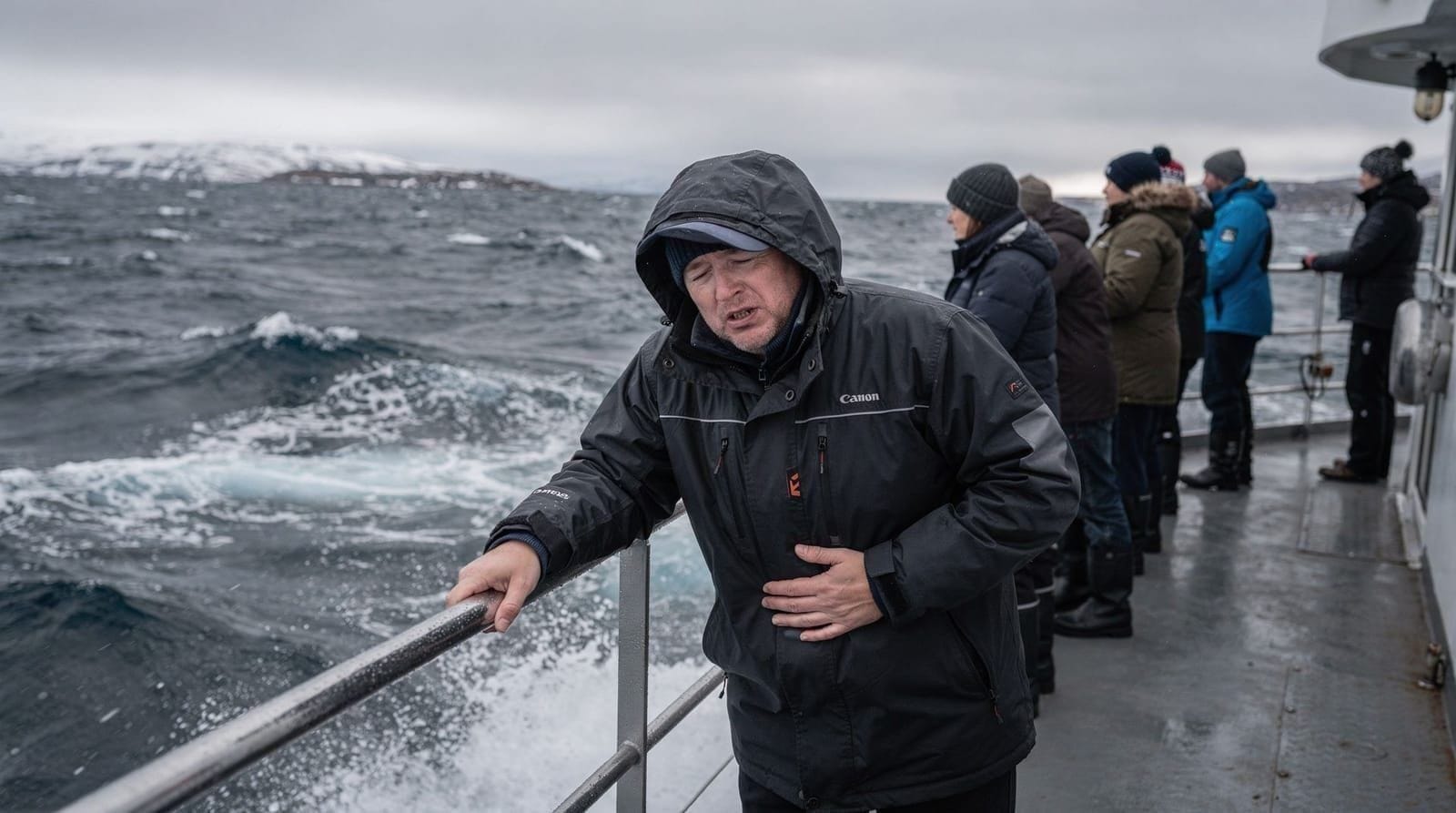
Seasickness is the most common reason visitors regret their boat choice, not cold or duration. RIBs pound over waves at speed and offer no below-deck refuge, which makes them a poor choice for anyone prone to motion sickness — the whale watching seasickness guide has the full medication and timing advice, but the short version is: take medication 1–2 hours before departure, not once you feel unwell, and choose the larger enclosed vessel if you have any doubt. Families and older visitors are almost always better served by the slower, heated boats even though the whale encounters are viewed from slightly further away.
Combining Skjervøy with the rest of a Tromsø trip
Because the round trip from Tromsø eats most of a day, most visitors treat Skjervøy whale watching as a single dedicated day within a longer stay rather than one of several activities squeezed into 24 hours. If you’re building a full itinerary, the 4-day aurora itinerary and similar multi-day plans typically place the whale watching day on its own, with lighter activities the day before and after to recover from the early start and long drive.
Frequently asked questions about whale watching at Skjervøy
What is the best month for whale watching at Skjervøy?
November and December are the peak months when large orca pods concentrate on herring. January remains good. By February, the herring migration shifts and sightings become less reliable. October tours are possible but sightings are less consistent. The whale watching season guide gives a month-by-month breakdown.
What if the tour doesn’t find whales?
Reputable operators have high sighting rates (90%+ in peak season) because local guides have daily contact with each other and know where pods were spotted in the preceding hours. Unlike aurora, whales are less affected by weather and more predictable in their seasonal range. Some operators offer rebooking if no sighting occurs.
Can I see orca from shore near Skjervøy?
Occasionally yes, from headlands on the E6 north of Tromsø between November and January, but sightings require the right tide, time of day, and luck. A boat tour provides vastly better probability. Shore sightings are a bonus, not a reliable plan.
Is Skjervøy worth visiting for anything else?
Skjervøy is a working fishing community with an active harbor. In winter it has the raw quality of Norwegian Arctic life — stockfish racks, small boats under snow, a population that treats subzero temperatures as normal. If you drive yourself, the drive north through Lyngen is spectacular.
How do orca and humpback behavior differ during viewing?
Orca in feeding mode circle herring balls in coordinated groups — you’ll see dorsal fins breaking the surface repeatedly in the same area. Humpbacks lunge-feed more dramatically but less predictably. Mixed-species encounters are common and among the most photogenic. See the orca vs humpback guide for fuller comparison.
Are there tours that combine whale watching with northern lights?
One operator runs a 24-hour combined tour — whale watching by day, aurora chase overnight. It is physically demanding (very little sleep) but eliminates the need to choose between the two. Only realistic if you have at least 3 nights in Tromsø.
Do I need travel or wildlife-viewing insurance specifically for this tour?
Standard travel insurance with winter sports and boat activity coverage is sufficient for most whale watching tours — check that your policy doesn’t exclude RIB boats specifically, since some budget policies treat high-speed boat travel differently from general “boat trips.” Operators carry their own liability and safety insurance for the vessel and crew, but that doesn’t cover your personal medical or trip-cancellation costs. Confirm coverage before booking a premium tour over 2,500 NOK.
Common mistakes when booking Skjervøy whale watching
Booking too close to the season edges. The first two weeks of October and the last two weeks of February are transitional periods where herring concentrations are less predictable. Booking mid-November through mid-January gives the best sighting rates. See the whale watching season guide for the detailed probability curve.
Choosing by price alone. The cheapest day-trip options from Tromsø use large buses (30+ passengers) and large vessels. The time from Tromsø to Skjervøy (2 hours one way) is the same regardless of operator — but larger groups mean more chaotic boarding, less time at the quay, and a slower vessel that loses time to whale activity windows. Mid-range group sizes (10–16 people) consistently outperform the budget format.
Ignoring the RIB/catamaran decision. Most people who choose a RIB expecting it to be better are correct about the photography and proximity. But they are sometimes unpleasantly surprised by the physical intensity — cold spray over the gunwales, slamming over waves at 40 knots, and sitting in the same position for 3 hours in a dry suit. Be honest with yourself about your tolerance for physical discomfort before choosing RIB over a vessel with interior cabin space.
Assuming the operator does all the logistics. If you book a “from Tromsø” day trip, transport is included. If you book a “Skjervøy local” operator directly (to save money), getting yourself to Skjervøy (130 km north, requiring a rental car or internal bus service) is entirely your responsibility. The Skjervøy destination page covers getting there independently.