The northern lights bucket list: what to tick off and what to skip
Every travel influencer has a “northern lights bucket list” that reads like an advertising catalogue. I want to do something different: rank the genuine Tromsø aurora experiences by what they actually deliver versus what they cost and what they claim to deliver. Some of these are worth the premium. Some are not.
| Best free option | Self-drive to Ersfjord or Breivikeidet |
| Best guided option | Small-group photography or cruise tour |
| Rarest sight | Full-sky corona (KP 5+) |
| Typical tour cost | 1,700–2,800 NOK per person |
| Minimum time to allow | 2–3 hours outside per attempt |
The experiences that genuinely earn their status
Aurora reflected in fjord water — not overhyped
The one image people come to Tromsø for — green lights mirrored in a perfectly still fjord — requires specific conditions that do not align reliably. You need calm winds (otherwise the fjord surface is choppy), a location with an unobstructed horizon to the north, and a display strong enough to be vivid, not just visible.
When these conditions do align, the visual effect is legitimately extraordinary. I have seen it once, near Malangen in January, with a KP 4 event over still water at -16°C. It looked exactly like the photographs and somehow also completely unlike them.
How to chase it: the fjord shores around Malangen, Lyngenfjord near Lyngen Alps, and the coast near Ersfjord on Kvaløya all offer the right combination of northward view and sheltered water. The key is cloud-free, windless nights — which are your best aurora nights anyway.
Aurora from a boat — different, worth experiencing
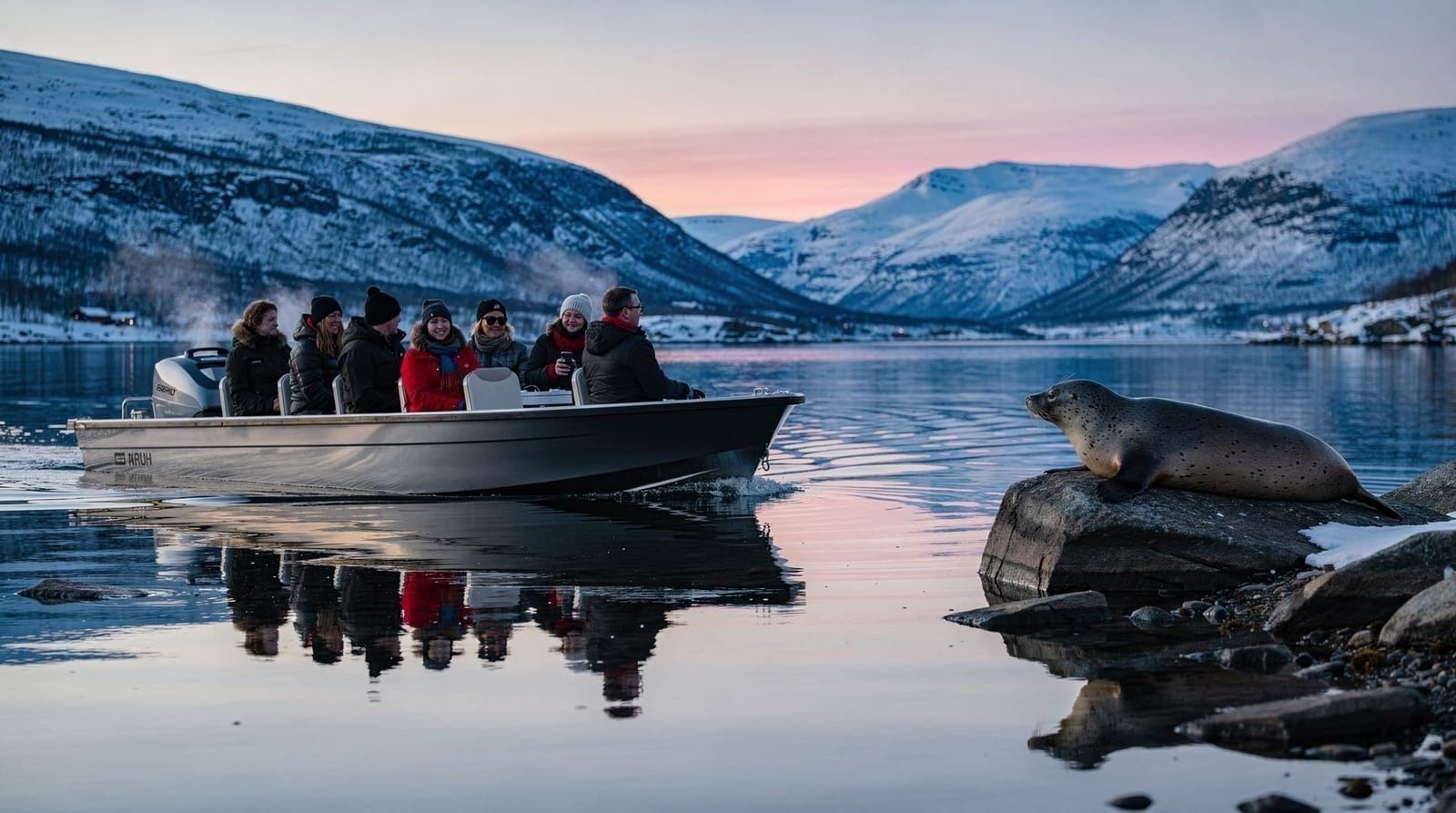
Being on the water during an aurora display gives you 360° visibility, removes light pollution from any direction, and allows the boat to reposition if cloud patches roll in from one direction. Dedicated electric aurora cruise operators run silent boats that minimize vibration and noise, which contributes to the atmosphere.
The catch: boats in choppy conditions are cold, less stable for photography, and occasionally seasick-inducing. If you are sensitive to motion, choose a calm-forecast night or opt for a land-based chase instead. See the aurora cruise guide for specifics.
Seeing the corona — the crown display
Most aurora displays produce an arc or bands across the northern sky. A corona — where the aurora forms directly overhead, streaming from a central point in all directions — is relatively rare and completely different in character. It is disorienting in the best sense: you spin in circles, the curtains are directly above and around you, and there is no single direction to face.
Coronas occur during intense periods of a strong event, typically KP 5 or higher. They last minutes to tens of minutes. If you are outside during a strong event and the display migrates overhead, do not look at your phone. Put it away. Stand in the middle of a dark field and look straight up.
There is no ticket for a corona. You just have to be outside on the right night and stay outside long enough.
Aurora with fresh snowfall — a specific aesthetic
A new snow surface reflects aurora light more than packed snow or bare ground. After a snowfall, the landscape is simultaneously darker (clouds at sunset) and more luminous at aurora time if the system clears. The white ground multiplies the green overhead.
This combination — fresh powder, clearing sky, aurora — happens several times each winter in Tromsø and is what produces the photographs that look too beautiful to be real. The best aurora locations guide covers the viewpoints where this effect is maximised.
Experiences that are good but not transcendent
Aurora photography tour — educational, but manage expectations
A guided aurora evening experience or dedicated photography workshop will teach you proper settings, composition, and how to read the sky. For photographers, this is valuable. For non-photographers who want to “get the shot,” the gap between what a professional guide with an expensive camera produces and what you can achieve with a phone or entry-level mirrorless camera in the same conditions is significant.
The aurora photography settings guide covers the technical side. The honest summary: a 20-second exposure at f/2.8 and ISO 800–1600 on a wide lens will capture what is there. A phone in “night mode” will show something. Neither will match a guide’s 50mm f/1.4 composition from the ideal viewpoint at the ideal moment.
Aurora from a hot tub — the Instagram experience
Several luxury operators offer heated outdoor hot tubs with an aurora view. This is expensive (2000–3000 NOK per person for a dedicated session), warm, and if the aurora cooperates, genuinely memorable. If the aurora does not appear or is weak, you are in a hot tub in the dark in Norway for 2000 NOK.
The problem is that you cannot move. If cloud comes in from the north and the aurora is visible to the east, you are stuck. Land-based chasing with a vehicle is more flexible for the same or lower cost.
Worth considering for a honeymooner or anniversary treat. Not the optimal aurora-hunting strategy.
Things that appear on bucket lists but should not
”Sleeping under the aurora”
Every aurora “glass cabin” package in northern Norway promises you will watch the lights from bed. The reality: aurora displays are rarely overhead and sustained. They are usually to the north, moving, and lasting minutes to hours with variable intensity. You cannot reliably sleep while watching them — you wake up, look, maybe see something, maybe not, go back to sleep, repeat.
The glass cabin experience can be excellent for other reasons — isolation, Arctic landscape, genuine cold. But as an aurora delivery mechanism, it is less reliable than going outside and staying awake.
”See aurora every night guaranteed”
No operator can guarantee aurora. No operator can guarantee cloudless skies. Some operators guarantee a rebooking if you do not see the lights — which is the honest version of a guarantee. Any claim of “guaranteed northern lights” refers to a policy promise, not a natural phenomenon promise.
The full list, ranked by value
| Experience | Cost | Verdict |
|---|---|---|
| Fjord reflection | Free (self-drive) or tour cost | Genuinely earns the hype, weather-dependent |
| Boat/cruise viewing | ~1,700–2,300 NOK | Different, not better — good for flexibility and no light pollution |
| Full-sky corona | Free (luck + patience) | Rarest, unticketed, worth staying out for |
| Fresh snow + aurora | Free or tour cost | Best photography conditions of the season |
| Photography tour | ~2,200–2,800 NOK | Worth it for photographers, skip if not |
| Hot tub aurora | 2,000–3,000 NOK | Fine for a treat, poor as a hunting strategy |
| Glass cabin sleep | Premium accommodation cost | Good for atmosphere, unreliable for viewing |
| ”Guaranteed” aurora claims | Varies | Red flag — no operator can guarantee weather |
What actually determines whether you see anything
Beyond the specific experiences above, three factors decide most aurora outcomes more than any tour choice does: clear sky (checked via cloud forecast, not just KP index), enough time outside (2–3 hours minimum, not a 45-minute stop), and mobility to move away from local cloud cover. A KP 6 storm behind full cloud cover produces nothing; a KP 2 display under a clear sky can be genuinely good. The aurora forecast and KP explained guide breaks down how to read forecasts properly rather than fixating on the KP number alone.
Building your actual aurora bucket list
The most honest aurora bucket list is experiences rather than checkboxes:
- Be outside for a full-sky corona during a KP 5+ event — this requires luck and patience
- See the reflection in still fjord water — requires calm, clear, dark night at the right location
- Stay outside for a 3+ hour display from dark to 2 a.m. — this is how you learn what aurora actually is
- Watch aurora from the Fjellheisen summit on a clear night — the cable car runs late in aurora season
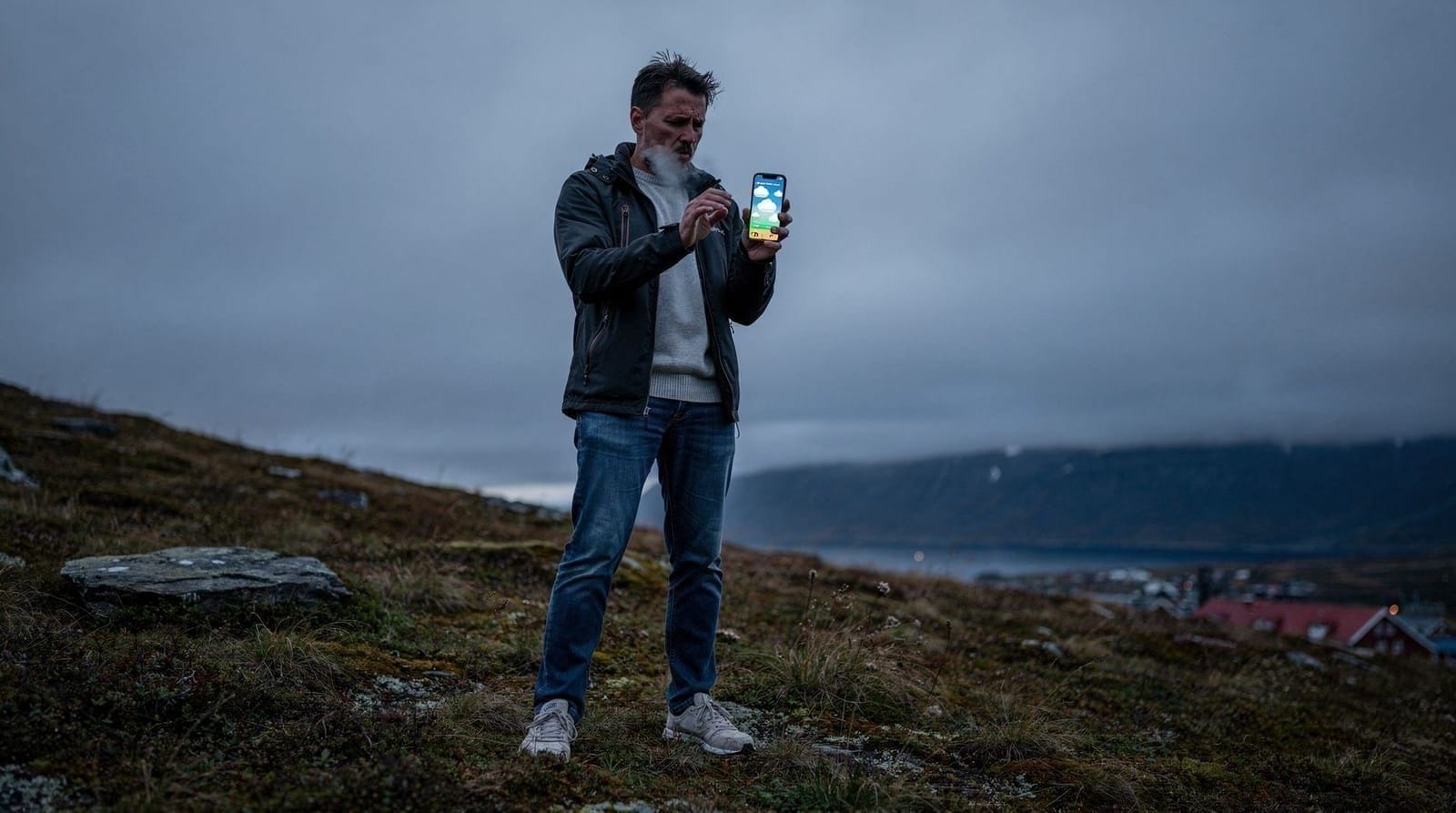
- See aurora without looking at your phone — genuinely difficult and genuinely transformative
The tromso 4-day aurora itinerary is built around maximising your chances of experiencing multiple of these. The first-time mistakes guide explains what prevents most visitors from getting there.
Frequently asked questions about the northern lights bucket list
What is the rarest aurora phenomenon to see in Tromsø?
A full corona display — where aurora streams directly overhead from a central point. It requires KP 5+ activity and a cloudless sky directly overhead. It occurs several times per season in Tromsø.
Is a glass cabin worth the premium for aurora viewing?
For atmosphere and Arctic experience, yes. As a dedicated aurora-hunting strategy, no — you cannot chase cloud breaks from a fixed accommodation. The optimal aurora strategy involves mobility.
What is the difference between a green and a purple aurora?
Green aurora is produced by oxygen atoms at 100–150 km altitude. Purple or pink fringes appear at the lower edge and are produced by nitrogen molecules. Red aurora appears at very high altitude (200+ km) and is typically only visible in photographs. A strong display with all three colours is a KP 5+ event.
Can I see aurora from inside the city?
Weak displays are often invisible from city centres due to light pollution. Moderate displays (KP 3+) can be seen from darker parts of Tromsøya — the north coast or high ground. Strong displays (KP 5+) are visible from almost anywhere in the region.
How long do aurora displays last?
From minutes to several hours. The most spectacular displays tend to be intense for 15–45 minutes with lower-level activity before and after. This is why staying outside for 2–3 hours rather than 45 minutes matters enormously.
Which single aurora experience should I prioritise if I can only do one?
A standard chase tour with a free-rebook policy, on a night with a clear forecast, staying out for the full 2–3 hours rather than rushing back after 45 minutes. Everything else on the bucket list — corona, reflection, photography — is a bonus that depends on luck and conditions layered on top of that basic formula.