When not to visit Tromsø — the honest seasonal reality
Tromsø: Small-Group Northern Lights Tour by Minibus
Are there months to avoid Tromsø?
November has frequent slush and bad weather with limited aurora activity (still early season). April and May are the shoulder "mud season" with melting snow and no aurora once midnight sun approaches. The weeks immediately before and after the aurora season (late September, late April) are often the worst value for the price.
The travel calendar Tromsø tourism will not show you
Tromsø’s official tourism calendar makes every month sound appealing. “November: first aurora of the season!” “April: spring skiing and the return of the sun!” The reality of each month is more textured. Some months are genuinely excellent. Some are actively bad for certain types of traveller. And some exist in an in-between zone where the price does not reflect the experience quality.
This guide gives you the honest version. If you have already picked a window and just want it confirmed as a good one, see common mistakes in Tromsø and is Tromsø worth it for the flip side of this page.
| Worst value | Late April–early May (dead zone), Christmas–New Year (peak price) |
| Marketing overstates | November aurora reliability, “spring” thaw appeal |
| Genuinely wrong season | Aurora hunting between late May and late July (no dark sky) |
| Better alternative window | Second/third week of January over Christmas dates |
| Related read | Tromsø tourist traps for where money gets wasted regardless of season |
The months with the most complaints
November: promising marketing, mediocre delivery
November is marketed as the “beginning of aurora season” and “first whale watching of the year.” In reality:
Weather: November is statistically one of the cloudiest months in Tromsø. Precipitation is frequent, often falling as wet snow or sleet that turns into slush. The temperature hovers around −2 °C to −5 °C — cold enough for slipping, not cold enough for the crisp, clear conditions that make good aurora nights.
Aurora: The season is just starting. Geomagnetic activity is not significantly different from February, but cloud cover statistics in November are worse. Aurora sightings in November are real but less reliable than in January–February.
Whale watching: The orca and humpback whales typically arrive in the Skjervøy area in late October to mid-November — but “typically” means there is genuine variance. In some years, concentrations do not build until December. November whale watching can be excellent or a near-miss depending on the year.
Who November works for: Travellers with budget constraints who want to try aurora season early. First-timers who want the full winter experience but have lower photo expectations. Those who specifically want to experience the atmospheric transition into polar night.
Who should avoid November: Photographers hoping for pristine blue-hour light and dry, snowy landscapes. Visitors with only 3–4 nights who need aurora statistical consistency. Anyone sensitive to grey, wet weather.
Late April and May: the forgotten dead zone
This is Tromsø’s most honest weak period and the one least discussed in travel guides.
What happens in late April–May:
Aurora season ends in late April. The sky stays bright enough after 21:00 that aurora is invisible even if geomagnetic activity is high. By mid-May, the sun barely sets at all.
The landscape goes through its ugliest phase. Snow melts from the top down, exposing the grey-brown ground cover beneath. Mountains are half-brown, half-snow. Roads are dirty and wet. The waterfront city looks its least attractive.
Winter activities close: dog sledding typically ends in March–early April; snowmobile safaris close; Lyngen Alps ski touring becomes avalanche-risk terrain; the ice on frozen lakes becomes unstable.
Summer activities have not yet started: sea kayaking typically opens in late May; organised hiking day trips begin in June; midnight sun does not reach full intensity until late May.
The two-week dead zone in late April–early May is the period where neither winter nor summer experiences are accessible, the landscape is at its least photogenic, and accommodation prices remain elevated because operators have not yet dropped to shoulder rates.
Who late April–May works for: Visitors specifically interested in spring skiing in the Lyngen Alps (this requires experience and planning). Budget travellers who accept the limited activities in exchange for lower prices. Those returning for a second or third visit who want to see Tromsø in every season.
July–August: legitimately beautiful, but not what Tromsø is famous for
Tromsø in summer is an excellent destination that most visitors do not consider because the marketing focus is so heavily on winter. Midnight sun, kayaking around Sommarøy, hiking up Tromsdalstinden and Fjellheisen, fjord cruises under continuous sunlight — all excellent.
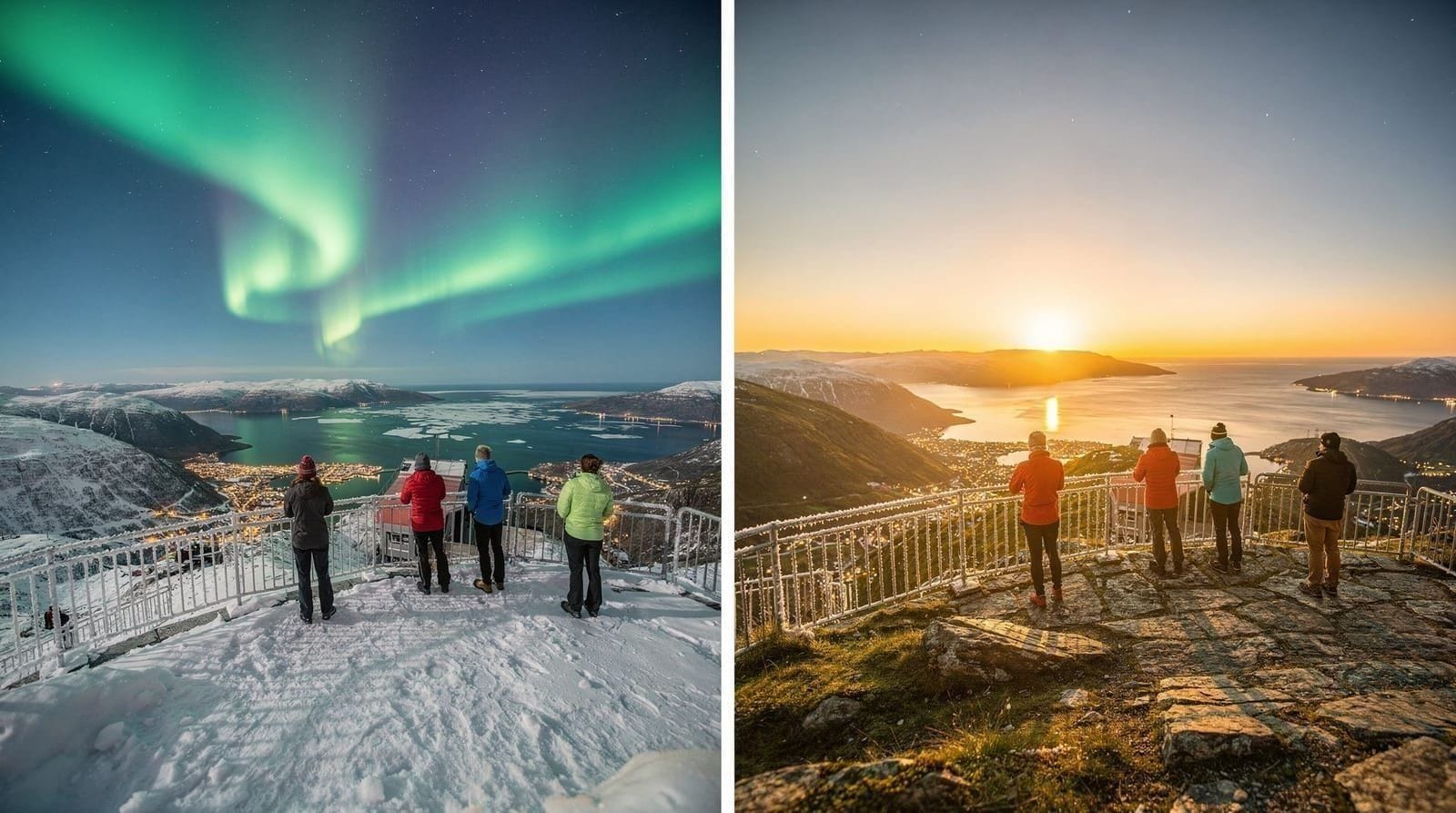
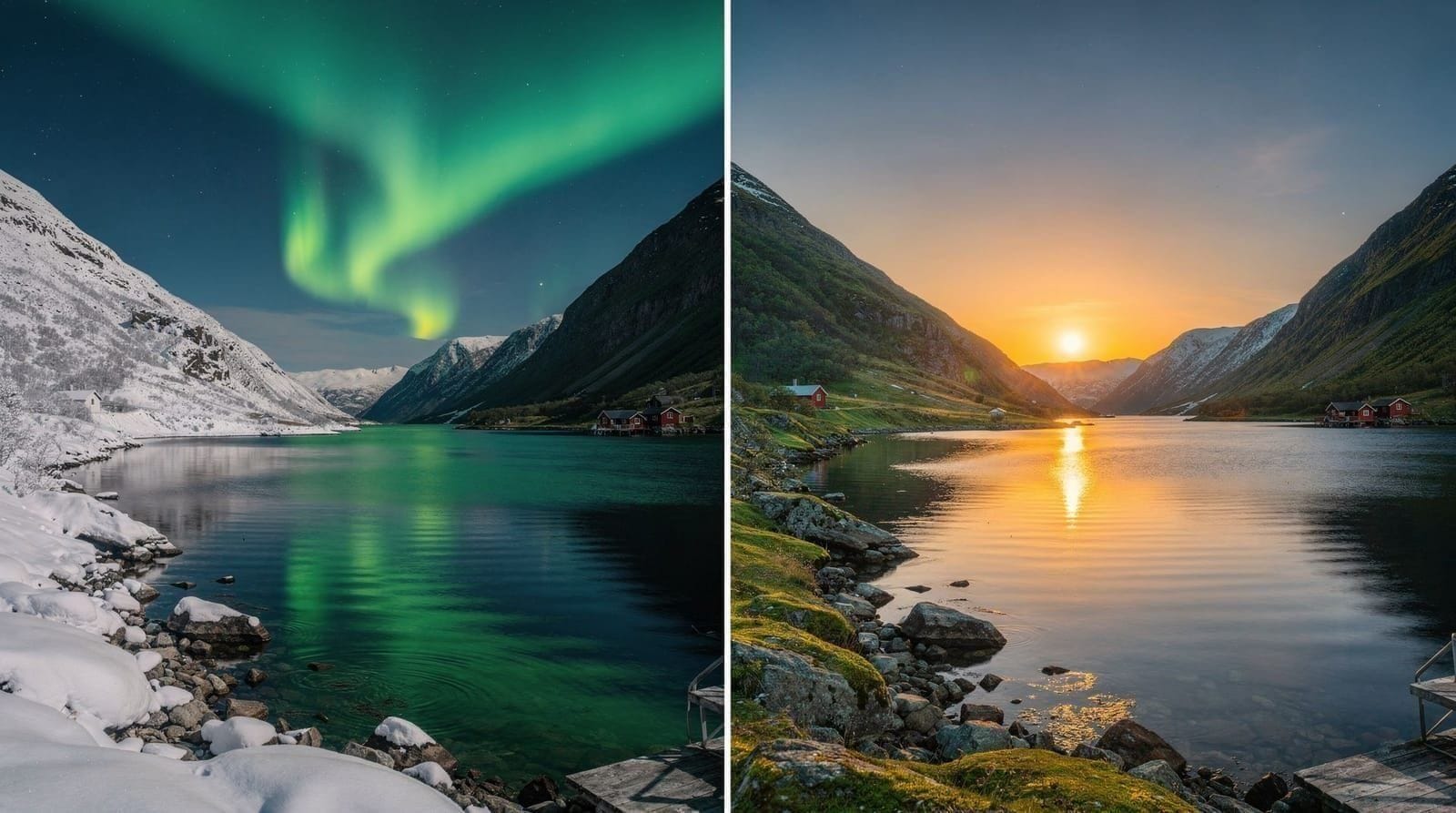
But: If you are visiting for the northern lights, summer is simply the wrong time. The sky never gets dark between approximately 20 May and 22 July. No aurora is visible regardless of geomagnetic activity. This is not negotiable physics.
Many visitors arrive in July asking about aurora forecasts. There are no aurora forecasts to give — it does not happen in the summer sky over Tromsø.
Who summer works for: Families with children (school holidays). Hikers and outdoor enthusiasts. Those who specifically want midnight sun experiences. Budget-conscious travellers (lower hotel rates than winter peak; many free outdoor activities).
The weeks that overcrowd without delivering better conditions
Christmas and New Year (Dec 20 – Jan 7)
Tromsø fills with travellers during Christmas and New Year. Hotels charge peak rates (2 500–4 500 NOK/night for a mid-range double). Aurora tours book out 2–4 weeks in advance. Restaurants have queues. The city atmosphere is festive and pleasant, but this is driven by demand, not by any meaningful improvement in conditions.
The aurora statistics for late December are slightly worse than January–February because December has more cloud on average. Yet December 24 – January 6 commands the highest prices of the year.
Better alternative: Travel the second or third week of January. Same darkness (polar night, maximum aurora window), lower hotel prices, better tour availability, and statistically equal or better clear-sky conditions.
The February school holiday week (uke 8 in Norwegian calendar)
Week 8 (typically mid-February) is the main Norwegian school winter holiday. Norwegian domestic tourism surges. Ski resorts fill. And Tromsø’s hotels book out with Norwegian families who want to show their children the northern lights.
From a foreign visitor’s perspective, this is avoidable. Check the specific dates of uke 8 for your travel year and plan around it.
If you can only avoid one thing
Of everything on this page, the single highest-impact fix is avoiding Christmas–New Year pricing without sacrificing conditions: shift to the second or third week of January instead. You keep the polar-night darkness and peak aurora window, hotels drop from Christmas peak rates, and tours have actual availability instead of being sold out weeks ahead. December itself is not a bad month — it is specifically the holiday fortnight that inflates prices without improving conditions.
Small-group northern lights minibus tourIf your dates are genuinely fixed and land in a weak window, don’t cancel the trip — adjust expectations. A November visit with modest aurora odds can still be worthwhile if you treat it as a city-and-culture trip with a chance of lights, not an aurora-guaranteed trip. The summer vs. winter Tromsø comparison is worth reading if your dates could still move between the two entirely different seasons.
Weather-related cancellations and delays
Winter travel to and from Tromsø carries a small but real risk of flight disruption, particularly in November and December when storm systems are more frequent than in the clearer months of January and February. Oslo–Tromsø flights are occasionally delayed or cancelled by weather at either end, and travellers arriving with a tight one-day margin before an aurora tour or cruise departure have the least room to absorb a delay. This is a genuine reason, separate from aurora odds or landscape aesthetics, to avoid booking a trip with zero buffer day in November — a single cancelled flight can cost an entire pre-paid tour night with no realistic way to reschedule during a short visit.
The practical response is not to avoid November entirely but to build in a spare day either before your first paid activity or at the end of the trip, and to check your airline’s rebooking policy for weather cancellations before you fly.
The month-by-month honest breakdown
| Month | Aurora | Whale watching | Landscape | Crowding | Price |
|---|---|---|---|---|---|
| Sep | Possible, low | None | Autumn colour, damp | Low | Low |
| Oct | Good, improving | Starts late Oct | First snow, atmospheric | Low-medium | Low-medium |
| Nov | Active but cloudy | Active, variable | Slush, grey | Medium | Medium |
| Dec | Active, best window | Active (peak) | Snow, polar night | High (Xmas) | High |
| Jan | Best (longest nights) | Peak | Snow, polar night | Medium-high | Medium-high |
| Feb | Excellent | Good until Feb | Great light returns | High (school hols) | High |
| Mar | Still good | Ending | Snow + sun = best landscapes | Medium | Medium |
| Apr | Early April only | Finished | Deteriorating | Low-medium | Medium-low |
| May | None | None | Thaw, brown | Low | Low |
| Jun | None | None | Midnight sun, green | Medium | Medium |
| Jul | None | None | Midnight sun, peak hiking | Medium-high | Medium |
| Aug | None | None | Hiking, kayaking | Low-medium | Low-medium |
Who should reconsider Tromsø entirely
If you have only one or two nights: The probability of seeing aurora is too low to justify the cost. Aurora hunting requires 5+ nights for a statistically good chance.
If you are sensitive to darkness: The polar night (27 November–15 January) means zero daylight. Seasonal affective disorder-prone travellers should visit in February–March when the sun returns (even if only for a few hours daily).
If budget is very tight in peak season: December–January mid-range costs run 4 000–6 000 NOK per day per person with activities. Budget versions exist but require significant sacrifice in activity quality. Shoulder season (October, March) offers meaningful savings.
If you are primarily interested in traditional fjord landscapes: The iconic Norwegian fjord imagery (Hardangerfjord, Geirangerfjord) is in western Norway, not Tromsø. Arctic fjords are dramatic and different — but if the postcard Norway image is the goal, Bergen and fjord country is the destination.
The best times, for contrast
The honest best times:
- Late January and early February: longest useful dark sky window (solar midnight at 02:00, polar night lifting but still dark for aurora), statistically best clear-sky probabilities in late winter, whale watching still active
- March: Sun returns, dramatic low-angle Arctic light, good snow cover for winter activities, excellent landscape photography conditions
- June–July: Midnight sun at its most dramatic, excellent hiking, emptier than winter season, no aurora but extraordinary light
For the full data-backed recommendation, see best time to visit Tromsø.
Hybrid-electric whale watching tourFrequently asked questions about when not to visit Tromsø
Is early September too early for aurora in Tromsø?
The aurora season technically starts when skies get dark enough (late August for the first real aurora-dark nights). September aurora is possible but requires clear skies and reasonable geomagnetic activity. The season builds through October. For statistical reliability, November onward is better, though October offers a good balance of some daylight and aurora potential.
Is February a bad month because of storms?
February can have storms — the Arctic weather pattern does not exclude February. But February is statistically one of the better months for clear-sky aurora, largely because the jet stream position and high-pressure patterns that produce clear conditions are somewhat more frequent. Storm days happen in every month; February just has better average odds.
Is Tromsø worth visiting in early December before the Christmas rush?
Early December (1–15) is actually a reasonable time — fewer crowds than the Christmas period, polar night atmosphere without the holiday price surge, and aurora season fully active. The main downside is that whale watching tours from Skjervøy may not yet be at full concentration, and some winter activity operators do not reach full operation until mid-December.
What happens to whale watching after February?
The orca and humpback whales follow the herring. In late January to February, the herring schools begin moving south and the whales follow. By mid-February, the concentration near Skjervøy has typically declined significantly. Some whale watching operators extend into March, but encounter rates drop. For peak whale watching, November 20 – January 31 is the window.
Is the summer midnight sun experience worth the trip?
For visitors who have not experienced a true midnight sun, yes — watching the sun circle the horizon at midnight from Storsteinen or from Sommarøy beach is a legitimately unusual experience. The summer also unlocks Senja hiking, kayaking at Sommarøy, and extremely long activity days. For visitors who specifically want dark skies and aurora, summer is entirely the wrong time.
Can I visit Tromsø in April to catch both aurora and whale watching?
No. Whale watching ends by late February (peak) to mid-March (stragglers). Aurora viewing becomes unreliable after mid-April due to reduced darkness. There is no month that provides both in peak quality simultaneously — they are fundamentally different seasons that do not overlap.
Top experiences
Bookable activities with verified prices and instant confirmation on GetYourGuide.