Tromsø public library — free stop for travellers
Tromsø: City Highlights Guided Walking Tour
Can visitors use the Tromsø public library?
Yes — the library is free to enter and open to anyone. Visitors can use WiFi, read in the warm reading rooms, access Norwegian and English books and magazines, and use computers. No library card is required to enter or browse.
The Tromsø public library is not the kind of place most travel guides mention, which is precisely why it is worth knowing about. It is a functional, well-maintained Scandinavian public library: warm, well-lit, quietly busy on weekday afternoons, and completely free to enter.
| Where | Grønnegata 94, about 10 min walk from Stortorget |
| Cost | Free entry, free WiFi |
| Time needed | 30–60 minutes, longer if researching |
| Getting there | Walk from the city centre; no bus needed |
| Best for | Rainy days, polar-night breaks, working between activities |
Why it matters for visitors
In a city where most cultural attractions charge for entry and outdoor activities are weather-dependent, the library offers something genuinely useful: a free, dry, warm indoor space with good seating, fast WiFi, and a collection that extends well beyond the tourist-facing materials available elsewhere.
The free things to do in Tromsø guide lists the library as one of the few central options where you can spend an hour or two productively without spending money.
What the library holds
Arctic and regional collection: Tromsø’s library maintains a strong collection of material on Arctic Norway — natural history, exploration history, local biography, Sami culture, and regional geology and ecology. Some of this material is only in Norwegian, but the English-language section includes key titles.
English-language books: A dedicated shelf or section holds English-language fiction and non-fiction, including travel writing about Norway and Scandinavia, Arctic exploration accounts, and contemporary Norwegian literature in translation.
Periodicals: Norwegian newspapers and some international magazines are available for reading in the library.
Computers and WiFi: Public-access computers are available (may require a short wait during busy periods). WiFi is fast and free for anyone in the building.
Children’s section: Norwegian and English picture books and early readers for young visitors or residents.
Using the library as a visitor
You do not need a library card to enter, browse, use WiFi, or read in the library. A library card — available to residents — is required to borrow books. As a visitor, you are welcome to use all the reading and browsing facilities.
The atmosphere is Nordic and quiet: comfortable furniture, good indoor lighting in a city that can be dark for months, and staff who are used to international visitors and speak English fluently. It is a sensible place to catch up on email, plan the rest of your trip, or simply be warm for an hour.
If you’d rather have a guided introduction to the city that takes in this side of Tromsø alongside the harbourfront and Storgata, a small-group city walking tour is a reasonable complement to a self-guided library stop.
Tromsø city highlights walking tourPractical details
Address: Grønnegt 94, central Tromsø. About 10 minutes’ walk from Stortorget heading inland from the harbour.
Opening hours: Monday–Friday 09:00–20:00; Saturday 10:00–16:00; Sunday 12:00–16:00. Reduced hours in summer and on public holidays. The Tromsø library website has current timetables.
Entry: Free to all visitors.
WiFi: Free, no registration required in most cases.
Nearest food: Rå Pizzabar (5-minute walk) and various cafés on Storgata are close. There is no café in the library itself, though vending machines are typically present.
Getting there without walking: if you’re staying further out or the weather is genuinely bad, city buses stop within a few minutes’ walk of Grønnegata; see getting around Tromsø for routes and ticket options. Most visitors based centrally simply walk, since the distance from Storgata is short even in winter boots.
The library building and UiT connection
The Tromsø public library is housed within a building complex shared with elements of UiT — The Arctic University of Norway, which makes the library larger and better resourced than a typical city of this size would have. UiT has around 17 000 students and a significant research staff, and the shared infrastructure means the public library section benefits from collections and facilities associated with an active university.
This connection is relevant for visitors: the research collections in Arctic studies, Norwegian and Sami languages, polar science, and northern European history are substantially more comprehensive than a standalone public library would maintain. If you have a specific research interest related to the Arctic or to northern Norway, the reference section is a legitimate resource.
The Arctic and Svalbard collection
The library maintains a dedicated section on Arctic literature and research. This includes:
- Natural history of Svalbard and the Barents Sea
- Accounts of Arctic expeditions (Norwegian, British, American, Russian)
- Political history of Norwegian sovereignty in the Arctic
- Sami language and cultural materials
- Scientific publications from Norwegian Polar Institute researchers
- Environmental studies on Arctic climate
Some of this material is in Norwegian only, but a significant portion is in English or has English summaries. If you are researching a trip to Svalbard or want background on the ecological changes happening in the Norwegian Arctic, this is a more useful resource than any tourist information office.
Tromsø and the student city
Tromsø is, in many respects, a university city. UiT is the northernmost university in the world and has profoundly shaped the character of Tromsø — creating a young, international population, supporting a cultural scene disproportionate to the city’s size, and generating research activity that places Tromsø at the centre of some of the most significant scientific work on Arctic climate, marine biology, and northern cultures.
The library is one of the most visible public manifestations of this. Walking into it and seeing the student population working alongside Norwegian and international researchers is a different kind of Tromsø experience from the tourist activity circuit. The city is not only an aurora-chasing and whale-watching destination; it is a serious academic centre.
What to do in Tromsø on a rainy day
The library is consistently one of the better answers to the rainy day question. But the full rainy day circuit in Tromsø might run:
- Morning: Polaria (paid, 175 NOK) — the indoor exhibits and seal feeding are not weather-dependent
- Lunch: Kaffebønna on Storgata or a dagensrett café
- Early afternoon: Perspektivet Museum (95 NOK) + the library (free)
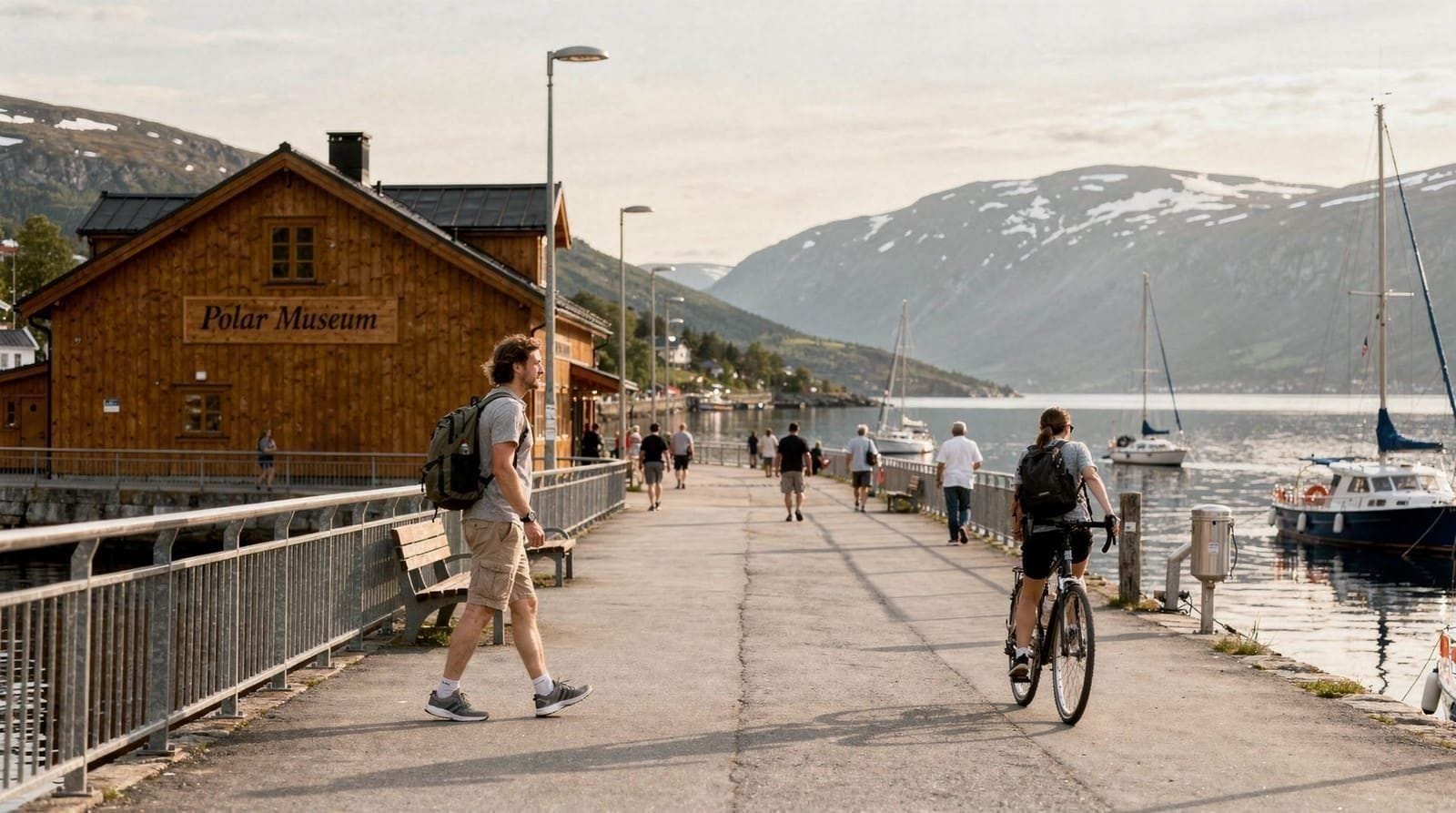
- Late afternoon: The Polar Museum (100 NOK) on the north harbourfront
- Evening: Ølhallen for a Mack beer before dinner
This circuit uses around 275 NOK in admissions and gives a substantial indoor day. For the full picture of indoor options and current ticket prices, see the Tromsø museums and tickets guide; for a structured single-day plan that already builds in a library-style breather, see Tromsø in one day.
Where the library fits among Tromsø’s indoor options
| Stop | Cost | Time | Best for |
|---|---|---|---|
| Tromsø library | Free | 30–60 min | WiFi, warmth, reading |
| Perspektivet Museum | 95 NOK | 30–45 min | Local social history |
| Polar Museum | ~130 NOK | 45–90 min | Arctic exploration history |
| Polaria aquarium | ~220 NOK | 60–90 min | Families, seal feeding |
| Ølhallen | Cost of a beer | 30–60 min | Evening wind-down |
If budget is the main driver of your rainy-day plan, the budget eats in Tromsø guide pairs well with a free afternoon in the library.
Combining the library with nearby attractions
The library is conveniently placed between the Storgata commercial centre and the Perspektivet Museum. A practical rainy-day circuit: start at Storgata for coffee and window shopping, visit Perspektivet (95 NOK), walk to the library (free), and end at Ølhallen for a beer. Total expenditure: one coffee, one beer.
For a full understanding of Tromsø as a city — not just as an adventure base — the library sits alongside Perspektivet and the Polar Museum as places that show the city’s intellectual and cultural life.
If you are based in Tromsø for several days while waiting for aurora or whale watching conditions, the library becomes genuinely useful: a comfortable, warm, WiFi-connected space where you can work, research, or read without spending money.
The library as a reflection of Tromsø’s identity
Libraries in Scandinavian cities function as civic anchors in a way that is not always the case elsewhere. The Norwegian public library model is well-funded, broadly accessible, and taken seriously as an institution. Tromsø’s library reflects this and adds a dimension specific to the Arctic university city: a concentration of intellectual material about one of the most significant environments on the planet.
Walking through the Arctic studies section on a clear February day, with polar night outside and researchers and students working around you, gives a version of Tromsø that the aurora tours and whale watching excursions do not. The city is also a place of serious work — environmental science, Sami language preservation, marine biology, climate research. The library is the clearest publicly accessible expression of this.
This is not a selling point for most visitors, and that is fine. But for visitors who engage with place beyond its touristic surface, the library is a specific kind of resource.
Reading in Tromsø — recommendations from the collection
The library’s Arctic studies section contains several books that are worth reading before or during a Tromsø visit. A selection that is reliably in stock:
Nansen’s Farthest North (Fridtjof Nansen, 1897, various English editions): The account of the Fram voyage — one of the great expedition narratives in any language. Long, but rewarding.
The Norwegian Arctic (various authors in the library’s reference section): English-language overview of Norwegian Arctic territories, ecology, and research history.
Sami histories and language books: The library maintains a Sami language section that is one of the more comprehensive public collections in Norway. This is more relevant if you are undertaking research than for a short visit, but it gives a sense of the depth of the collection.
For contemporary Norwegian literature, the library has a good selection of recent Norwegian fiction in translation, including Karl Ove Knausgård, Per Petterson, and Jon Fosse. If you are spending a week in Tromsø waiting for aurora, there are worse ways to spend an evening.
Practical differences between UiT library and public sections
The library complex in Tromsø serves both the public (Tromsø folkebibliotek) and the university (UiT Universitetsbiblioteket). In practice, the public and university collections overlap and the building is shared. Visitors are welcome in all the publicly accessible areas.
The university research material — journal subscriptions, scientific databases, and restricted collections — is not available to non-university users. But the physical book and periodical collections, reading rooms, and public computers are open.
If you need access to a specific scientific paper or research dataset, UiT has a librarian team that can sometimes assist visitors with specific research needs. Contact the reference desk in advance.
This distinction matters mostly for anyone doing serious pre-trip research — for example planning a Svalbard extension, or preparing for a deeper dive into Sami culture before visiting a reindeer camp or cultural experience elsewhere in the region. For most travellers, the practical takeaway is simpler: the public sections are generous, free, and genuinely useful, and the university connection is the reason the collection punches above what a city of Tromsø’s size would normally offer.
Frequently asked questions about Tromsø library
Can I use my own laptop in the Tromsø library?
Yes — personal laptops are welcome. The WiFi password or access is typically available from the desk or posted in the reading room.
Does the library have books about Tromsø and Arctic Norway?
Yes — the local history and Arctic collections are among the library’s strengths. Ask at the information desk for the relevant sections if you cannot find them on the shelves.
Is the library open during polar night and midnight sun seasons?
Yes — the library maintains regular hours year-round. During polar night, the warm, well-lit reading rooms are particularly appreciated by visitors who find the darkness disorienting.
Can I print documents at the Tromsø library?
Printing services are typically available for a small per-page fee. Scanning services may also be available. Ask at the desk.
Is the library accessible to wheelchair users?
The main library building has lift access and accessible entrances. Contact the library directly for specific accessibility queries.
How far is the library from the main hotels?
Most central Tromsø hotels are within a 10–15 minute walk. The library is in the inner city, walkable from the Scandic Ishavshotel, Thon Hotel Polar, and Rica Hotel.
Is the library a good option on a one-day Tromsø visit?
It can be, if the weather turns or you need a break between paid attractions — see Tromsø in one day for how a library stop fits into a tightly scheduled single-day itinerary without derailing the rest of the plan.
Are there events at the Tromsø library?
Yes — the library runs cultural events, author readings, and children’s programmes. Most events are in Norwegian, but some (particularly those associated with UiT Arctic University of Norway) are in English. Check the library’s website for the current programme.
Top experiences
Bookable activities with verified prices and instant confirmation on GetYourGuide.